
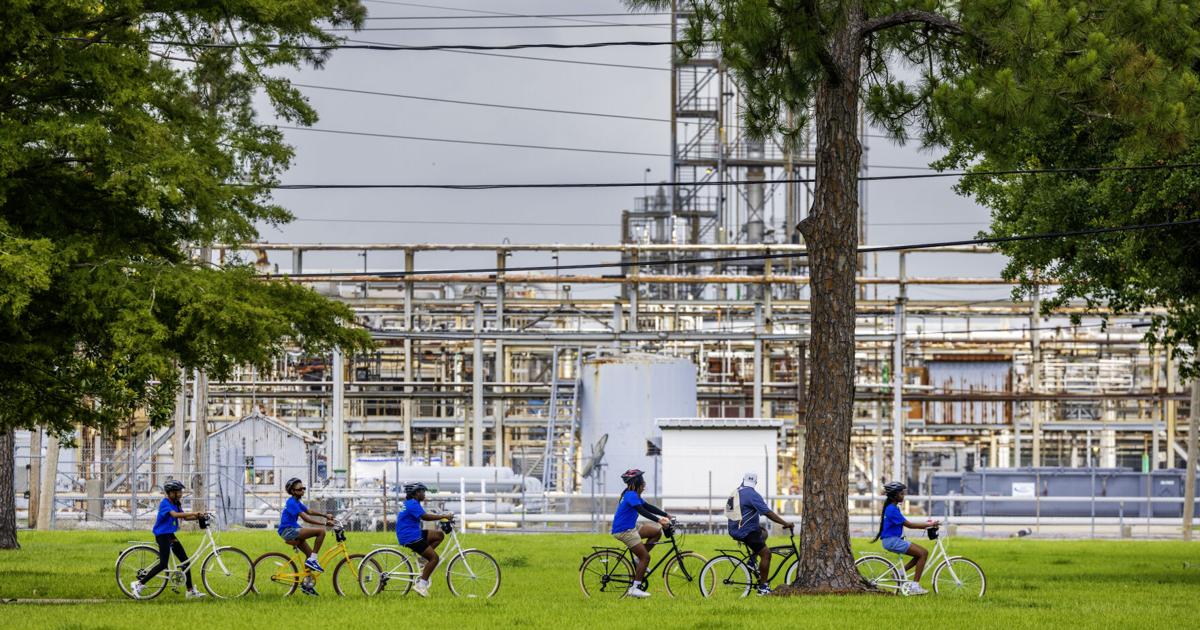
A dozen teenagers ride their bikes down a quiet street in Norco on a warm June morning, stopping at an empty playground beside a Shell petrochemical plant.
Helmets off and bikes parked, they listen to their tour guides for the day, local advocates telling a story that weaves together Black history in the River Parishes and the current environmental justice movement.
“The ordinary people stood up and fought Shell and won,” said Cathy Laurino, a tour guide with the advocacy group Louisiana Bucket Brigade, referencing a community battle over a relocation effort two decades ago.
Richlyn Gibson, a seventh grader from Donaldsonville, said later: “It was very inspirational because you see how you can stand up for something,”
The bike ride and related summer camp are examples of the kind of outreach a constellation of local community and environmental groups have long been engaged in. That work gained unprecedented prominence and funding under former President Joe Biden’s administration.

Cathy Laurino with the Louisiana Bucket Brigade leads a “Down by the River” bike tour in Norco on Thursday, June 4, 2026. The bike ride makes stops along the chemical corridor to help students learn the history of the environmental justice movement.
STAFF PHOTO BY CHRIS GRANGER
But since 2025, such groups have watched a stunning reversal both nationally and in Louisiana under the administrations of President Donald Trump and Gov. Jeff Landry. Landmark pollution rules long sought by local groups have been rolled back, and sharp cuts in grant funding have left environmental justice advocates navigating how to remain effective.
For some industry groups and politicians, the changes have been welcome – a necessary pushback against what they view as regulatory overreach that harms business and the broader economy.
But local organizations say that without the work they carry out, pollution will only worsen and poorer residents without an effective voice will suffer the most.
“The state of (environmental justice) is we’re in a bad place. We’re hanging on by a thread,” said Beverly Wright, founder of The Deep South Center for Environmental Justice, a New Orleans-based organization hit hard by cuts in federal grants.
“But I take heart in the fact that we have been here before and during worse times and under worse conditions, with fewer allies than what we have now.”
‘Lot of obstacles’
The Trump administration’s approach to environmental justice is in many ways the inverse of what occurred under Biden.
Biden’s Environmental Protection Agency chief, Michael Regan, was the first Black man to hold the position and put a high priority on environmental justice, or concerns that poor and Black neighborhoods have been forced to disproportionately suffer the effects of industrial pollution.
Louisiana and its heavily industrialized region along the river between Baton Rouge and New Orleans, which activists refer to as “Cancer Alley,” was among Regan’s areas of focus.
Activist Sharon Lavigne, of Rise St. James, poses at her home in St. James, La., Tuesday, June 9, 2026.
STAFF PHOTO BY SOPHIA GERMER
He visited Louisiana twice to tour industrialized areas and speak with residents. When he signed off on what is known as the HON rule aimed at reducing cancer risk in communities near industrial plants, Louisiana activists attended the event in Washington, D.C.
Sharon Lavigne, who founded Rise St. James, one of the most prominent local environmental groups, was there and still has a pen Regan used for the signing. But for her, the promise of that day has since eroded.
The 2024 rule had required over 200 industrial facilities nationwide to use stricter pollution controls and conduct routine air monitoring. The plants had until July 2026 to meet the bulk of these requirements.
But last summer, Trump exempted 49 chemical plants nationwide from complying with the standard by the 2026 deadline, including a dozen in Louisiana.
Industry groups in the state argued that the rule was impossible to comply with and would harm important sectors. Advocates see the exemptions as an interim move while the EPA seeks to permanently undo the requirements.
“Our member companies spend millions of dollars each year on emissions controls, operational reliability and safety systems because environmental, health and safety performance remains a core priority across the industry,” said David Cresson, president of the Louisiana Chemistry Association, which represents the state’s largest chemical companies.
Lavigne said “now that the new administration is in, we still have hope, but it’s a lot of obstacles that’s in our way,”
“We have to fight a little bit harder — a whole lot harder — and we have no one on our side,” she said.
‘Not going anywhere’
The changes have not only involved regulation. Some local groups have also been hit by the EPA’s cut of $70 million in funding for Louisiana agencies and nonprofits.
Wright’s Deep South Center, a 34-year-old organization that partners with smaller groups, lost a $13 million grant and laid off roughly 10 employees as a result, she said.
The grant had supported a project that spanned 250 communities across 14 states, connecting local groups with researchers with expertise in pollution, flooding and energy consumption.
Cathy Laurino with the Louisiana Bucket Brigade leads a “Down by the River” bike tour in Norco on Thursday, June 4, 2026. The bike ride makes stops along the chemical corridor to help students learn the history of the environmental justice movement.
STAFF PHOTO BY CHRIS GRANGER
Wright said the loss was a “big blow,” but it hasn’t “taken the wind out of us.”
Tish Taylor of The Concerned Citizens of St. John, another local group, said the organization received federal EPA support through a $500,000 grant managed by the Deep South center. The funding focused on air monitoring data in the parish, including exposure to a likely carcinogen – chloroprene – emitted from the now-suspended Denka Performance Elastomer Plant in Reserve.
Before Denka announced last May it would suspend operations, the Trump administration granted it an exemption from the HON rule and dropped a landmark federal government lawsuit alleging the facility threatened the area with unacceptable cancer risks.
When it comes to funding, however, Taylor said that philanthropy is the ultimate source.
“I’m just grateful because the philanthropy was there before. They’re not going anywhere,” she said. “They know that we need it even more now.”
Significant funding for Louisiana-based groups has come from organizations including Bloomberg Philanthropies, the Earth Island Institute and the Andrew Mellon Foundation.
Local groups have long faced criticism from Louisiana politicians and industry over allegations they are slowing economic development. Pointing to the groups’ funding, they also accuse them of doing the bidding of outside activists.
The groups counter that their work requires funding and that they are transparent about where it comes from. They also say the need for their advocacy is self-evident in a state with high levels of pollution.
Rise St. James recently welcomed middle schoolers from Colorado for an environmental class. Some schools in New York also teach students about the environmental justice group, Lavigne said.
But within the state, she said that U.S. Rep. Troy Carter, D-New Orleans, is the only elected official who has met with them.
Shamell Lavigne, Sharon Lavigne’s daughter who helps lead Rise St. James, said opposition to their work has appeared to become more organized recently.
She pointed to an organization called Industry Makes, which shares posts and videos on social media about Rise St. James. It has criticized the environmental group for traveling by car and plane, and for using items such as computers and clothing derived from industry.
She believes the group is also involved with a “Stop Rise St. James” yard sign campaign cropping up around the community and questioned whether it was paying residents to post about the advocacy group online.
Desiree Lemoine, executive director for Industry Makes, said that the organization does not pay anyone for the posts, yard signs or its ambassador program. However, she said that Industry Makes did “partially pay” for a poster seen in parts of the community.
Lemoine said Industry Makes’ focus on Rise St. James “is a small piece of our overall pillar to provide a positive perception of industry and the benefits it brings to the communities where it operates.”
“Industry Makes does not believe that Rise St. James or any of the other activist groups in and around the area work towards environmental advocacy,” Lemoine said. “It is our experience that they work to enrich their own pockets through spreading misinformation and fear amongst the communities they claim to want to protect.”
Lemoine said her organization’s funding comes from yearly dues from individuals, businesses and associations in Louisiana that “serve as partners that give us platforms and other media support.”
Like Rise St. James, Taylor’s organization has continued to fight on a wide range of issues.
Other smaller environmental groups are also pushing ahead – and even expanding – despite federal cuts and changing policies. Cynthia Robertson, who runs the Sulphur-based group Micah 6:8 Mission, said that her organization has persisted even after losing federal funding last year.
Robertson’s organization began in the aftermath of 2020’s Hurricane Laura and in the midst of the Covid pandemic, providing food, health information and clothing to residents in need.
“I just lean into God and know that whatever is supposed to happen will happen, and it does, so I’m very pleased with where we are now, despite the federal government,” Robertson said.