
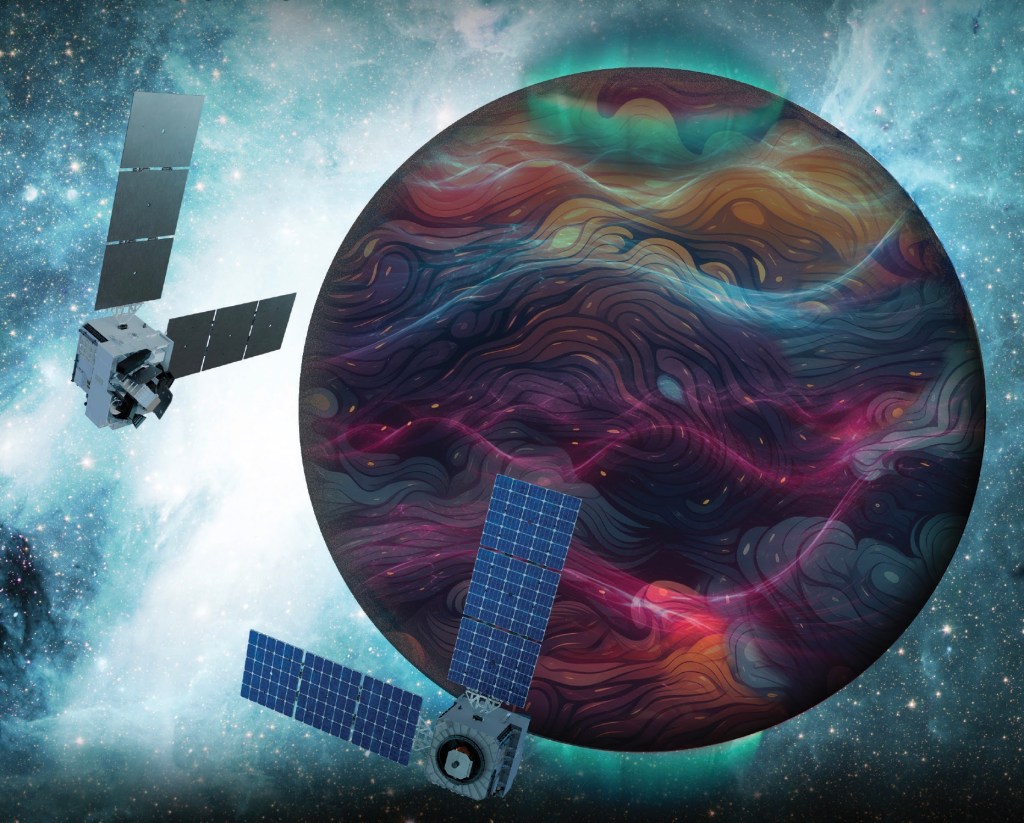
NASA has selected a mission concept led by the University of Colorado Boulder to study Earth’s space weather systems and their impact on the planet’s atmosphere.
The Dynamic Atmosphere-Ionosphere Explorer, or DAPHNE, mission will enter NASA’s phase B of development, which includes planning and design for flight and mission operations. Led by Laboratory for Atmospheric and Space Physics researcher Aimee Merkel, DAPHNE will use identical twin satellites to study how changes in Earth’s lower atmosphere influence the planet’s upper atmosphere, where space weather is created.
The mission will help improve prediction capabilities for impacts on crucial technology, such as GPS and low Earth orbit satellites, as well as astronauts in space, according to NASA.
“Scientists have long studied how space weather affects Earth, but much less is known about how Earth’s lower atmosphere affects the upper atmosphere and space weather,” Merkel said in a release. “DAPHNE will fill this major gap in scientific understanding and help answer long-standing questions about how Earth interacts with our sun. The DAPHNE team is very excited to get started, and we thank NASA for the opportunity to investigate this region that is critical to modern technology and human spaceflight.”
Both DAPHNE satellites will be equipped with three remote-sensing instruments that will provide multi-point measurements of winds, temperature and composition in very low Earth orbit, a region where Earth’s atmosphere transitions into charged particles.
“This mission has wide-ranging implications for human spaceflight and technology,” CU Boulder Chancellor Justin Schwartz said in the release. “LASP and CU Boulder are honored to partner with NASA on such an important flight project for our country.”
The mission will be subject to a confirmation review in 2027, which will assess the mission’s progress and the availability of funds. If confirmed, the total estimated cost of the mission, excluding launch, will not exceed $250 million in fiscal year 2023 dollars, with a mission launch date of no earlier than 2029.
Subscribe to our new newsletter to get CU Boulder’s latest news sent straight to your inbox.