
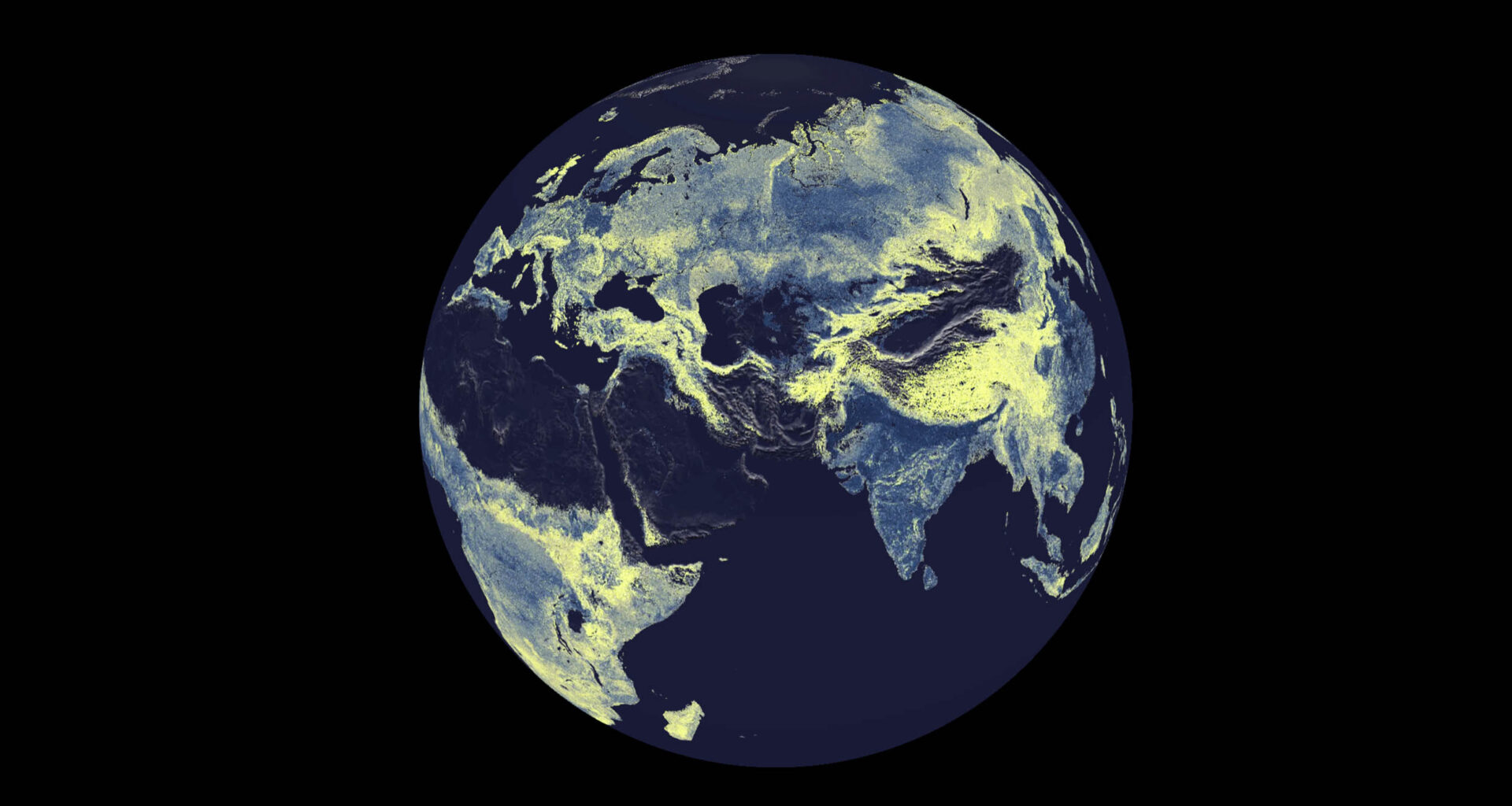
Open a map app and you can trace almost anything above ground. One of the planet’s largest living systems had no such map. Now researchers have mapped the underground fungi network.
The web runs underground, wrapped around the roots of nearly every plant. Until now, no one had charted where it lies. No one knew how far it spreads.
Underground fungi network

The threads belong to mycorrhizal fungi. This group laces through topsoil almost everywhere plants grow.
Their bodies are not the mushrooms you spot after rain. They are hyphae – microscopic tubes thinner than a human hair. The threads branch and spread out of sight.
Add up every strand in the world’s topsoil and the length is staggering. It reaches roughly 68 quadrillion miles (110 quadrillion kilometers).
That is nearly a billion times the distance from Earth to the Sun. The network even stretches a tenth of the way across the Milky Way.
Dr. Justin Stewart offers a figure that is easier to grasp. He is an evolutionary biologist at the Society for the Protection of Underground Networks (SPUN).
A teaspoon of soil, by his estimate, can hold up to 32 feet (10 meters) of thread. All of it together weighs four to six times as much as every living person.
How they mapped it
Pinning down something this small took a patchwork of evidence. The team gathered more than 16,000 soil samples. These came from over 300 earlier studies.
The samples reached every continent and nine major habitat types. Together they trained a computer model to map the network’s density.
The model maps how thick the threads run across every 0.4 square miles (1 square kilometer). It draws on clues the samples miss, like climate, soil chemistry, and the plants overhead.
To test the predictions, the team turned to a Dutch institute called AMOLF. Researchers there grew living fungi and filmed them with robotic cameras. More than 300,000 threads were measured.
That work anchored the model in how the fungi really grow. Still, the picture is not finished.
Deserts and tropical rainforests remain thinly sampled. The team expects to sharpen the map within five years.
 Global predicted global mycorrhizal infrastructure density and model uncertainty of AM hyphae. (A) Dark colors (blue) represent soils predicted to have low densities, and bright colors (yellow) represent those predicted to have high densities. Earth’s densest AM fungal hyphae are predicted in grasslands, with particularly high densities in the Sudd wetlands, the Everglades, and the Tibetan steppe. Credit: Science. Click image to enlarge.A planetary trade
These fungi earn their keep through trade. They tap into the roots of about 70% of the world’s plants. In return for water and nutrients, they hand over sugars the plants make from sunlight.
An earlier study clocked the carbon racing through these threads. It moved faster than anyone expected.
The payoff for the plant is real. A root tied into the network can forage up to 100 times more soil than it could alone. The fungi can also supply over 80% of the phosphorus it needs.
The fungal networks give back to the whole planet too. Each year they haul roughly 4 billion tons (3.6 billion metric tons) of carbon dioxide into the soil.
That is close to a tenth of what people pump into the air.
Surprise under grasslands
The densest fungal ground was not where the team expected. Forget tropical rainforest. The richest threads run under the world’s wild grasslands.
These grasslands hold an estimated 40% of all this fungal life. Grass, of all things.
“This is the most dense fungal forest on Earth, and they’re under wild grasslands,” said Stewart. Density ran highest in cold and flooded grasslands.
Think of the Tibetan Plateau, or the wetlands of Florida and South Sudan. A few things may explain the pattern.
Grasses send a big share of their carbon to their fungal partners. They also grow deep, hidden roots. The soil carbon they build stays underground, even when fire sweeps the surface.
 Global mycorrhizal infrastructure map of hyphal density of AM fungi. Credit: Truth & Beauty / Moritz Stefaner Justin Stewart – SPUN. Click image to enlarge.Farming thins networks
Farmland told a different story. Under large farms the threads ran about half as dense as in untouched land. Ground cut from old grassland was nearly 50% sparser than the grass beside it.
Same crop, far less fungus. What drives the loss is not yet clear. Plowing may tear the threads apart.
Fertilizer may let plants skip the fungal trade. Fungicides may kill the fungi outright. The data cannot yet say which one hurts most.
That loss hits hardest where fungal life is densest. Wild grasslands are vanishing into farmland four times faster than forests. They sit among the least protected ecosystems on Earth.
What the map opens
Until this study, no one had measured how much of this hidden network the planet holds. No one knew where it pools. Now a map can single out one 0.4-square-mile patch.
The raw numbers are free to download. That opens real possibilities for science and conservation.
Conservation groups can protect the densest ground. Farmers can test gentler methods, like planting without plowing. Researchers can watch the fungal networks gain or lose strength.
Dr. Toby Kiers has long pushed for fungi to count in climate plans. She is an evolutionary biologist and SPUN’s executive director.
An earlier analysis found 95% of the richest fungal sites already sit outside protected land. Kiers wants that to change.
“Fungi have been ignored in climate and conservation for too long. Now is the time to change that trajectory,” said Kiers. The blank space under our feet is finally filling in.
The study is published in the journal Science.
—–
Like what you read? Subscribe to our newsletter for engaging articles, exclusive content, and the latest updates.
Check us out on EarthSnap, a free app brought to you by Eric Ralls and Earth.com.
—–