
If you grew up in the soccer-obsessed Mercer County area, chances are you were exposed to our great game at an early age.
When our country gets off to a 2-0 start and already wins Group D, there’s an optimistic feeling moving into Thursday’s final Group Stage match vs Turkiye.
The US has evolved from a team that previously relied on defense and grit to one that combines toughness and speed with attacking prowess. It is accomplishing things that have rarely, if ever, been done by the American side, such as qualifying for the knockout round with a game still to play in the group stage.
This is great stuff.
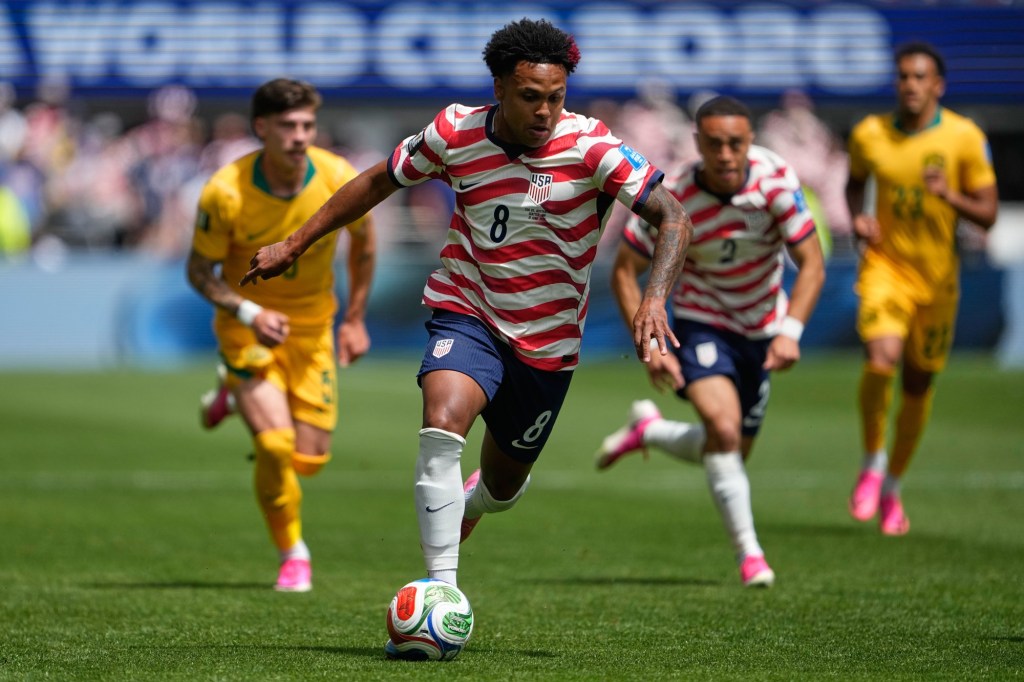
And while watching Weston McKennie and his US teammates, you might wonder how they got to soccer’s biggest stage.
If so, it’s my honor to try to explain.
In this country, soccer takes an outside-the-box approach to player development, and while we still have a ton of work ahead, here’s a look at how we develop our players.
In 2006, a bold experiment was implemented by US Soccer that shaped the careers of 19 of our current US players. The results of a survey by youth national team coaches detailing poor playing environments across the country were the catalyst for organizing a more competitive breeding ground for our players.
The country embarked upon a system unlike that of any other sport. The initiative was originally called the US Development Academy (now MLS NEXT), and its fledgling experiment created a national league that spans ages under-13 to under-19 and now features 150 teams from across the nation.
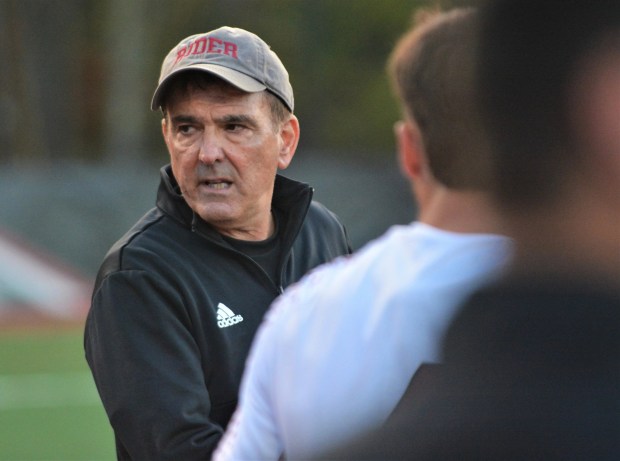 In this Nov. 2022 file photo, Rider men’s soccer coach Charlie Inverso looks on fro the bench against Canisius during a MAAC game at Ben Cohen Field in Lawrenceville.
Here’s how it works.
The 30 professional teams in MLS (Major League Soccer), along with top non-MLS youth clubs, are tasked with developing ‘homegrown talent’. It’s a pretty serious business. Starting as early as age 12, teams are fully staffed (a minimum of 8 staff members) with coaches, trainers, conditioning/training staff, a video coordinator, and other administrators.
Each club has a geographic area from which it can recruit, and teams are allotted 8 players from outside this region. The majority of MLS teams have a residential facility that houses players from outside their hometown.
A multitude of full-time and part-time scouts are employed by each club. And boy, do these scouts get around.
Using a baseball analogy, here is how club scouting works. Say there is a 10- or 11-year-old tearing it up in Nottingham Little League. Chances are, a tipster would contact a scout in his region. In this case, it would be the Phillies, Mets, or Yankees.
From there, a scout would show up at Sayen Park, and if everything checked out, the player would be invited to train with the team’s youth academy. If this were a soccer scenario and they proved to be a top talent, they would now sign with a professional club academy.
Once signed, it is serious business. Pro academies are mandated to train four nights a week and compete in an MLS Next regional league in the fall and spring. Travel to league matches and training is very demanding.
There are two national showcase events, national playoffs, and most likely an international trip. Sound exhausting? It usually is, and few make it to the professional squad, commonly known as the first team. Many, however, use it as a pathway to college. Players are renewed or released from the club at the end of each season.
MLS Next was, and still is, somewhat controversial because it does not allow its players to play high school soccer. Most CVC teams have been impacted by this, but none more so than Princeton High School. Last fall, there were 10 players walking the halls at PHS who played MLS Next rather than wear a Tigers uniform, including Harvey Smith, who led the Tigers to the 2023 Group IV state championship as a freshman.
Eight of the current 19 US players who played MLS Next did not start with MLS Academies, but began with smaller clubs. It is common for highly successful non-MLS academy teams, such as FC Delco and PDA, to lose players to pro academies. This used to be labeled ‘poaching,’ and while it can be painful, it is now a more commonly acceptable practice.
Pro academies train and scout players who fit the first team’s style and methodology. Using another baseball analogy, the Yankees would look for home run hitters over contact hitters and teach their youngsters to hit with launch angles. Please, don’t get me started on that!
Do you have to play in MLS Next to be scouted by US Soccer?
No, players from the next highest level, ECNL, get invited to regional Talent ID centers held throughout the US.
From there, the journey to the full national team and the World Cup becomes interesting. Dan Donigan and I have been fortunate to have been US Youth National scouts/coaches since 2007. Danny, a Steinert and Mercer County Hall of Famer, is the Talent ID manager for the entire Midwest region. I am one of three goalkeeping scouts in the country, and I also scout MLS Next matches for US Soccer.
There is one thing we can tell you: while there are flaws in the system, the evaluation process is fair, and there is a tireless effort to find the best players.
Matches are scouted every weekend throughout the country by a national scouting network of over 80 scouts. Top players like the Philadelphia Union’s Cavan Sullivan have been evaluated numerous times, but the emphasis is always on finding “discovery players” who may have been overlooked in the past.
When players perform well on the weekend with their clubs and/or Talent ID centers, they will get national youth team call-ups.
Why is a national youth team experience significant?
There are national teams spanning from U15 to U20. Nineteen players on our US roster have played a total of 327 matches in the Youth National Team setup. Christian Pulisic, who leads the US with 44 YNT games, was called into the U14 camp by the legendary Manny Schellscheidt at age 12.
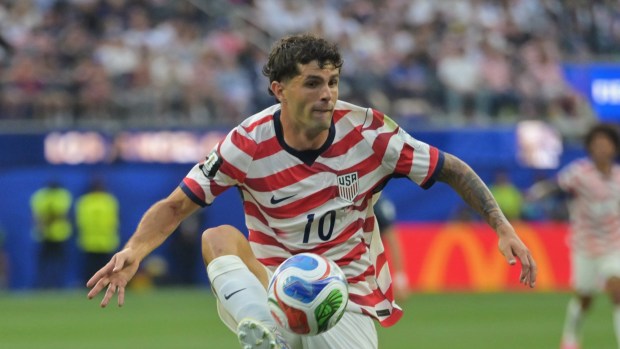 United States’ Christian Pulisic (10) controls the ball during the World Cup Group D soccer match between the United States and Paraguay in Inglewood, Calif., near Los Angeles, Friday, June 12, 2026. (AP Photo/Jayne Kamin-Oncea)
Also, there is top-down integration coaching, meaning that the U15s will be taught in the same system (4-3-3) with the same principles of play as the full national team. If our US team looks connected, it is because coach Mauricio Pochettino is doing his job, and these players have played together in a US shirt for years.
College is still a viable pathway, and 6 US players competed at that level, including Tim Ream and Matt Turner, who played four years in college
Whether you were a Jurgen Klinsmann fan or not, he was the first US coach advocating for players to challenge themselves in Europe. Currently, we have 18 players (17 in Europe) playing internationally, and 16 are playing in the top five leagues around the world
It took a long time to get here, but it may also be time to recognize soccer as one of 5 major sports, with football being clearly the national sport. Aside from a high-profile domestic pro league, soccer is often as competitive, in youth and adult participation, high-level international TV ratings, and overall interest.
We have come a long way, and suffered in this journey, but still, there are tons of flaws in the system, such as:
1) Unlike football and basketball, there is a lack of opportunity for low-middle-class children and those below the poverty line. As our US roster indicates, like most sports, soccer remains an upper-middle-class game.
2) Our players still lag behind soccer royalty nations in skill. Soccer skills begin at home in the backyard, but there are few reliable guidelines for parents to teach and reinforce them. I would highly recommend reading Trenton native Billy Gazonas’ book, The Billy Gazonas Story , for a better understanding of how important skill is and how it is developed
3) Parents are paying too much for kids to play and often are not getting their money’s worth. I’ll leave it at that
4) Kids spend too much time traveling, and that leaves less time for them to develop skills, especially in the critical stages of ages 11-14.
5) Coaching and Youth Soccer in general. While we have made massive strides, we are behind nations that regularly develop high-level players.
Everyone who is following the US team is on a sugar rush right now.
My recommendation: Pump the brakes. Everyone wants to win the World Cup. Of the 212 nations that were polled, 182 (86%) listed soccer as their most popular sport. We may end up playing Bosnia in the knockout round. They are a gritty team that took out Italy to qualify for the World Cup. Taking them lightly would be a big mistake.
For now, just sit back and enjoy the process. The US is playing fun attacking soccer, and it took a long time for us to get to this point.
Mercer County Soccer Hall of Famer Charlie Inverso is formerly the head coach at Mercer CC and Rider University. He works as a goalkeeping scout for US Soccer.