
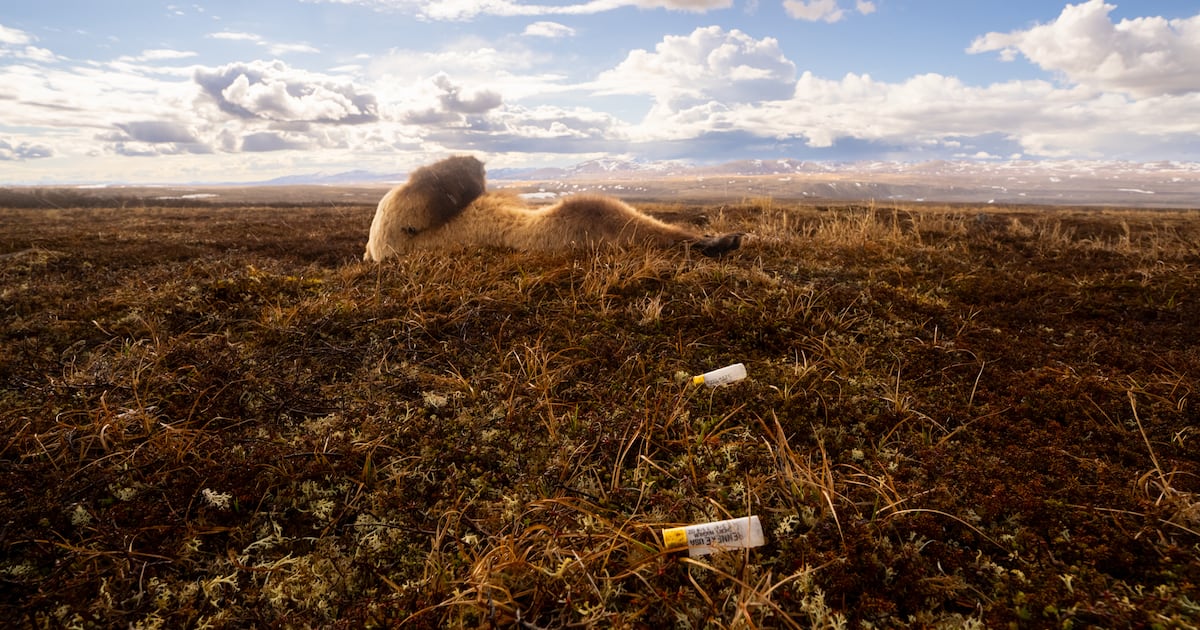
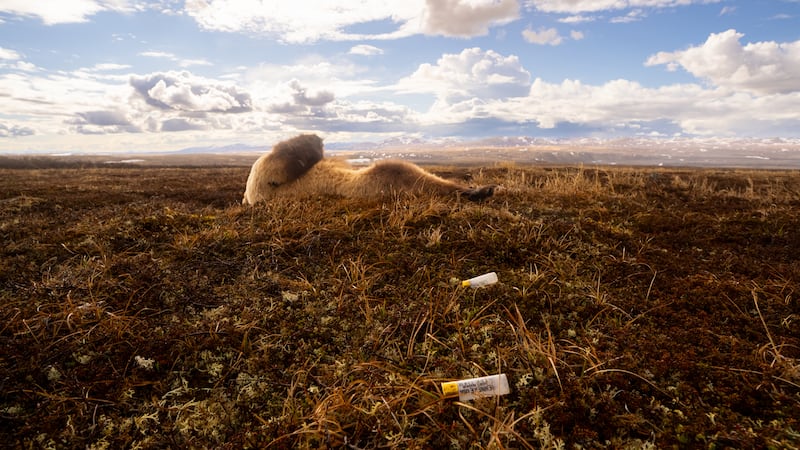
 Shotgun slug cartridges are visible on the tundra near a deceased adult bear on state land within the Mulchatna intensive management area in Southwest Alaska in May 2026. (David Rossow / Alaska Wildlife Alliance)
Photographs of dead bears in a remote part of Southwest Alaska taken by a wildlife advocacy group contradict prior assertions by the state about its predator control program in the area and raise questions about the policy’s execution in the field.
Members of the Alaska Wildlife Alliance chartered a helicopter at the end of May, flying north from the hub town of Dillingham to the western part of the Wood-Tikchik State Park. That’s the area where, since 2023, the state of Alaska’s Department of Fish and Game has concentrated its aerial gunning program against brown bears in an effort to improve calf survival among the Mulchatna caribou herd.
From 2023 to 2026, the state reported killing nearly 254 brown bears. Fish and Game reported that between May 9 and June 7 this year, it shot 68 bears.
Photos from the Alaska Wildlife Alliance shared with the Daily News in June show two dead bears found close together a few miles west of Kisaralik Lake, near the boundary of the federal Yukon Delta National Wildlife Refuge. One was a cub that wildlife alliance Executive Director Nicole Schmitt, who was part of the crew in the field, said looked like it had been dead only a short time, with its hide still on and no indication that any biological samples had been collected to aid in scientific purposes. The other was an adult with its head and front paws removed.
The Alaska Department of Fish and Game confirmed the two bears were “very likely” killed as part of predator control efforts this spring, according to Division of Wildlife Conservation Director Ryan Scott.
The Alaska Wildlife Alliance is not a neutral party in the controversy around the Mulchatna predator control program. The group at Board of Game meetings has vigorously opposed proposals related to using helicopters to shoot bears, and has been party to two lawsuits suing the state to halt the program.
The first challenge, which the group won in December, claimed the state had violated public process rules when it speedily expanded the predator program from just wolves to include bears. Months later, the state and Board of Game approved a lightly adjusted version of the program, this time cured of its process defects. The Alaska Wildlife Alliance is suing the state over that version too, alleging it lacks the necessary scientific rigor required under Alaska law.
“I’ve read these reports, I’ve been in all these meetings,” Schmitt said during an interview in June shortly after returning from the trip. “This left a bigger impression on me than reading all the reports.”
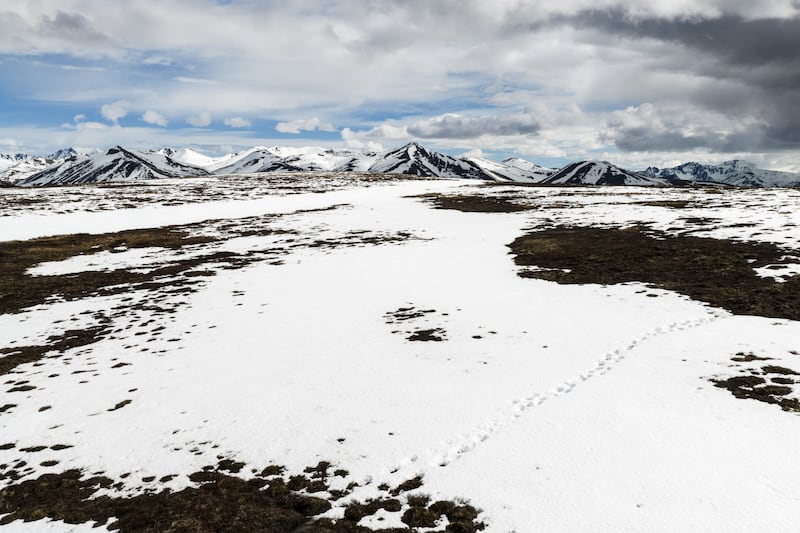 Bear tracks dot snow within the Mulchatna intensive management area in Southwest Alaska in May 2026. (David Rossow / Alaska Wildlife Alliance)
The bear control area is determined by where the Mulchatna caribou are observed calving each spring within the much larger 40,000-square-mile boundaries approved by the state’s Board of Game for broader intensive management efforts. Schmitt said her group targeted a general vicinity to survey based on advice from hunters and guides in the region, and cross-checked that against public flight record data for the aircraft used by the Department of Fish and Game.
Schmitt recalled that the Alaska Wildlife Alliance was about a hundred miles north of Dillingham — flying high enough to avoid disturbing wildlife in the area — scanning for gut piles that might indicate bear kills when a member of their team spotted a “circular lump” that stood out on the tundra. They set down near it and ultimately found two brown bears they believe were killed by state officials as part of the predator control program. The “lump” was the cub.
“Its paw was the size of my hand. To me it looked like a yearling,” Schmitt said. “I didn’t see any evidence that it had been sampled.”
The wildlife alliance found the second bear close by, which Schmitt said looked like an adult male.
“It had been beheaded, its front paws were taken, and it had been pseudo gutted,” she said, adding that it appeared to have been dead for longer than the cub, with obvious signs of decay.
In photographs, the boar carcass is on its back. It has no head or front paws, the edges of its forearm bones visibly poking out. Spilling out of its lower abdomen is a heap of internal organs.
Discarded near both carcasses were the same spent ammunition cartridges: 2 3/4-inch high-velocity shotgun slugs, and a bit of plastic trash by the boar.
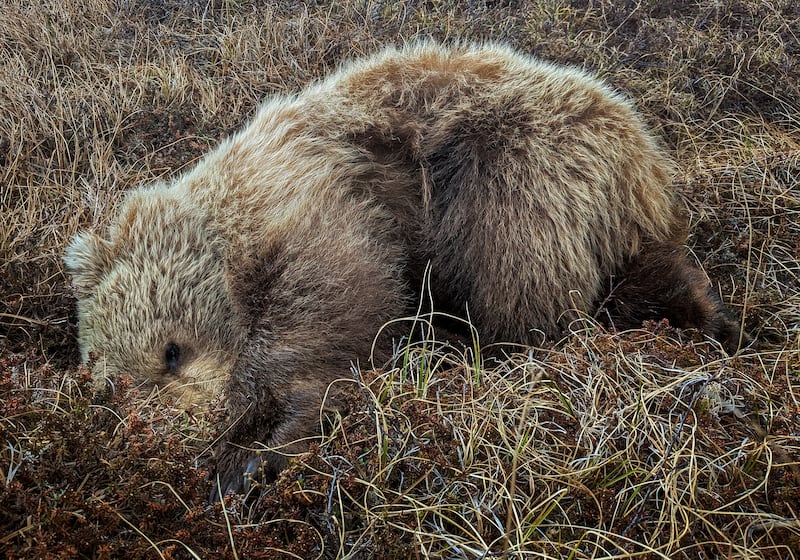 A deceased bear cub is left intact on the tundra on state land within the Mulchatna intensive management area in Southwest Alaska in May 2026. (Nicole Schmitt / Alaska Wildlife Alliance)
‘Miscommunication in the salvage protocols’
One of the major discrepancies between how state game management officials have described the program and what the wildlife alliance found relates to the bear hides.
“The field crew salvaged the hide and skull of bears for sealing when safe to do so,” wrote Todd Rinaldi, regional manager for the state’s Division of Wildlife Conservation, in a November memo to a superior on the 2025 predator control season. “When possible, a tooth was collected from bears for aging and hair was collected for possible genetic and isotopic analysis.”
A similar memo from 2024 specifies that bear hides were salvaged “as often as possible” to be shipped to “taxidermists on the road system for fleshing and salting” before being sold at auction. It took two Fish and Game employees “roughly one-half hour per bear” to fully remove each hide, the report noted.
In response to detailed questions about the photos shared by the Alaska Wildlife Alliance, Scott said there had been “miscommunication in the salvage protocols” between division leadership and field teams.
“I contacted staff asking for details for bear salvage during the removal operation. I learned that bears with low quality fur and cub bears were not skinned in the field. Heads and paws were removed for both educational use and to destroy the trophy value of the carcass,” Scott wrote.
Salvaged hides that are not retained for educational purposes are tanned by private businesses in preparation for the Horn and Hide Auction held during the Anchorage Fur Rendezvous each March.
“Bears that are significantly rubbed and actively molting do not serve educational or auction uses well and require significant staff time and resources to process. Juvenile brown bears (1 yr.-2 yr.) experience the same limitations in terms of requests,” Scott wrote. “This year, a total of 68 bears were removed. Fifty-five hides were salvaged. Based on field reports, the number of rubbed and molting bears was higher than previous years.”
Though state-sponsored predator control programs have been going on for decades in Alaska, photographs and similar documentary evidence of the tactics are extremely rare. The Mulchatna program is carried out in one of the most sparsely populated parts of the state, with no permanent communities within the range or much significant travel through it besides occasional river rafters, anglers and hunters.
The state has denied multiple requests from the Daily News to embed with its staff in the field. Independently visiting the area is costly and difficult. Schmitt said her group had made plans to go multiple times, only to be hampered by weather and logistical obstacles.
“These things are so hard to document,” she said, adding that she assumed if she saw anything from the air it would be a skinned-out bear carcass. “If we’re spending all the resources to go up there, we wanted to document it. Because the public has taken such a keen interest in this, and predator control is something that is reflected as being very ‘surgical’ or very ‘clinical.’ And we wanted to understand the realities of a program like this on the ground.”
Though Schmitt said both the bears she saw were on relatively flat, accessible tundra terrain, neither fully aligned with the state’s account of how it’s handling animal remains.
“It calls into question for me what is being reported. And I’ve heard people like the commissioner go on to say they are salvaging these things,” she said. “It was really trashy, and just felt like they were in a hurry and didn’t much care about what was left behind.”
Schmitt emphasized that the aim of surveying the control area was not to disturb or block state employees carrying out their aerial gunning work. Not only is predator control legally authorized in state statutes, but Schmitt, a hunter herself, said she didn’t think it was safe to be flying around if there could be firearms shooting from moving aircraft.
“I think it’s worth people knowing what that looks like,” she said of aerial gunning for bears. “I think most Alaskans would have looked at, especially the cub, and thought, ‘What are we doing?’”
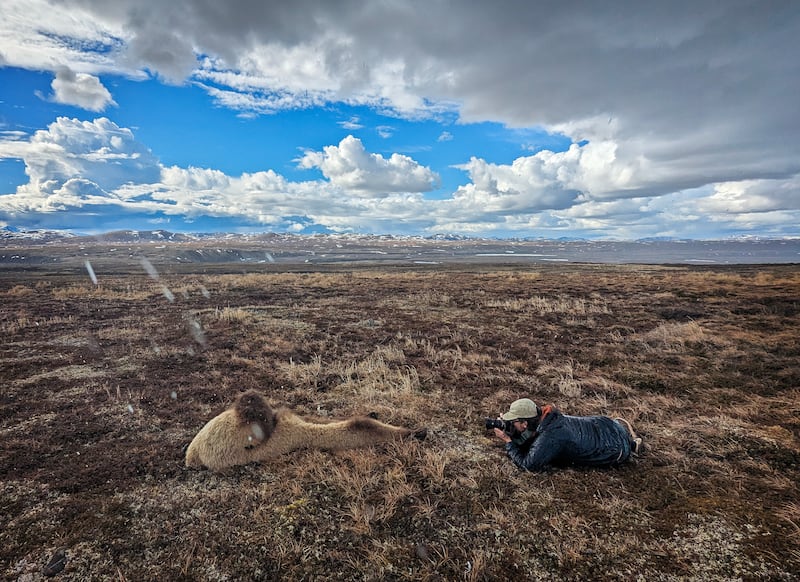 David Rossow photographs an adult bear that was killed in May 2026 on state land, within the Mulchatna intensive management area, as part of the state of Alaska’s Mulchatna bear control program. Since 2023, state employees and contractors have gunned down 254 brown bears, including cubs, using helicopters and spotting planes. The project is authorized to continue every spring until 2028. (Photo by Nicole Schmitt / Alaska Wildlife Alliance)
One other aspect of the state’s program that struck her was the expense. Schmitt estimated that after accounting for commercial flights out to the region and lodging, the total cost for two Alaska Wildlife Alliance members to travel there for just a few hours on a single day with a helicopter came to between $20,000 and $26,000. That is a fraction of the $2.18 million the state reported spending on intensive management efforts related to the Mulchatna predator control program from 2023 to 2025, which entails flying a helicopter almost daily, accompanied by two small spotter planes.
“Holy moly, this is expensive,” Schmitt said of the state’s intensive management tactics. “You’re spending millions of Alaska’s dollars on a program? Let’s see what you do with it.”
Scott said that the Department of Fish and Game is working on a report about this year’s operations for the Board of Game, and addressing internal communications on bear salvage protocols for the future.