
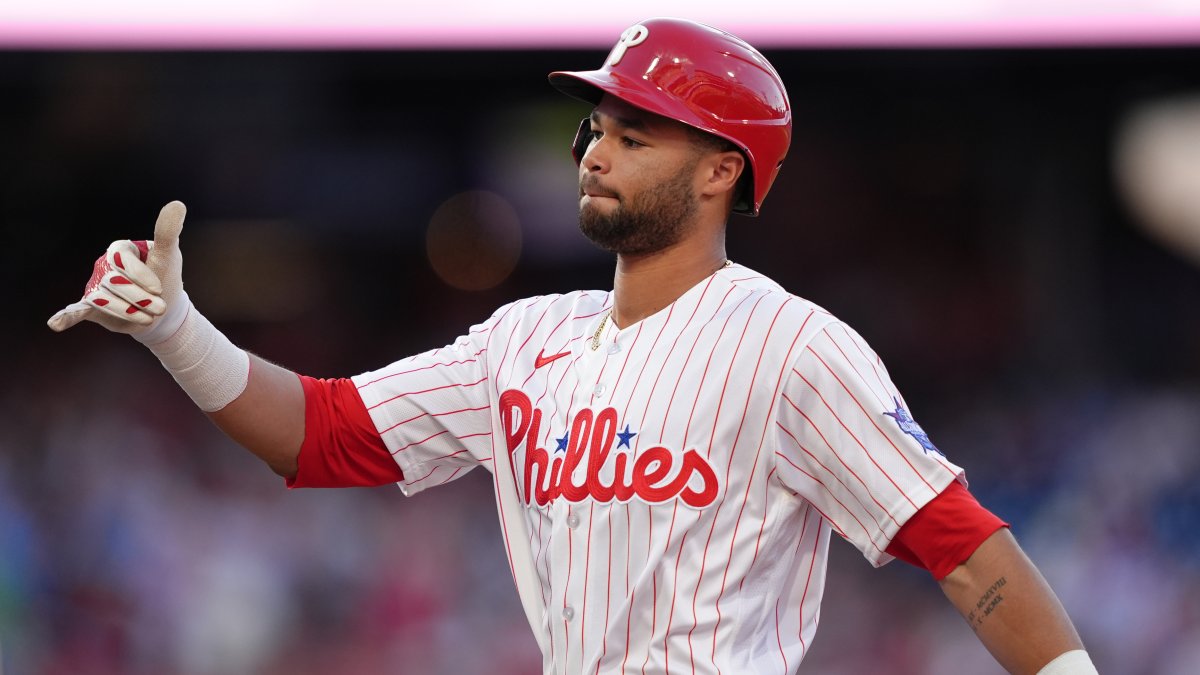
WASHINGTON — Jacob Misiorowski had the Phillies’ number on June 12, especially rookie Justin Crawford.
The Brewers’ fireballer got nine swings from the Phillies rookie that night. All nine came against fastballs of at least 99 mph.
Crawford missed eight of them. He went 0-for-3 with three punch outs.
Misiorowski ended the game by striking Crawford out on three straight 103 mph heaters, then roared toward the home crowd after a 15-strikeout performance.
Few hitters would have looked comfortable against that velocity. But the at-bats reflected a larger problem Crawford had been trying to solve for more than a month.
Through May 10, Crawford was hitting .281 with a .748 OPS. From then through June 13, he hit .150/.200/.213 with three extra-base hits in 85 plate appearances over 29 games.
The rookie had opened the season looking like the hitter who won the International League batting title in 2025 and hit above .300 in each of his four minor league seasons.
Then pitchers adjusted.
“Earlier in the year, they were kind of pitching me at my strengths, out and over,” Crawford said. “They would kind of get [my arms] extended, pitching the ball where I liked it. As the season went on, they started pitching me inside, kind of going hard in, maybe soft away, but really just going inside a lot.”
That attack exposed extra movement in Crawford’s swing.
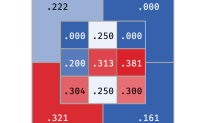
A breakdown of Justin Crawford’s batting average based on the strike zone. He has excelled when he’s gotten his arms extended in 2026, but hasn’t found success on pitches up-and-in, specifically fastballs (Credit: Baseball Savant)
From June 1 through June 13, Crawford had a 36 percent swing-and-miss rate against fastballs. Before that stretch, it sat at 18.8 percent.
The Phillies’ answer was not to overhaul him. It was to simplify him.
“I’ve been working on a no-stride,” Crawford said. “Lowered my hands a little bit, just to take a little of the extra movement that I had going on. I’ve been working with Kevin [Long] a lot, especially with that, the last week or so. It’s been feeling good.”
The changes, which also includes a slight close of his stance, have reduced the time between his load and his swing, helping him get the barrel to fastballs inside, and adjust to breaking pitches away.
Since June 14, Crawford is hitting .333 over 10 games. He has nine hits, including five against fastballs, while cutting his fastball swing-and-miss rate to 11.5 percent in that stretch.
The no-stride (and lowered hands) look is not about chasing a different launch angle or forcing more loft. Crawford entered Wednesday with a 2.7-degree average launch angle, the second-lowest mark in baseball.
He is not concerned.
“Not at all,” Crawford said. “Just work on being on time and getting in a good position to be able to put a good swing on the ball.”
That remains the goal behind the lower hands, too.
“I’m thinking about getting into the ball quicker and being on time,” Crawford said. “I think me naturally getting my hands in and having a quicker, shorter swing at the ball, I’ll naturally be able to hit the ball hard.”
Crawford has always made his living by putting the ball in play, using the whole field and forcing defenders to account for his speed.
His 29.5 feet-per-second sprint speed ranks in the top 4 percent of the sport. That speed helps explain why the Phillies are not alarmed by a ground-ball-heavy profile. Many of the lowest launch-angle hitters in baseball, including Tampa Bay’s Chandler Simpson, survive by putting pressure on defenses in ways most hitters cannot.
Crawford has only barreled two of his 170 batted balls this season. His 0.8 barrels per plate appearance rank among the seven lowest marks in baseball.
But the Phillies are still focused more on timing, contact quality and his ability to use every part of the field than trying to turn him into a different hitter.
Over the wall in DEAD CENTER at Fenway Park! Justin Crawford’s second career home run ties the game at one against the Red Sox on Wednesday night.
His recent adjustments have also drawn praise from Mattingly, who also managed the rookie’s father Carl in L.A.
“Justin’s been working,” Mattingly said June 16. “His face is really good every day. He has a good attitude every day, he’s working. I think he knows he needs to get better and thinks he’s working on it.”
Mattingly said then that the Phillies had seen signs that Crawford was moving toward the adjustment that the rookie recently spelled out.
“I know [the hitting coaches have] been pushing on a certain thing,” Mattingly said. “You start to see they get where they want to go.”
Crawford has another weapon the Phillies want him to use more often.
The rookie attempted to bunt for a base hit with two outs Tuesday. It did not work, but it showed the type of pressure he can place on an infield.
“I’m always looking,” Crawford said. “I’m always checking where the infielders are at. It obviously depends on the situation, but I’m always going up there looking at the first baseman or third baseman, seeing where they’re playing.”
Mattingly views the bunt as apart of his offensive identity.
“I don’t feel like it’s a work in progress because he’s a pretty good bunter,” Mattingly said. “We do want him to bunt, and we do want him to keep it in his game and use it.”
Crawford routinely draws third basemen in, which opens another wrinkle. A defender who creeps too far toward the line has to guard against the bunt, while Crawford still has the ability to slap a ball past him or roll one softly toward third.
“Sometimes they even push that guy over,” Mattingly said. “They think they’re in, they’re really not, because they can’t go right and throw the other way.”
Crawford has also found success going the other way in leverage spots. He entered Thursday hitting .357 in high-leverage situations (which includes two walk-off hits), according to FanGraphs.
THEY’VE DONE IT AGAIN! For the second straight night, the Phillies take the lead in the top of the ninth! This time, it’s DEREK HILL the hero!
The Phillies acquired Derek Hill two weeks ago to give them another right-handed outfielder and more flexibility against left-handed pitching.
Crawford is hitting .139 against southpaws, and Hill’s arrival has helped ease some of the immediate pressure in those matchups.
But the Las Vegas native remains a central part of the Phillies’ long-term outfield picture.
He has already handled the first major adjustment of his rookie season. The next step is sustaining it.
“I’ve been working with Kevin a lot and slowly, but surely, kind of moving that needle,” Crawford said.