
Sign up for the Slatest to get the most insightful analysis, criticism, and advice out there, delivered to your inbox daily.
Larry David famously built Seinfeld around the mantra “No hugging, no learning.” There would be no moral lessons at the close of each episode, no slowly building love story, none of what the entertainment industry likes to call “heart.” The show’s narcissistic Manhattanites would not grow or change in any way, except perhaps to become more like themselves—a kind of existential stubbornness they shared with the protagonist of Curb Your Enthusiasm, a fictionalized version of David played by the man himself. But while David’s characters never changed, the world around them did, and as Curb stretched from the tail end of the Clinton era into the beginning of Trump, the anti-sentimentality that initially seemed so bracing started to feel like an ominous harbinger of the red-tinted “Fuck your feelings” era, a time when discarding the social contract went from being a secret shame to a proud performance. Suddenly, we lived in a world of Larry Davids, insisting everyone else play by their rules and yet beholden to none.
David made clear on Curb that neither he nor his on-screen avatar had any fondness for MAGA, and it was canon from the beginning that, far from being an incipient right-winger, TV-Larry was practically the archetype of the self-satisfied L.A. liberal. (In an early episode, he gets incensed that other Prius drivers won’t ratify the smug superiority he gets from driving around town in an electric car.) But the show’s universe had no way to accommodate sincerity, so the closest it could get to a clean break was insisting that Larry wasn’t that kind of a jerk.
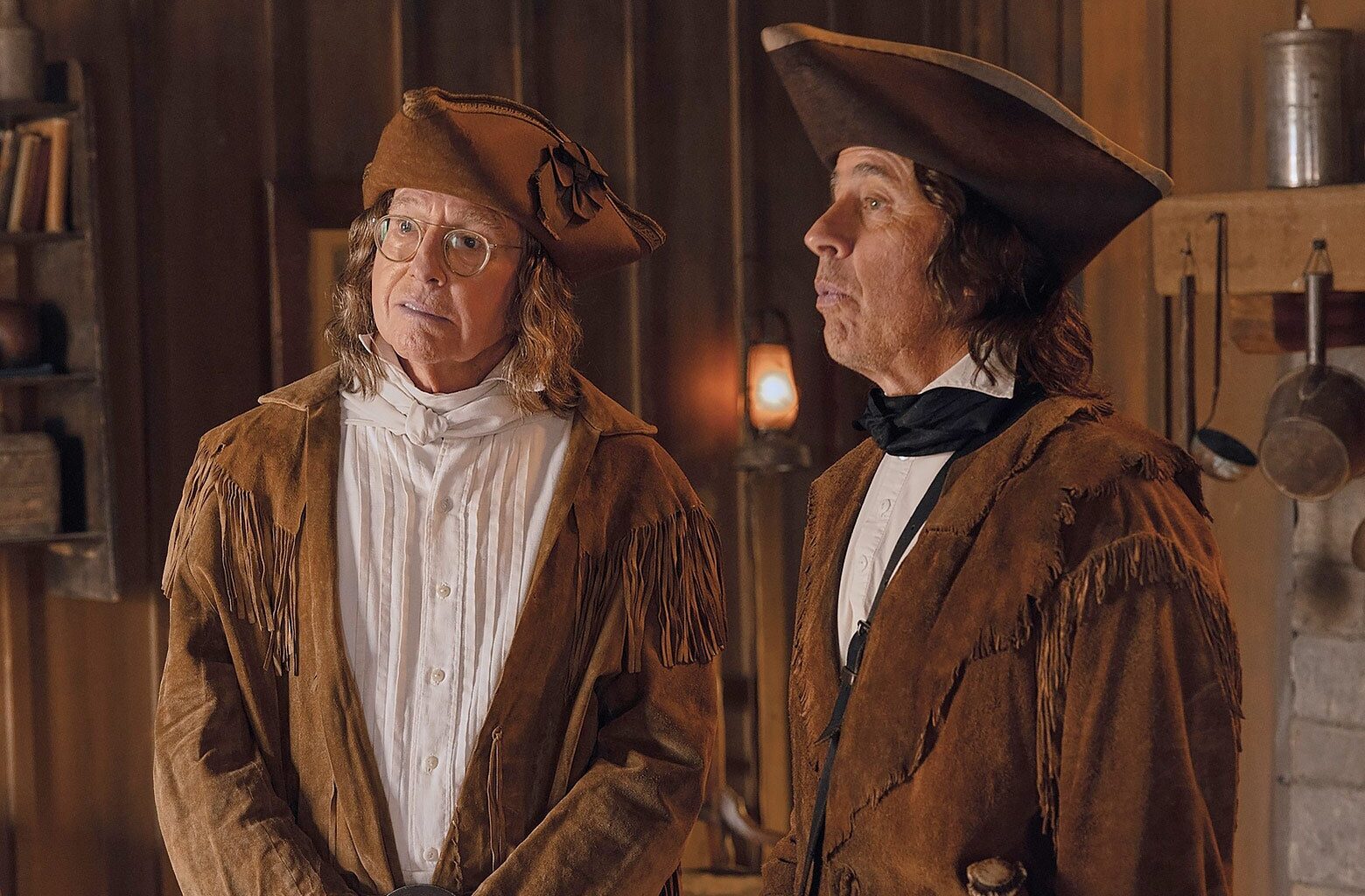
David’s new series, Life, Larry and the Pursuit of Unhappiness, premiering Friday evening on HBO, is a more dramatic departure, in that its “almost history of America” plays out as a series of disconnected sketches roughly spanning the first 200 years of the United States. But its central conceit is that, even at the republic’s proudest moments, there have always been what Barack Obama, who provides the intro to the series and serves as one of its executive producers, calls “deeply unpleasant people who stood in the way of progress.” In other words, Larrys. At the drafting of the Declaration of Independence, he’s the Founding Father who wants to load up the document with a list of his personal grievances: We hold these truths to be self-evident, that no one should be forced to share an umbrella, and if you’re invited to a dinner party, you have a legal right to ask who you’re seated next to.
Sometimes, David’s character thwarts the march of history simply by being himself. When Rosa Parks refuses to give up her seat next to his garrulous Alabaman in the white section of a city bus, he defends her right to do so, or at least his right not to have to get up and risk someone else forcing him to move down a spot. But sitting next to an old white man with no filter or self-awareness turns out not to be quite the milestone Rosa was hoping to achieve, so she eventually joins her friends in the back and resolves to try again another day. Sometimes, the historical breakthrough goes as planned, but its future downsides emerge at the same instant: David’s Alexander Graham Bell invents the telephone and immediately discovers the friend who has nothing to say but won’t get off the line; the Wright brothers realize the dream of airplane flight, and also the discomfort of getting stuck in a middle seat.
Although Life, Larry’s “almost history” mostly cuts off around Watergate, there are times in its seven-episode run when it pulls back the curtain and makes direct reference to the present. HBO has asked critics not to spoil one such sketch, despite the fact that, as the closer to the episode that premieres next week a few hours before the nation’s 250th birthday, it serves as something of a mission statement for the show. (The implicit reason is to protect the identity of the guest star playing a certain former president, although the pointed criticism of the office’s present occupant may also have something to do with it.) But I can tell you that Jonas Salk’s leather-skinned neighbor, the one with a voice like a blender full of rocks and extremely unscientific opinions about vaccines, bears an awfully close resemblance to the current husband of David’s former Curb co-star, and that’s before David cuts off his ranting with a name drop that all but seals it.

Rebecca Onion
Hulu’s New Hit Show Should Be Delicious Schadenfreude. There’s Just One Problem.
Read More
A Canceled Star Is Back. His Hateful New Movie Is One of the Most Disturbing Things I’ve Seen Lately.
Supergirl Is a Super-Bummer
In Obama’s mock-serious preamble, he describes the U.S. as a bold experiment in self-governance, one where “power resides not with a monarch but with ordinary citizens.” But the series plays out, over and over again, the most treacherous variable in that experiment: namely, the people. (At the time he makes that statement, Obama is standing in a museum the people’s duly elected leader has said focuses too much on the downside of slavery; he may stop short of underlining how others have betrayed the promise of the nation’s ideals, but he’s happy to act as the straight man while someone else does it.) It’s essentially a one-joke show, although some variations, like the suggestion that the Civil War was started by a dispute over passed appetizers, are more inspired than others. And, apart from jabbing the occasional finger in the White House’s eye, David and his co-creator Jeff Schaffer largely avoid the calculated provocation of Curb’s cringe comedy—there are handful of sketches set during slavery, but never a joke about slavery. You know who the good and the bad guys are, and who you’re meant to be rooting for, even if the answer is frequently no one.
In other words, it all feels a little safe. If David isn’t quite apologizing for loosing his self-interested monsters upon the world, he seems intent on making sure we know we’re supposed to be laughing at and not with them. Still no hugging, but perhaps a little learning?
Get the best of movies, TV, books, music, and more.