
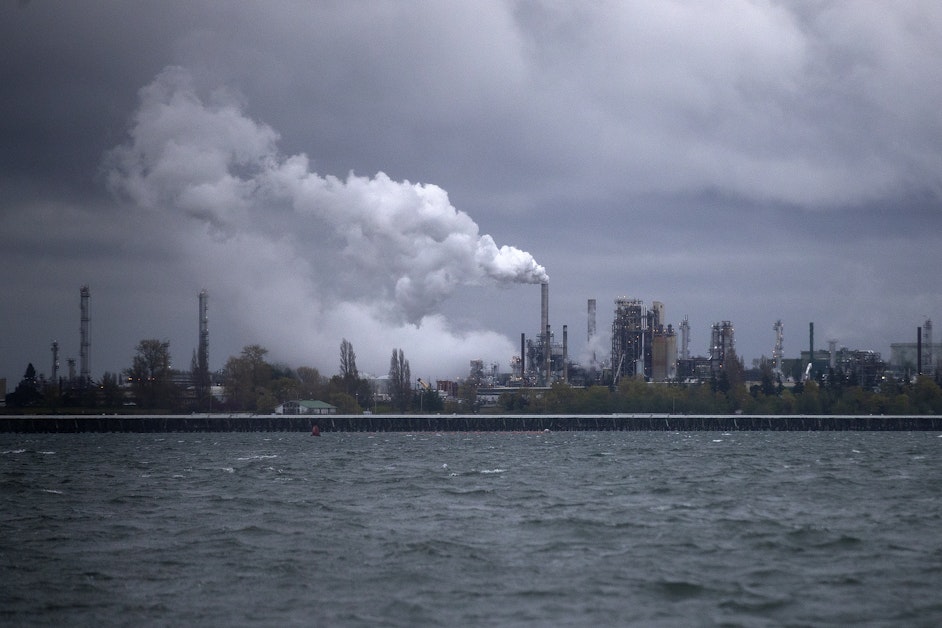
California, Quebec, and Washington state have agreed to merge their markets for carbon pollution.
Each government has been making some of its biggest polluters pay to keep harming the climate. Polluters can also buy and sell their permits to emit heat-trapping carbon dioxide.
With an agreement signed Thursday, polluters should be able to buy and sell carbon allowances from anywhere in the three jurisdictions by 2027.
“While Washington, D.C., is really abandoning our country’s commitment to move forward on climate and addressing such an urgent and existential issue, I’m thankful to be governor of a state that does exactly the opposite,” Washington Gov. Bob Ferguson said at a press conference.
RELATED: Microsoft signals pause in funding for carbon dioxide removal market
Billions in revenue from governmental carbon auctions has been funding clean-energy projects and supporting low-income communities.
Washington’s “cap-and-invest” program is the centerpiece of the state’s efforts to control the pollutants that are causing record-breaking heat waves around the world and generally sending the earth’s climate into dangerous, uncharted territory.
“Snowpack is no longer a reliable water supply,” Ferguson said. “We cannot wait for the other Washington to catch up or get with the program.”
“Our linked market, once operational in 2027, will be the world’s largest subnational carbon market,” said David Ruiz with the Québec Government Office in Seattle.
RELATED: ‘Big beautiful bill’ not so pretty for Port of Seattle’s carbon reduction goals
California is the world’s fifth-largest economy. Together with Quebec and Washington, they are equivalent to the world’s fourth largest economy.
China, the European Union, and Japan have larger carbon markets.
“At a time when cross-border cooperation and environmental policy are being challenged more than ever, our teams demonstrated remarkable dedication to work together and bring this vision to life,” Ruiz said.
Washington’s cap-and-invest program limits climate pollution from major emitters, with that limit gradually tightening over the next two decades. The price of carbon is expected to rise as the cap tightens.
“We’re not expecting for it to come down,” said Peter Godlewski with the Association of Washington Business. “We’re hopeful that, once this agreement is in place, we’re going to see some sort of leveling out of those future price increases.”
RELATED: Washington carbon auctions resume after surviving election challenge
In their latest quarterly joint auction on May 20, California and Quebec sold the right to emit carbon dioxide at $28.81 per metric ton, less than half the $64.56 price at Washington state’s latest auction on June 3.
“Joining California will help fix our broken system,” Todd Myers with the Washington Policy Center, a free-market think tank, said by email. “I would expect carbon prices — and gas and energy costs with them — to decline after we link with California and Quebec. Functionally, California is subsidizing Washington residents.”
Pollution-trading schemes allow local facilities to choose between reducing their emissions or paying to continue them. That can leave communities next to power plants, refineries, or pulp mills living in pockets of polluted air.
Christina Estela Brown with the environmental justice group Front and Centered said linkage to faraway markets can exacerbate that problem.
“Washington state must deliver real greenhouse gas reductions, reduce the unfair share of pollution that frontline communities continue to face, and ensure that cap-and-trade revenue delivers benefits where they’re needed most,” Brown said by email.