
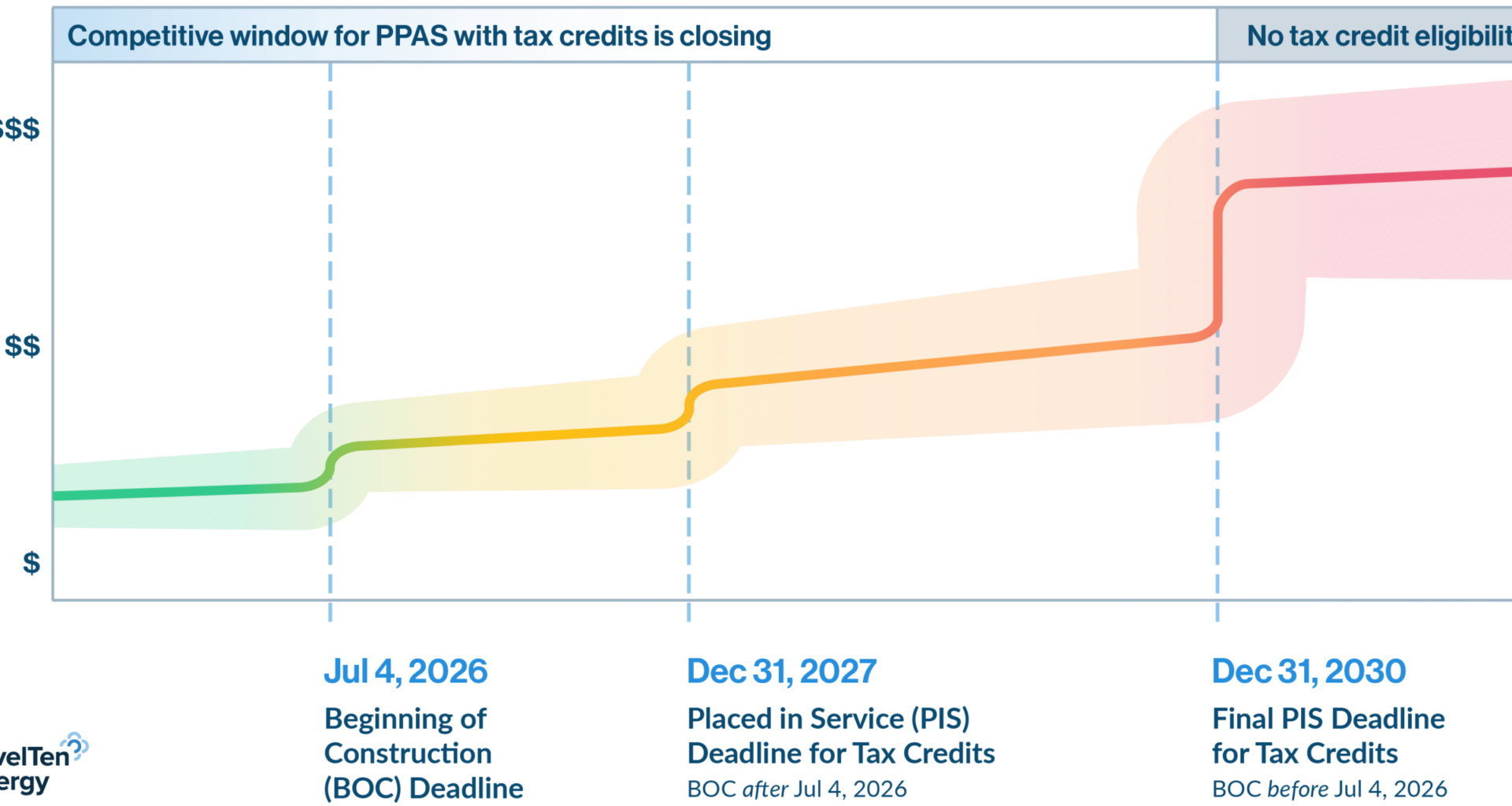
Clean energy buyers who are waiting for perfect macroeconomic conditions to execute renewable power purchase agreements (PPAs) are running out of time. According to a new market insight report from LevelTen Energy, the impending July 4 “tax credit cliff” is poised to rapidly spike PPA prices, forcing corporate procurement managers to move with extreme speed or face soaring project costs.
It has been nearly a year since the passage of the Trump Administration’s One Big Beautiful Bill Act (OBBBA), which established an aggressive timeline for phasing out federal wind and solar tax incentives. Under the law’s structural guidelines, utility-scale projects must either begin construction by July 4, 2026, or be placed in service (PIS) by December 31, 2027, to capture full federal tax credits. All pipeline projects must achieve PIS by December 31, 2030, to qualify for any remaining credits.
While a recent U.S. district court decision upheld the alternative construction-start test allowing developers to qualify by proving 5% of total project costs have been incurred, LevelTen warns that narrow timelines and bottlenecks around execution capacity will prevent most developers from leveraging this workaround.
The looming deadline means the total pool of safe-harbored, tax-credit-eligible projects is drying up.
As the fixed supply of mature assets is bought up, market leverage is expected to shift heavily from buyers to developers. LevelTen reported that 50% of the projects listed on its original “Most Valuable Projects on the Market” tracker have already been snatched up under exclusivity agreements since last July.
“Supply is shrinking by the week, and prices are expected to be on a one-way trajectory upward into 2028 and beyond,” warned Sarah Wolf, author of the LevelTen report. “Contracting with a tax-credit-eligible project today means securing terms that reflect today’s economics, before a no-tax-credit premium becomes the PPA market’s new normal.”
Regional price hikes
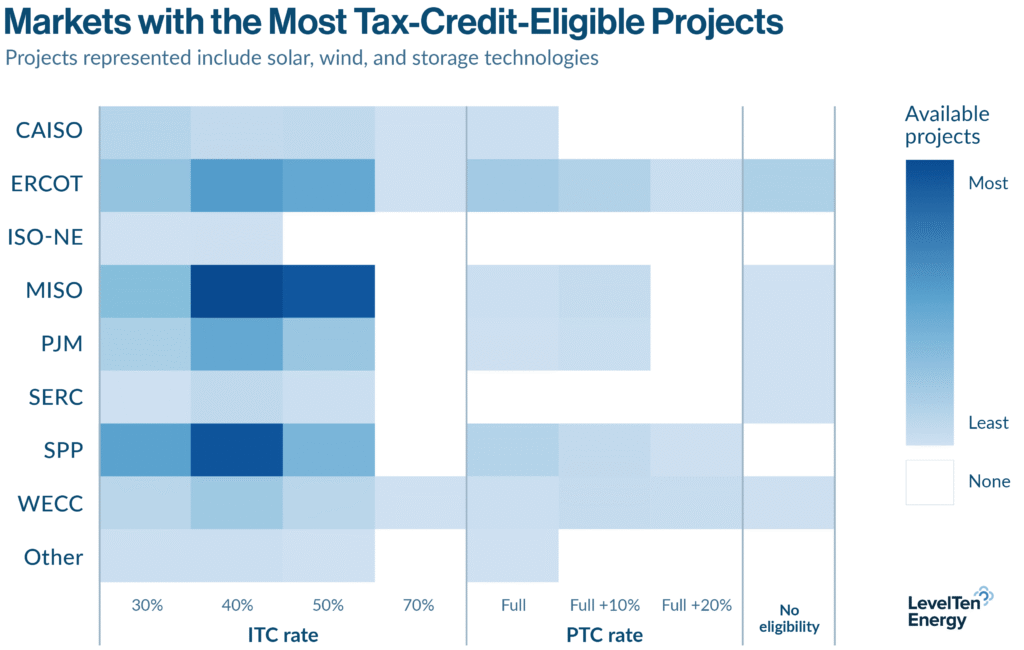
The report notes that MISO and SPP have emerged as primary hotspots for remaining tax-credit-eligible project availability. In SPP, wind assets continue to maintain a notable Production Tax Credit (PTC) presence, while ERCOT shows a strong blend of both Investment Tax Credit (ITC) and PTC-eligible projects reflecting its heavy solar-and-wind mix. Across nearly all major independent system operators (ISOs), developers are actively targeting one or two bonus tax adders to optimize project financials.
While real-world pricing data for projects built entirely without tax credits has been sparse as developers prioritize marketing their remaining safe-harbored assets, LevelTen’s early transaction modeling reveals a stark look at the post-cliff future.
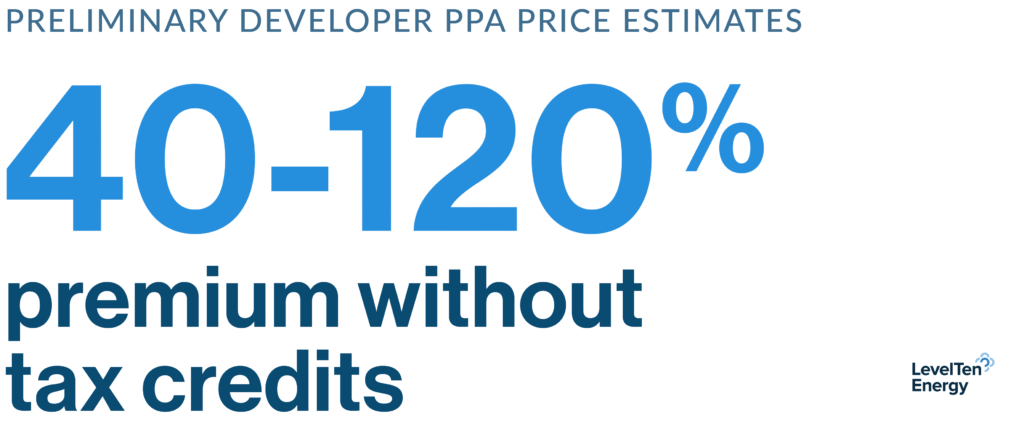
Immediately following the OBBBA’s passage in late 2025, PPA price offers for top-tier projects jumped up to 7% in a single quarter. Looking ahead to the expiration of the ITC/PTC framework, some developers are modeling baseline PPA price increases of 40% to 50% across all ISOs.
In ERCOT, the premium is even more severe. Early transaction data suggests that PPA prices could more than double without tax credits, representing a massive 120% spike, or an incremental cost increase of $66.21 per MWh.
Window of opportunity
Despite the tightening supply, corporate buyers may hold a temporary competitive advantage over big-tech hyperscalers. Data from the Corporate Energy Buyers Association (CEBA) reveals that while over 13 GW of clean energy has been contracted so far this year, the number of unique corporate buyers fell 40% over the last year.
The drop-off highlights a market dominated by massive data center developers executing mega-scale PPAs. However, data center development is inherently restricted by geography due to stringent regional grid constraints, accredited capacity needs, and precise co-location demands.
LevelTen said that outside of these dense data center pockets, prime, tax-credit-eligible renewable assets remain wide open for standard corporate buyers. But with the July 4 cliff effectively calling time on the current tax era, the buyers who come out ahead will be those who lock in remaining safe-harbored assets before they disappear from the marketplace.