
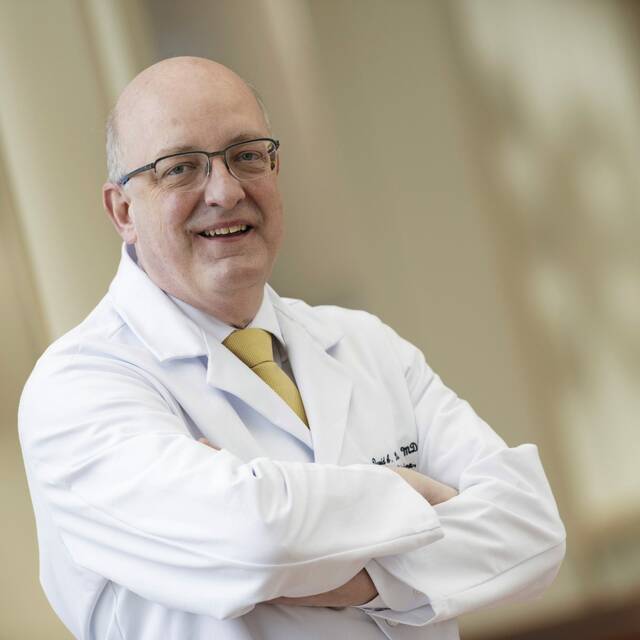
Dealing with new health issues that come along with aging can get old quickly, which is one reason there is a medical specialty dedicated to helping individuals maintain their physical, mental and emotional well-being as they age.
UPMC chief of geriatric medicine Dr. David A. Nace, of Wexford, has been helping Western Pennsylvanians get the most out of life’s inevitable course since 1990. Recently, he has seen his field increase in importance.
From 2004 to 2024, the percentage of the population age 65 or older increased from 12.4% to 18%, thanks to declining birth rates and increased longevity, according to the Pew Research Center. By 2030, every baby boomer will be 65 or older — meaning 1 in 5 people will be retirement age.
Q: Why have doctors who cater specifically to older adults?
A: What people die of in their 80s and 90s is different than what they die of in their 40s and 50s and certainly different than their 20s and 30s.
If you’re managing quality [of life] across four different diseases at the same time, something’s got to give. You can’t put people on a five-drug regimen for heart failure, a four-drug regimen for osteoporosis, a three-drug regimen for diabetes. You’re going to start to run into issues. So you have to look and see what’s most important to that person, what they want to focus on that impedes their quality of life, or what is most likely to cause the biggest problem for them. You focus on that one first, and then try to optimize the other things.
Q: What aspects of healthcare do geriatricians focus on?
A: The five Ms help us think about the person holistically.
One of them is mentation, being able to think, whether it is cognitive impairment from dementia, depression or delirium, acute confusion because of some serious illness.
Mobility, being able to get around in the environment, whether that’s walking, walking with a walker, walking independently, or using a wheelchair or scooter.
Being able to manage the medications is the third M.
We talked about what matters most, so being able to decide what’s important to that person, what their care wishes are.
And then, lastly, multicomplexity or multimorbidity, where you’re dealing with multiple things at once.
Q: Why is awareness of the field becoming more important?
A: The number one issue that we face in the United States and across the world is aging. It’s not a problem. It’s not a disease. It’s an issue because it affects everything we do, not just healthcare: housing, transportation, the workforce, the economy, national defense. Every one of those has been impacted by aging.
Q: When should people start thinking about seeing a geriatrician and why?
A: There are not enough geriatricians in the United States to care for all older adults, and that should not be our role.
We need to be either co-managing with the primary care physician or as a consultant to the PCP, allowing the PCP to maintain that relationship and to manage most of the other things.
Typically, when there are cognitive issues — you notice that the person is becoming more frail, they’re definitely changed, and what they used to do is different. The person is walking slower, they’re having greater trouble managing their medications, those types of things. When you start to see that change, that allows you to set a care plan that might change things for the person you know based on what matters most.
Life-changing events, when a spouse dies, oftentimes somebody notices that there’s a change, that might be a time to have a fresh set of eyes looking at somebody that you know has focused on the age-related changes and how that has an impact.
Q: What are some general quality of life tips for older adults?
A: I think exercise is at the core. And when I say exercise, I’m not referring to going necessarily to the gym and workouts of an hour and a half every day or three times a week. If you can do that, that’s great.
Get out and walk, whether it’s at the mall, the store, in a hallway, in the apartment complex, whatever it might be. Walking is important.
Being able to do things like chair yoga, just gentle chair exercises that you can do at home, is enough to help with flexibility, reduce some muscle pain, restrictions of movement, those aspects become really important in managing, especially if that person has arthritis and pain.
There is evidence that things like tai chi can reduce the risk of falls or at least injurious falls.
Diet, staying away from processed foods, staying away from foods high in saturated fat, and eating vegetables, foods that have antioxidants.
Social engagement is absolutely critical, staying in touch with people. If there’s a hobby or an interest, pursue it, go after it.
Q: How have you seen the field change over the years?
A: The cognitive aspect has changed dramatically. What we do for cognitive care today is different than before. We used to not worry: “They have dementia. It could be Alzheimer’s. It could be that or it could be this, but it’s dementia.”
That’s different because of the counseling that goes with a specific type. We need to link you to these resources. We need to be understanding.
Sometimes the behavioral aspects of frontotemporal dementia can be just overwhelming to a person’s caregiver, so the value of the testing has increased because it allows us to kind of tailor messaging around what to do and what to expect.
Q: How do I start to see a geriatrician? Do I need a referral?
A: You do not need a referral. A lot of people will self-refer. Sometimes they will talk with their doctor about it. Sometimes the doctor will refer.
Q: Is a geriatrician visit typically covered by insurance?
A: It’s definitely covered by insurance. Physician visits are always covered by insurance.