
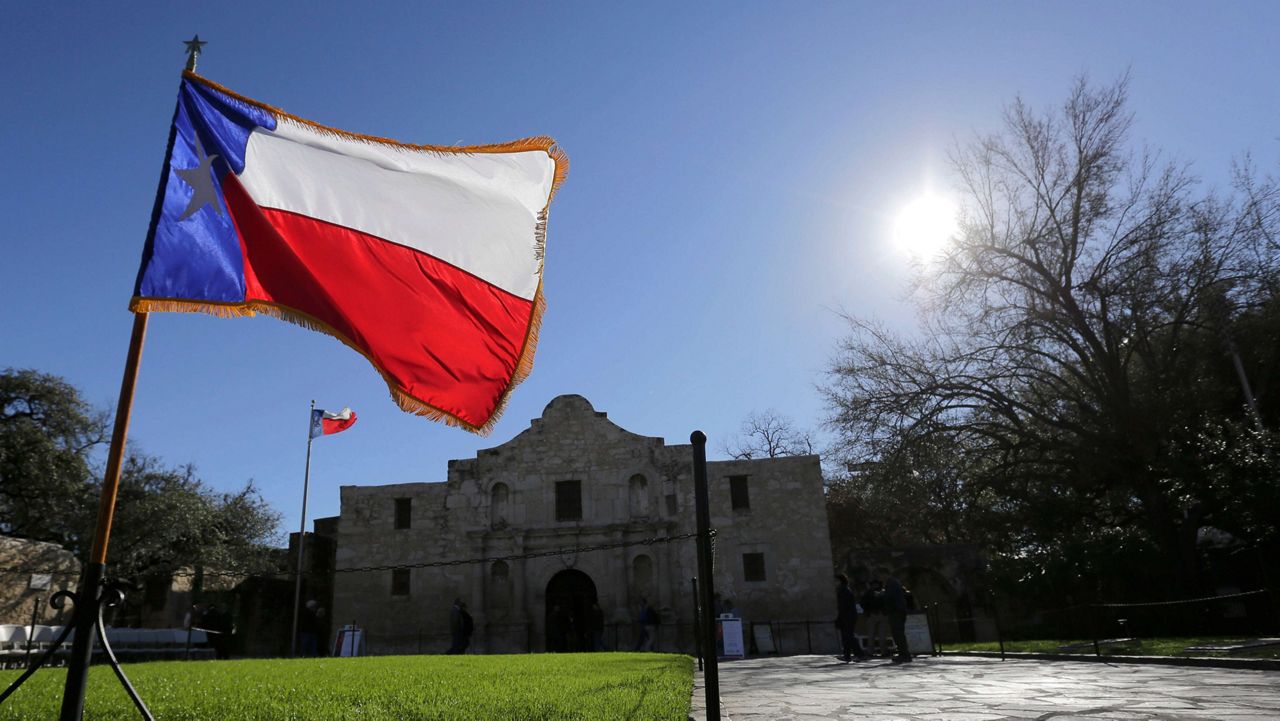
SAN ANTONIO — The phrase “Remember the Alamo” has become synonymous with Texas history, and experts say it is for good reason.
“It’s the most important place we have in Texas,” said Ernesto Rodriguez, senior curator for the 1836 Project.
Amongst a packed crowd at the small, historic building in downtown San Antonio, Rodriguez recounted the story of the defenders of the Alamo, who fought and died trying to hold on to the mission. The heroics of that battle, in early 1836, has become such a symbol of the state and the spirit of the early American story that it has been adapted and told repeatedly in movies and TV.
The gravity of that history clearly still touches visitors to the historic site.
“The Battle of the Alamo,” said Rodriguez. “It changes the course of world history.”
While the Alamo is often seen as a sort-of “main event” of Texas history, it’s certainly not the only moment that shaped the state and its place in the American story.
“It’s not a story that starts with the Alamo,” said Kathryn Siefker, curator at the Bullock Texas State History Museum in Austin. “It’s a story that starts 14,000 years ago.”
That’s the story that Siefker and her team at the Bullock Museum specialize in — what they call “the Story of Texas.”
Siefker said the museum stretches back to the earliest Texans who called the land home thousands of years ago. While only three Native American tribes are federally recognized with reservations in the state today, the museum showcases the artifacts, languages and stories left behind by many more.
“Their extensive trade networks, their relationships with one another, their amazing skillsets,” said Siekfer, showing off an exhibit comparing several of the First Nation tribes and their historic presence in Texas. “The sizes of the circles represent their populations in the state.”
It wasn’t until 1519 that Europeans explored the Lone Star State, beginning Texas’ other well-known historic spotlight: the six flags over Texas.
Not to be confused with the amusement parks of the same name, the flags represent the six separate nations that have planted a flag and claimed Texas as their own on the road to it becoming a part of the United States.
That earliest and first flag belonged to Spain, whose explorers arrived in the early 1500s and trekked the land for decades before planting their flag here. Siefker says they claimed the land as Spain’s for almost 100 years, but it was just a claim.
“Spain doesn’t do much with the area though, until France gets involved,” said Seifker.
Yeah, Texas was technically a part of France, or at least claimed by France, for a few years.
That was in 1685 when an explorer named Robert Cavelier de La Salle sailed into the Americas hoping to establish a French colony at the mouth of the Mississippi River. That mission would eventually be accomplished with the founding of a city by the name of New Orleans, but not by La Salle.
La Salle, instead, sailed past the Mississippi and ended up wrecking his ship near what’s now Victoria, Texas. The Bullock Museum proudly displays the remains of La Salle’s last ship, La Belle, which left the explorer and his team stranded, starving and in need of a route forward.
“They establish a colony, Fort Saint Louis,” said Seifker.
That fort is long-gone today but was enough of a presence for France’s flag to fly over Texas for five years. Seifker said the short period’s largest impact, though, may have been reigniting Spain’s interest in the land.
With the French gone, Spain again became the only European flag over the land, and the Spanish explorers began a 130-year push to bring their way of life to Texas.
“They start to really settle what we now know as Texas. They do that by establishing missions and presidios,” said Seifker.
Seifker said the Spanish goal was to spread Catholicism to the Native people, despite those people vastly outnumbering them. They established several missions in the San Antonio area, including the one that would become known as the world-famous Alamo.
However, during that period, Spain was also in conflict with the people of Mexico who sought independence of their own. They’d gain that independence in 1821, pushing Spain out of Mexico and planting Mexico’s flag over Texas instead.
Thus began the reign of the third flag over Texas, and it was a controversial reign, Seifker said.
The era that ran from 1821 to 1836 and included the rise of Antonio Lopez de Santa Anna as president of Mexico. However, Seifker said many of Santa Anna’s policies led to him butting heads with the Texans moving into the area from the newly formed United States. Conflict brewed between the two sides, leading to the Texans pushing for their own independence from Mexico.
That brings us to the point where we say, “Remember the Alamo.”
The defenders of the Alamo included famous Texans like Bowie, Travis and Crockett, who famously stood their ground at the mission despite an overwhelming attack from Santa Anna’s forces.
“This is a struggle for an independent nation to try to get out from, what they call, a tyrannical yoke,” said Rodriguez.
The Alamo would fall, but Mexico’s victory would be short-lived.
The fighting moved eastward toward Houston, where General Sam Houston’s troops were ready for Santa Anna at the Battle of San Jacinto. It was there that the Texas troops would win handily and claim their independence from Mexico.
This is obviously a shorthand version of Texas’ story. Historians encourage folks to visit sites like the Bullock Museum, the Alamo and other famous Texas history centers to hear more about the long journey to the Texas of today.