
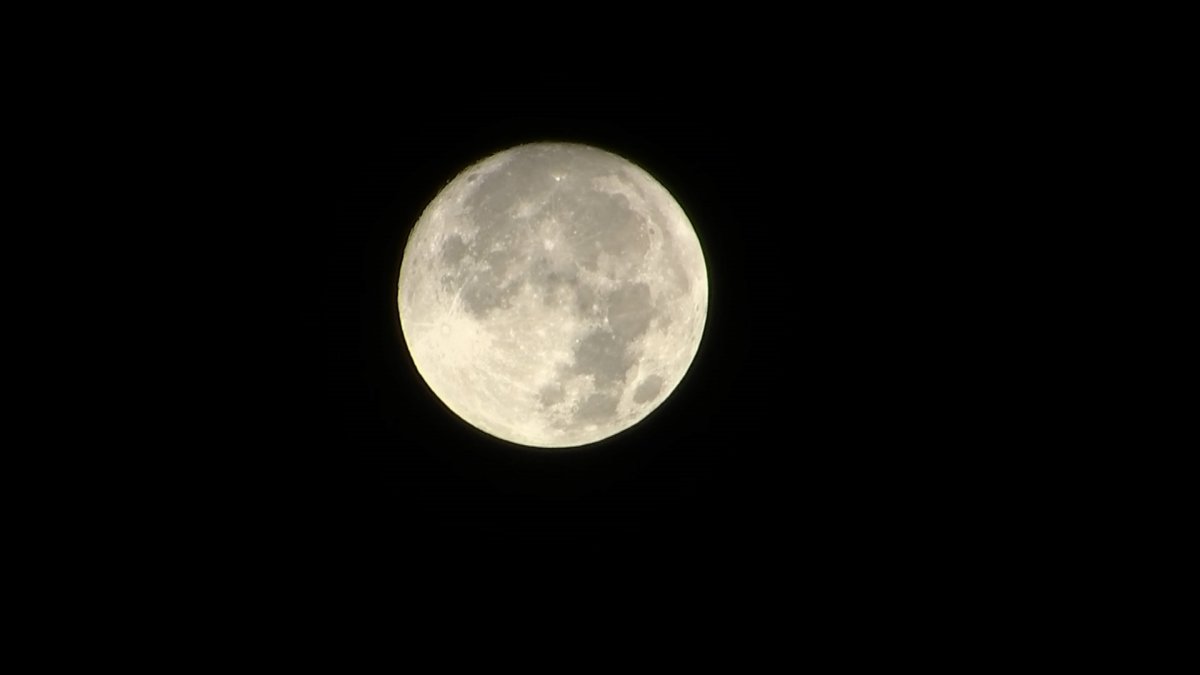
This month’s full moon will finally rise on Monday evening, and it will be a unique one for Chicago-area residents.
According to NASA, this month’s full moon will be a “micromoon,” one of the smallest of the year and the first of the summer season.
So what is a “micromoon?” Why is it called a “strawberry” moon? And why might the moon not look so….micro?
Here’s what you need to know.
When is the June full moon?
According to NASA, the full moon will officially occur Monday at 6:58 p.m., meaning it will have already technically been full before it rises over the Chicago area on Monday night.
Why is it called the “strawberry” moon?
According to the Royal Museums Greenwich, the “strawberry moon” gets its name not from a reddish color on its surface, but because of the time of year when it occurs, as strawberries are typically harvested beginning in June in North America.
Other cultures have different names for the full moon in June, including the “hot moon” since June is the official start of summer in the Northern Hemisphere.
What else will be special about this month’s full moon?
According to NASA, this month’s full moon is considered a “micromoon,” so named because it occurs near the timing of the moon’s apogee, or its furthest point from Earth.
The moon’s orbit around the planet is not a perfect oval, meaning it is different distances from Earth at different times in its orbit around the planet. As a result, there are times in the calendar when the moon appears as a “micromoon” when its near its apogee, and as a “supermoon” when it occurs near perigee.
This month’s “micromoon” will be the final one of 2026, according to NASA, with the next “supermoon” set to take place in late November.
Wait, why doesn’t the “micromoon” actually look super small?
The sun and the moon appear differently in the Northern Hemisphere’s skies during different parts of the year. Whereas the sun is higher in the sky during the summer in the Northern Hemisphere and lower during the winter, the moon is the opposite, appearing lower in the sky during the summer months.
As a result, the perception of “micromoons” and “supermoons” is a bit different during the summer, and when the moon rises on Monday night, it might still appear to be a normal-sized or even perhaps slightly bigger than usual because of how low it will be in the southeastern sky.
One thing to remember about the way the moon looks when it first rises and when it reaches its apex in the sky: it’s all an illusion.
According to NASA, the “moon illusion” is our brains tricking us into thinking that the moon appears bigger when it’s near the horizon than it does when it’s high in the sky, but in reality the moon is the same size in the sky.
According to NASA, there is no definitive explanation of why the “moon illusion” takes place. The moon is the same width near the horizon as it is when it’s high in the sky, but that’s not how we perceive it. The moon’s size is an illusion. The thought is our brains are responsible for it, but there’s also a theory objects in the foreground can influence it, but NASA astronauts also see it when they’re in orbit.