
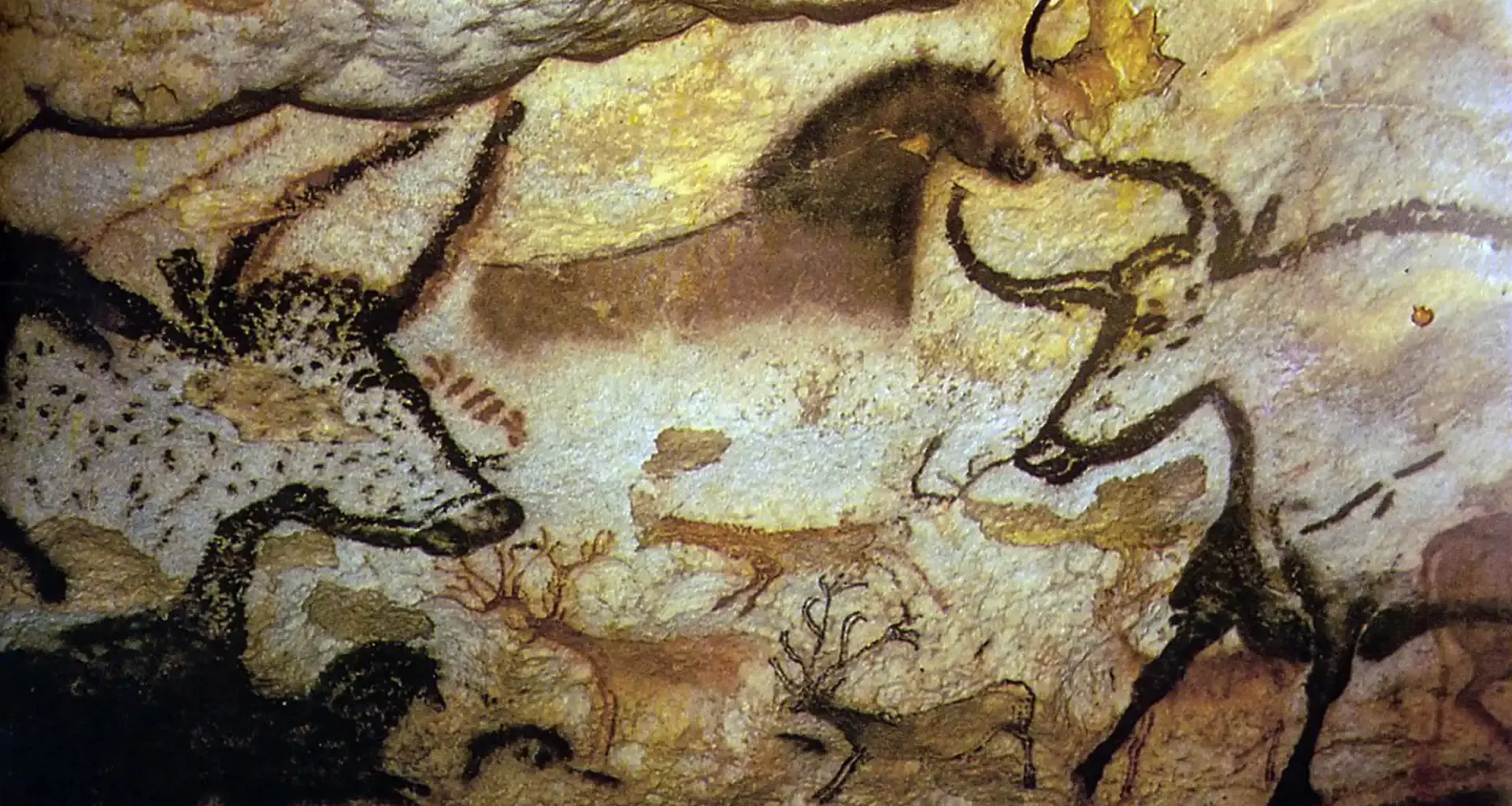
 Cave art from Lascaux Cave, in the Dordogne region of France. It contains over 600 stunning parietal wall paintings and 1,500 engravings created by Upper Paleolithic humans roughly 17,000 years ago. The new study did not use samples from this cave. Credit: Pictures from History
A red dot on a cave wall in Portugal does not look like much. It’s a small mark, crusted over by minerals, easy to miss beside the much more interesting animal figures and hand stencils made by Stone Age people a long time ago.
But from that dot, researchers have recovered something archaeologists had long sought: ancient human DNA from rock art itself.
In a study published in Nature Communications, an international team of scientists reports that cave walls can preserve genetic traces of people who touched, painted, leaned on or otherwise came into contact with them thousands of years ago. This is the first time DNA has been recovered from such a medium.
This means cave walls can now form a new kind of archive, one that may record not only what people painted, but where they moved, touched, and lingered underground.
A Genetic Trace in Calcite
 Pigment sampling at a claviform rock art figure in Tebellín, Spain. Credit: Alberto Martínez Villa
The team sampled 24 rock art panels in 11 caves across Spain and Portugal, including simple red marks, hand stencils in Maltravieso Cave and pigment from Altamira’s famous bison imagery. They used scalpels, drills and swabs under strict contamination controls, often removing only tiny pieces of pigment or calcite, the mineral crust that can form over cave walls.
The key sample came from Escoural Cave in Portugal, on a panel known as Panel 11. The mark was a red ocher dot covered by calcite. That crust may have acted like a seal, protecting traces of DNA from later contamination.
 Calcite fragment with pigment underneath from Escoural, Portugal, stored in a membrane box. Credit: Alba Bossoms Mesa
Ancient DNA breaks and chemically changes over time in predictable ways, so you can use these markers to distinguish it from more recent biological samples. In the Escoural pigment sample, the team found damaged mitochondrial DNA consistent with ancient human DNA. When they checked for animal DNA, they found none.
Cave sediments usually contain DNA from many animals, often more than from humans. If the human DNA had washed in from dirt or water, the researchers would have expected animal DNA too. Instead, the result points to direct human contact; perhaps saliva, sweat, skin cells or another bodily trace.
×
Thank you! One more thing…
Please check your inbox and confirm your subscription.
Not Quite Meeting the Artist
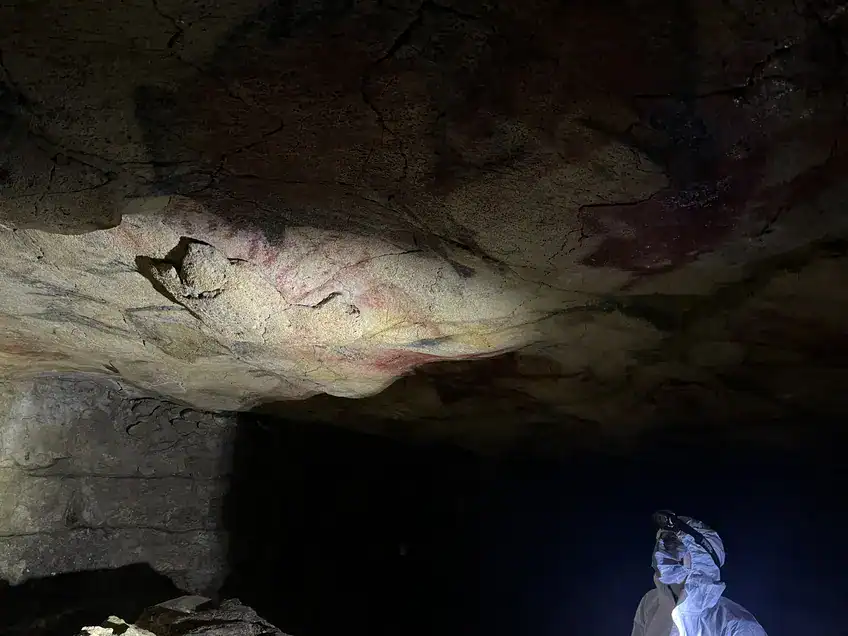 Polychrome ceiling of Altamira from which pigment samples were analysed. Credit: Matthias Meyer
The discovery invites an irresistible question: so who made the cave art?
The DNA could have come from the artist, from someone preparing pigment, or from a later visitor who touched the wall. Even if pigment and DNA sit together, they may not have been deposited at the same time.
The cave appears to have been sealed after the Copper Age (the transitional phase between the Stone Age and the Bronze Age) and was not reopened until 1963, meaning the human DNA from its walls is at least 4,000 to 5,000 years old. Damage patterns suggest it could be older, potentially Upper Paleolithic or later, but the team cannot yet date it precisely.
The researchers also found ancient human DNA on unpainted cave walls: two samples from Escoural and two from Covarón Cave in Spain. Some contained animal DNA, suggesting the material may have arrived indirectly through sediment, dirty hands or water movement.
Nuclear DNA from the Covarón wall clustered with western hunter-gatherers, genetic groups known in Europe between about 16,700 and 5,200 years ago. The team could infer sex for several unpainted wall samples: three appeared predominantly female-derived and one male-derived. The Escoural painted sample did not yield enough nuclear DNA to determine sex.
Only one painted rock art sample produced ancient human DNA. An ocher-coated bird bone from Altamira, likely used as an airbrush to blow pigment onto walls, produced human DNA fragments but not enough damage signal to distinguish ancient DNA from modern contamination.
“This pioneering study expands the boundaries of palaeogenetics by proving that ancient human DNA can persist on cave walls for thousands of years,” Enrico Cappellini, a paleogeneticist at the University of Copenhagen who was not involved in the study, told National Geographic. “However, we must remain cautious, as authentic ancient human DNA was successfully recovered from only a few of the many rock art paintings sampled across the sites.”
Rock art is fragile, and sampling remains destructive, even when researchers remove only tiny amounts. Future studies will need to compare painted and unpainted areas, test better-preserved caves and combine DNA with dating methods such as uranium-thorium analysis of mineral crusts.
Still, the finding adds cave walls to a growing list of unlikely places where ancient DNA can survive.
History in the Walls
In recent years, researchers have recovered human genetic material not only from bones and teeth, but from cave sediment, where DNA can reveal who occupied a site even when no skeletons remain. They have also pulled DNA from handled objects, including a Paleolithic pendant, showing that artifacts can preserve traces of the people who used them.
Cave walls could extend that approach into a different part of prehistoric life. Floors record occupation. Tools record use. But walls may record movement, touch and ritual behavior — the places people reached, painted, leaned against or revisited deep inside caves. If the method improves, it could help researchers map where different groups moved within caves, whether certain panels were associated with men or women, and whether debated art was made by Homo sapiens, Neanderthals or both.
“This is not just about rock art,” said study co-author Hipólito Collado Giraldo, archaeologist for Spain’s Extremadura region. “It’s about understanding how people used caves and where they left their marks.”