
Except the discharges continued, to the point where in all but three of the last 10 years, Haverhill released an even greater volume of so-called combined sewage overflow than it did in 2016, when the consent decree was signed.
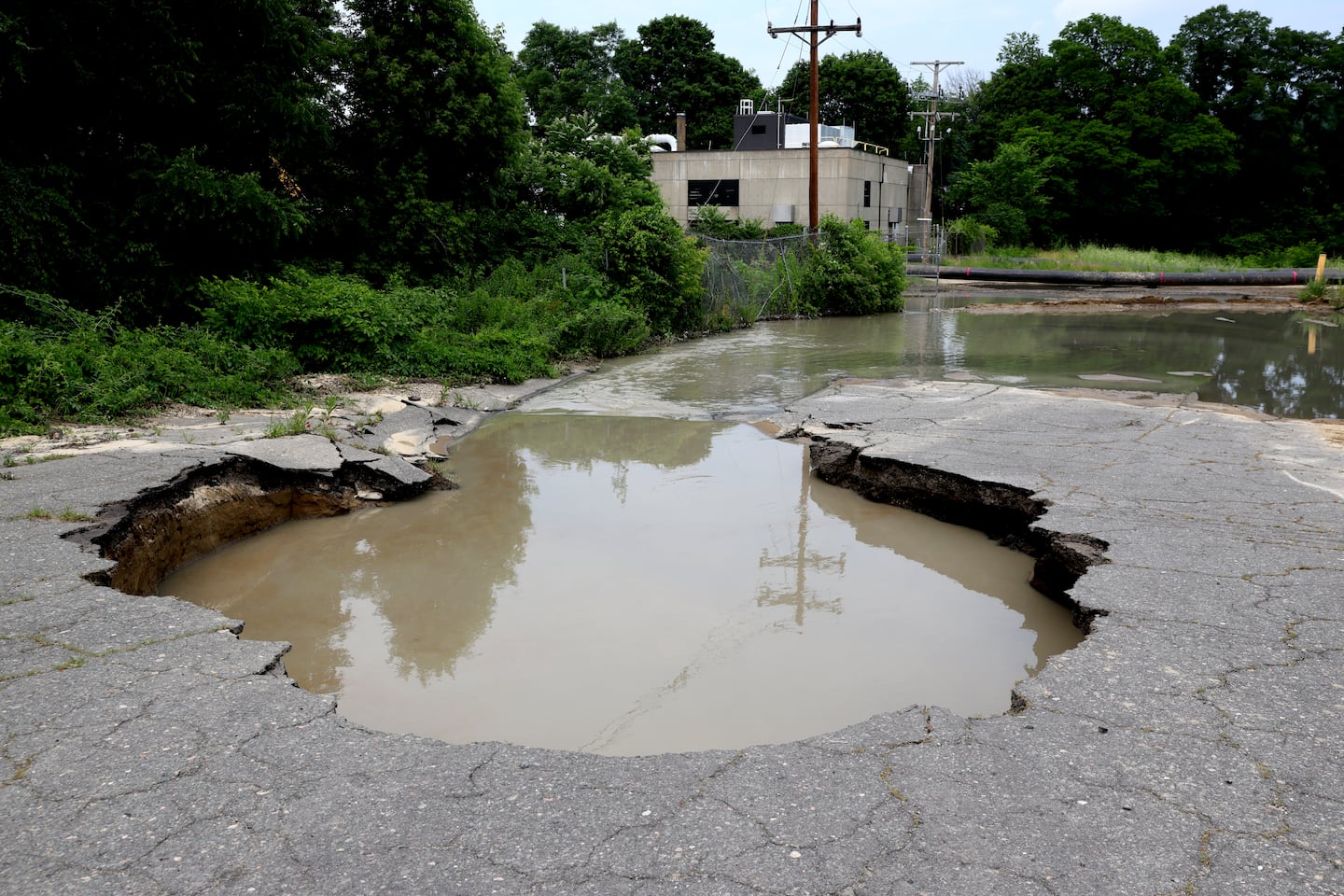
And last Friday, a worst-case scenario came true: The system buckled under the deluge of an evening storm and a 42-inch sewage main near the city’s South Mill Street Pump Station broke in two places.
“This is a result of not putting the funds in earlier on to fix this,” said Heather Govern, vice president of the Conservation Law Foundation environmental group. “It’s an issue that EPA should have dealt with earlier on … with a stricter message that you have to get this done a lot quicker.”
Millions of gallons of untreated sewage flowed into the river before the leak was stopped Wednesday. A barrier held back the solid waste, but polluted waste water forced the closure of beaches in Newport, Salisbury, Ipswich, and Essex to swimming, and led to closures of shellfish fisheries too.
Testing from Monday and Tuesday showed bacteria levels at some locations along the river as high as 40 times the safe level, according to Curt Rogers, executive director of the Merrimack River Watershed Council.
The result: At the very time a punishing heat wave and the 250th anniversary of the country are converging, some of the region’s best beaches were functionally closed. (Two were cleared for swimming late Wednesday after the leak was closed.)
The breakdown was a blow to tourism in the area, to the fishery, and to those hoping to enjoy the long weekend and escape the heat.
“It is a major disruption, we know,” Governor Healey said at a press conference Tuesday. “That’s why we’re going to do everything that we can, and have been doing everything we can, to get this fixed, and to get everything back online as quickly as possible.”
The EPA, for its part, said its priority is to support state and local partners working on the situation and to offer technical support. “As repairs progress on the system, EPA will continue, together with the Massachusetts Department of Environmental Protection, to monitor and evaluate compliance including with the 2016 Consent Decree, making sure all necessary environmental and public health requirements are met,” said agency spokesperson Ellen Frank-Lajqi.
Now that the leaks are fixed, inspectors can start investigating what went wrong. The answer, according to some officials, should be pretty obvious.
“This is what aging infrastructure looks like,” state Representative Andy Vargas wrote in a Facebook post. “The pipe that failed is 1970s-era concrete near the end of its life. This is a problem that runs through many Massachusetts communities, not just Haverhill.”
Indeed, across Massachusetts, many cities and towns are grappling with infrastructure that wasn’t designed for the size of the population or the kinds of rain events that are becoming increasingly common as the climate warms, leading to greater amounts of moisture in the atmosphere and bigger storms.
Because many of these old systems, such as the one in Haverhill, route both storm water and sewage through the same pipes, they can be overwhelmed by a major rainfall and the excess waste water is directed into overflow pipes that empty in streams and rivers such as the Merrimack. It’s either that, or residents would have that polluted water backing up into their basements.
The solution is to separate the lines — one for sewage and another for storm water — or to create large storage tanks that can hold the waste water until a storm has ended, and then treat it after. But both options are easier said than done, because they often cost tens of millions, if not hundreds of millions of dollars — price tags that are often beyond the ability of a smaller community to shoulder on its own.
In 2017, as part of the consent decree, Haverhill identified 28 deficiencies and a schedule for completing them, tabulating that the fixes could cost an estimated $56 million.
In subsequent reports, the city detailed steady progress. For example, in its most recent compliance report, from April, Haverhill reported eight action items remaining, including continued work on emergency response training, and standardization and upgrades at some pump stations.
Also in that report, the city noted a contractor was working on final designs for discharge pipe replacements at the South Mill Pumping Station — the site of the recent breaks.
The federal government has used consent decrees such as the one in Haverhill to push local governments to act, but advocates say that’s only so effective. Without funding, it’s hard to actually make that work happen.
“These consent decrees are huge and overwhelming for any municipality,” said Rogers. “Our perspective in general is, how do we support the towns in getting the funding to make these corrections?”
What often happens, said Govern of the Conservation Law Foundation, is that cities and towns “cry poor,” and say they don’t have the funds for the upgrades, which can cost hundreds of millions of dollars, and the EPA offers some leniency.
“EPA will move the goal line for these towns and cities, and that’s why it sometimes takes 20 or 30 years for these separations to happen,” she said.
That’s been true in Haverhill, where the city occasionally has asked for small extensions over the years. Those have been granted only if there’s a good reason, said Robert Ward, director of Haverhill’s Department of Public Works, and only if it’s clear that the delay isn’t the fault of the city.
But the concern about a lack of funds is real, too, said US Representative Lori Trahan, who said she talked so much about the issue when entering Congress in 2019 that she was known as “the sewage lady.”
“These are extremely expensive projects that can’t be funded or completed overnight,” she said. And the federal government has consistently failed to offer funds for this kind of work.
When Trahan entered Congress, the federal government had a municipal grant program aimed at this problem, but it was not funded. It now has a grand total of $41 million — for all the 800-plus communities across the US with combined sewer systems.
“Over the course of history, the feds have kind of walked away from these federal investments,” said Trahan, who represents Massachusetts’ Third District, which includes Haverhill and other cities along the Merrimack River. “That’s hugely problematic because these are super expensive projects and they’re time consuming. They require a sustained investment.”
Federal funding options are often just low-interest loans, too, which means the city has to lean on ratepayers. In the past five years, Haverhill has received $220 million in low-interest loans from the state, including $50 million this year for the waste water treatment facility and upgrades at the South Mill Street Pump Station.
“We’re trying to balance getting things done with costs, which are ultimately paid for by the ratepayers,” said Ward.
Particularly frustrating, he said, is that the section of the system that broke was scheduled to be upgraded and was included in Haverhill’s capital improvement plan, which they expected to get to in a few years. Other big projects are completed or underway, such as upgrading the waste water treatment plant (with a $60 million to $70 million price tag) and separating sewer lines in some parts of the city (to the tune of $33 million).
The work “is way more extensive than people understand,” said Ward, who has been in the public works department for 31 years.
In a sense, having that many years under his belt is helpful at times like this, when so much goes wrong. Days into responding to the leak, he said his attitude is, “You know what? Stuff happens. We’ll deal with it.”
Sabrina Shankman can be reached at sabrina.shankman@globe.com. Audrey Tomlin can be reached at audrey.tomlin@globe.com. Thai Theodoro can be reached at thai.theorodo@globe.com.