
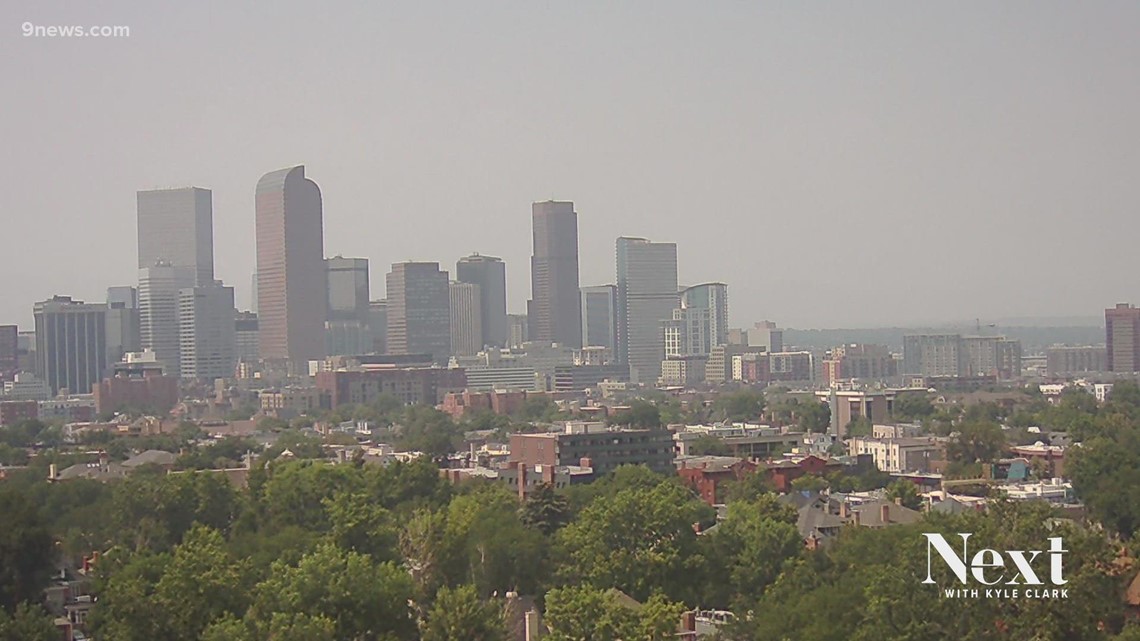
Denver’s air quality ranks among the worst worldwide as wildfire smoke spreads across the West, prompting health alerts from state officials.
DENVER — The air quality in Denver is among the worst in the world Wednesday afternoon.
Denver’s air quality Wednesday afternoon was ranked as the worst in the United States, with an Air Quality Index (AQI) of 102, which is listed as unhealthy for sensitive groups.
As of 4:30 p.m. Wednesday, Denver had the 10th worst air quality among major cities globally. The only countries with worse air quality than Denver were cities in Indonesia, China, Democratic Republic of Congo, Ethiopia, Uganda, Israel, Pakistan, Bangladesh, and South Africa, according to IQ Air.
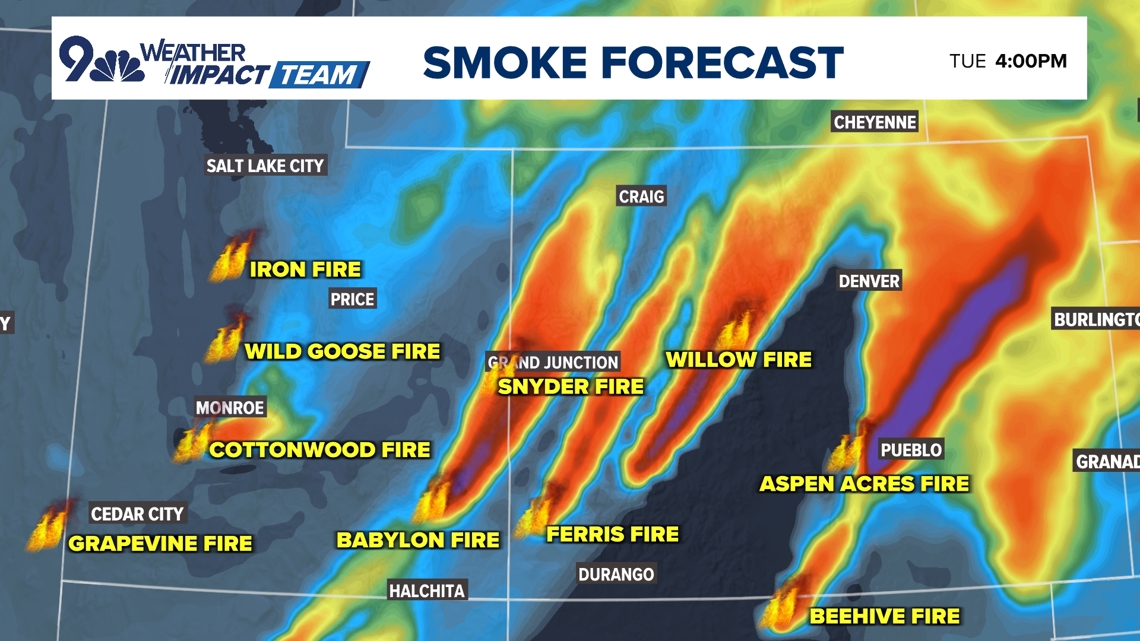
Wildfire smoke from wildfires across the West is impacting several states including Colorado on Wednesday.
Air Quality Alerts
The Colorado Department of Public Health and Environment (CDPHE) issued an Action Day Alert for the Front Range Urban Corridor from Douglas County north to Larimer and Weld counties, including Denver, Boulder, Fort Collins and Greeley areas.
CDPHE said continued hot and sunny weather conditions may allow ozone concentrations to reach the unhealthy for sensitive groups category on Wednesday. The transport of wildfire smoke may increase particle pollution levels.
As more smoke enters the Front Range, it is advised to limit time outdoors, especially for those with heart disease, respiratory illness, the very young and the elderly.
“Wildfire smoke contains fine particles that can irritate the lungs and heart,” CDPHE said in a statement. “People do not always need to see or smell smoke for it to affect their health. Children, older adults, pregnant and postpartum people, outdoor workers, people with asthma or other heart or lung conditions, and anyone exercising outdoors may face greater health risks.”
“While limiting time outdoors helps, fine particles can also enter homes and buildings and adversely impact individuals. When smoke events are widespread and long-lasting, exposures add up. All Coloradans are encouraged to pay attention to how they are feeling and check in on their loved ones, so that you can react to the first signs or symptoms,” the statement said.
“CDPHE’s air quality forecasters are closely monitoring smoke conditions and air quality data to provide timely information to Coloradans and local partners,” said Jill Hunsaker Ryan, executive director of CDPHE. “We encourage people in affected areas to use CDPHE air quality advisories and alerts, as well as the Colorado Smoke Blog.”
Ways to protect against poor air quality in Colorado
Limit time outdoors when smoke is present.Avoid strenuous outdoor activity, including running, biking, or mowing the lawn.Take steps to maintain a cleaner indoor air space:Keep windows and doors closed when smoke is present. Use air conditioning on the recirculate setting, if available.Use a HEPA air cleaner in the room where you spend the most time, if available. Consider spending time at a public space with cleaner indoor air, if you don’t have air conditioning or a HEPA air cleaner at home.Consider wearing a well-fitting N95 or KN95 mask if you must be outside. Check on your friends, family, and neighbors.Check current air quality conditions at Colorado.gov/airquality, Fire.AirNow.gov, or through the AirNow mobile app. Sign up to receive CDPHE Air Quality Alerts via email.Review CDPHE air quality advisories and the Colorado Smoke Blog for current smoke information.
Another hot, dry, and windy day will lead to critical fire weather conditions across the southern foothills and Palmer Divide and through the rest of the southwestern part of the state. Please avoid starting fires. Much of the state will be smoky from ongoing wildfires. #COwx pic.twitter.com/IIgpC3xQ3l
— NWS Boulder (@NWSBoulder) July 1, 2026