
Photo: Courtesy of the subjects
Manage cookie preferences
Zuhair Lakhani has always understood the allure of scarcity. When he was 15, he started sneakerbotting — coding programs that could purchase hard-to-find shoes at lightning speed and then resell them for an upcharge. His father owned phone-accessory stores in Greater New York, but like any brick-and-mortar retailer, was struggling in the age of Amazon. When the pandemic hit, the stores closed for good and the family moved to Dallas, where his father opened a restaurant. So Lakhani, then in his junior year of remote high school, turned to the golden rule of sneakerbotting: If something is really hard to get, people will want it really bad. “Before even taking any reservations, ‘I was like, ‘The restaurant’s sold out,’” he says. “We did reservation drops every Wednesday at 4 p.m. for the next week, and at 4:10, I would just close them.” Within two weeks, the wait list for reservations at his father’s restaurant grew to around 6,000 people —many of whom could expect an imminent call saying that a spot had magically appeared for them.
Lakhani, handsome, hungry, and with a quiet intensity he masks in lowercase X jokes about slop bowls and mogging, is the sort of 21-year-old who is uniquely equipped for the economy of the moment. The world’s most-future-oriented companies are currently seeking “agentic” people— that is, those who don’t ask permission to change things before breaking them. Only a highly agentic human, for instance, could come up with an idea for a start-up nobody asked for.
In October, Lakhani announced Doublespeed and claimed it was the only venture-capital-backed bot farm in America when he received an investment from Andreessen Horowitz, also known as a16z. “Because why let Russia and China have all the fun?” Lakhani asks in his launch video, in which he peels a digital mask off a pretty young woman’s face to reveal his own, sitting in front of a green-lit stack of phones, a cyberpunk set for an explicitly bleak vision. “Never pay a human again,” reads Doublespeed’s website, which advertises the ability to create AI personas on TikTok like a 62-year-old mother in Phoenix or a Gen-Z skater in Atlanta who will then post about your product. The investment was part of a16z’s three-month Speedrun accelerator program, in which young founders with start-up ideas can receive investments up to $1 million from the firm. Peers included “the world’s first AI-powered credit card,” the “world’s largest Netflix-quality AI streaming platform,” and a “Bible-based AI buddy,” which together formed what the tech publication 404 Media called an “AI-generated hell on earth.”
Doublespeed is just one of a growing number of start-ups devoted to fabricating genuine virality online, some of which pay Discord users to create clips of podcasts, make fan edits of movie stars, and post glowing praise of whatever pop star has hired them. Lakhani’s pitch is one step beyond this: He wants not only to manufacture the trends but also to replace the real people involved with an army of AI influencers free of the human need for nuisances like payment or sleep. Clients of Doublespeed can invent a hot girl dancing to the song they’re trying to promote or a man in a lab coat extolling the science behind a skin-care brand. Each account is connected to its own physical phone in order to circumvent TikTok’s bot-detection systems.
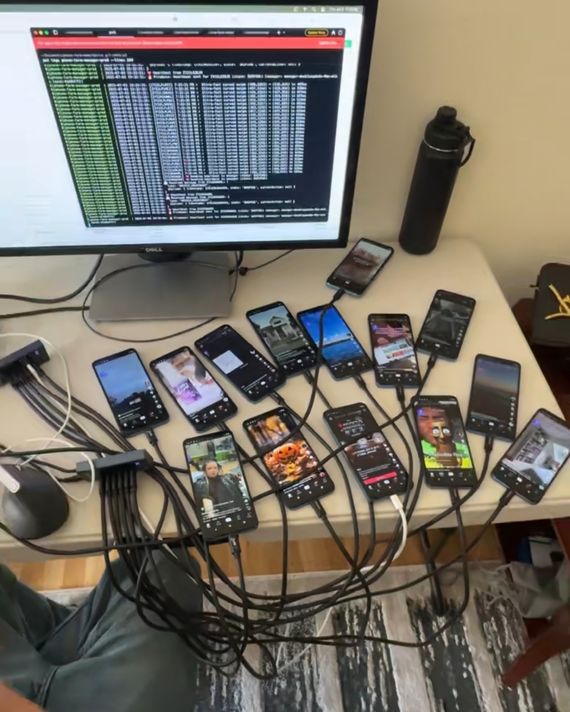
Photo: Courtesy of the subjects
The goals seem to be to titillate his peers and stoke fear in everybody else. Where other tech founders have tried to style themselves as responsible stewards of human morality, Lakhani has shrewdly begun to use nihilism as a marketing technique. “You’ve been watching slop all your life,” he says in the launch video, cutting to a grid of Fox News anchors. “We didn’t break the internet; it was broken to begin with. But now we’re killing it entirely. Welcome to the dead internet.”
Doublespeed is not yet meaningfully contributing to the enshittification of social media (earlier this year, it claimed to be managing a fleet of around 4,500 phones), nor has it reached its ultimate goal of completely agentic AI social-media accounts that can ideate, create, and publish content without human intervention. But Lakhani apparently hopes to make as much money as possible while people still believe he might succeed. The waiting list for Doublespeed grew to 6,000 companies in the first two months of its launch, though it bears repeating that Lakhani has built his career on manufacturing shortages of whatever he’s selling.
“I have no problem leaning into the dystopian feeling of our company. That’s what brought us all this attention so far,” he tells me. “A core belief of mine is that it’s very hard to get attention as a new company nowadays. Even if you raise $50 million, no one’s gonna write about you unless you’re doing something crazy.”
Phone farms are cold, and they are loud. Lakhani and three team members have been living inside one for the past seven months in a bright-white Spanish-style duplex in the middle of L.A. It’s a sunny Saturday in March, and the blast of arctic air and whirring fans greets me as soon as I open the front door. “We’ve all been desensitized to it,” says Hassan Syed, Lakhani’s 29-year-old co-founder and software engineer. What was designed as a living room has been transformed into an open-plan office, four standing desks jammed together next to a whiteboard that ranks each of Doublespeed’s employees on their “aura” points, which they receive by fixing bugs or performing other acts of kindness for the group. “One guy shipped 50 boxes of cookies to another employee. That gave aura on both sides,” explains Lakhani, who is wearing an oversize Ralph Lauren oxford and off-white jeans, his thick hair in Gen Z’s iteration on the butt cut. The Doublespeed crew are quiet and polite, their apartment equally polished. “We have the Nerf gun out right now!” Lakhani says, pointing to a blue-and-orange contraption stacked carefully on a shelf.
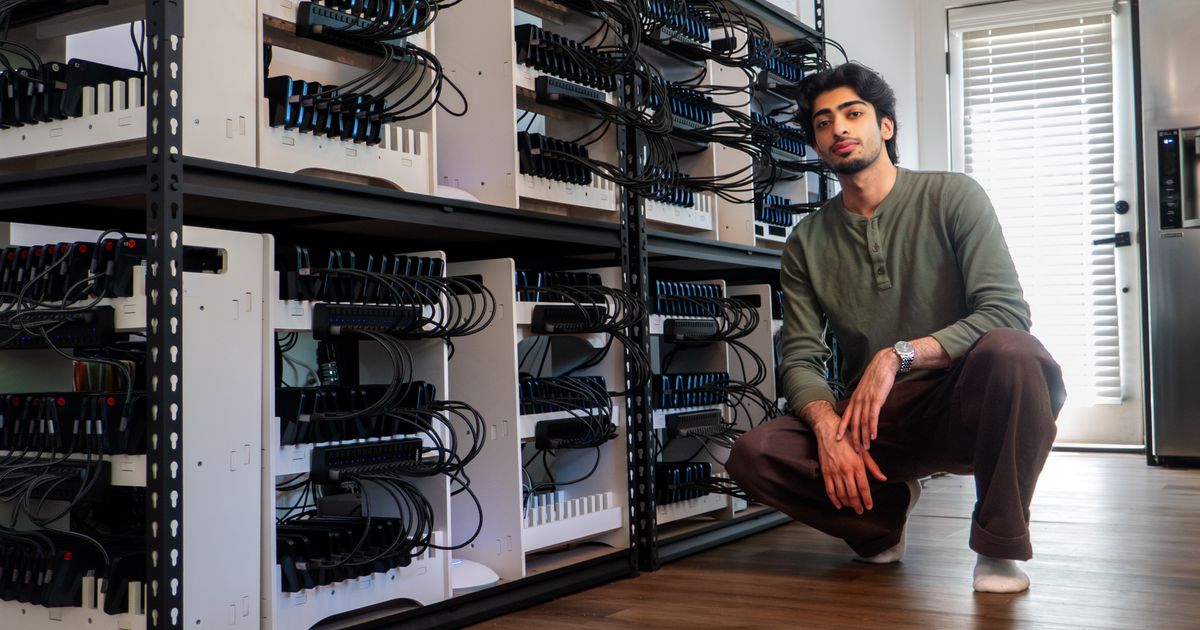
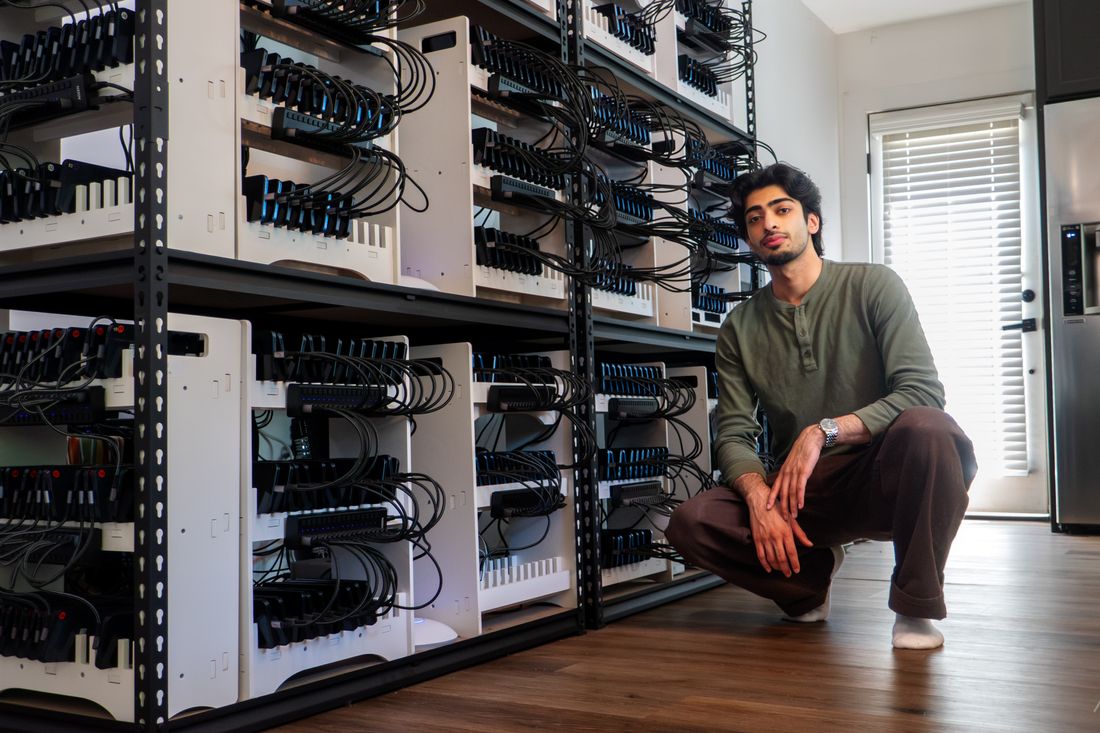
The real work happens in the would-be dining room, where 1,200 smartphones are plugged into a grid system of racks, USB hubs, and color-coded labels. (When I visited, the remaining 3,000 or so of Doublespeed’s phones were stored in off-site locations.) While phone farms are traditionally thought of as click farms — that is, legions of phones operated either by AI or low-paid human workers who earn money by engaging with a specific post to artificially inflate traffic — the livestock on Doublespeed’s farm are creating, not just passively consuming. Each phone is controlled remotely, spending a week or two in a warm-up period in which it creates a social-media account and scrolls through the app the way a human might using an AI agent created by Syed’s team. “So if you come to us and you’re like, ‘I have this tennis racquet I want to sell,’ we’re gonna make new accounts for you on TikTok and warm them up in that tennis niche. We’re gonna make it watch tennis content, comment on tennis stuff, engage with tennis stuff so the algorithms recognize that we are a tennis viewer,” the idea being that when the account starts posting about tennis racquets, TikTok will see the video as more legitimate and serve it to other tennis players; it also helps the agent get data on “what’s currently working in the tennis niche.”
Every single aspect of a phone farm is engineered to trick algorithms into thinking you are not, in fact, operating a phone farm. Zachary Thompson, who runs the 250-phone farm Autoviral, tells me, “On any platform, you want to be cognizant of something called a trust score, which is basically how trustworthy your phone is.” According to him, several factors can weigh against your trustworthiness on an app — a TikTok account on a new or wiped phone that wasn’t purchased in the U.S., for instance, may be less likely to be served to American users, and he believes new accounts are less trustworthy than old ones, though Lakhani claims it “fully depends on the warm-up process.” TikTok, for its part, says it doesn’t give users a simple trust score and that it relies on a “variety of signals” to try to detect spamming and other “inauthentic behavior.” It also denies that newer accounts are necessarily seen as “less trustworthy.”
Most clients pay Doublespeed around $450 per month, which Lakhani says is much less than paying an army of humans to post. “They’re paying college kids like $1,500 a month to do 30 videos,” he says, “plus a manager on top of that.” Lakhani stresses that “slop will not work,” only “tasteful, realistic” content that looks like a human made it. Last year, he posted a tutorial on how to re-create viral videos with Sora; clients are now encouraged to replicate static-image carousels using Claude or use AI video generators like Kling, Seedance, or Veo 3. One tutorial Doublespeed dropped in its Discord last fall suggests creating image carousels with Pinterest-y photos of young women on vacation overlaid with skin-care advice. Doublespeed’s posts are not always labeled as ads, and it’s unclear whether the Federal Trade Commission under President Trump will take any action against undisclosed AI advertisements. (In December, citing conflicts with Trump’s pro-AI executive order, the FTC set aside a 2024 settlement that sought to prevent an AI company from helping people create fake online reviews). Some clients make their own content, and more recently, with human managers overseeing the process, Doublespeed has been using its own AI agents to create clients’ content for them; Lakhani’s ultimate goal is to have AI do it all in an instant.
Lakhani wouldn’t provide me with a full list of his clients, but chatter on Discord between Doublespeed employees and apparent clients indicates they range from a Christian prayer app to a foam roller targeting women over 50. Eliza Wu, co-founder of the map-sharing app Corner, has been using Doublespeed since the fall and compares the service to SEO marketing in the days when Google actually mattered. Now that many young people are using TikTok as a search engine, companies have found ways to rig results. Around 30 percent of Corner’s marketing budget goes to Doublespeed, which operates accounts with names like “where to go out in paris” that then post carousels of hot spots in the five cities that Corner covers. Corner uses AI to create the posts, though not, as of now, AI influencers — but Wu says it might experiment with this in the future “because things are moving very rapidly.” The TikToks, some of which have even made their way onto my own feed, have been the app’s primary growth driver since it launched. “These things sound scarier than they are,” says Wu. UGC creators are already flooding platforms with advertisements, often without disclosure. Chaotic Good Projects, a music-marketing company, was recently accused of creating a “psyop” by using similar tactics to promote certain musicians, such as Geese, whose rise felt organic and special. “The reality is everyone’s doing this, just manually,” she says.
Phone farms have long existed in less wealthy parts of the world, especially in Eastern Europe and Southeast Asia, and only recently have they become popular passive-income schemes for young U.S.-based entrepreneurs. Americans’ ideas of phone farms (“troll farms”) tend to involve political-influence campaigns like those practiced by Russia’s Internet Research Agency or the “pig-butchering” scams to catfish money from lonely and unsuspecting people. Thompson’s co-founder Ayo Mosuro has one idea why the U.S. was slower to embrace botting: “Platforms favor us,” he says. “Back in the day, I don’t think you had to rely on phone botting or pushing yourself on the algorithm as much as you do now.” There is a sense among many in the space that these days, the only way to get a message out on social media is to co-opt the methods used by the three earliest adopters of social-media manipulation: dark-money political campaigns, gambling, and, of course, porn.
From the earliest days, Lakhani has been trying to make Doublespeed feel, as he says, “dystopian.” “We don’t run UGC campaigns, we run propaganda campaigns,” he tweeted recently. His mentors at a16z advised against this, he says (in 2023, the company famously published a 5,000-word “manifesto” by its founder Marc Andreessen arguing that technology has made the world wonderful and that AI will only make it better). “They were like, ‘Are you sure about this?’” he says. “Whatever. They didn’t understand the vision.” (a16z did not respond to requests for comment.) When Doublespeed launched in October, the internet reacted predictably, flooding X with criticisms that its practices seem to violate all the major social platforms’ terms of service and with more existential concerns about the internet’s slopification. Even music’s leading techno-optimist, Grimes, quote-tweeted a post about the announcement with a blithe “I see.” Lakhani received death threats, but, he says, they “honestly kinda made me happy that my plan worked.”
Not all of the attention went as intended. Within months, Doublespeed was reportedly hacked, first in December, when a hacker claimed to take control of more than 1,000 of the company’s smartphones, then again in April, when another attempted to use the phone farm to spread a meme that read, “a16z is the antichrist, sponsored by doublespeed.ai,” though the memes were never posted. Lakhani denies its phones were breached and says Doublespeed’s clients and their data remained secure and unaffected. Since then, he has only fueled the fire with his tweets, calling human creators “UNSUSTAINABLE” in their unreasonable demands and flakiness. AI, meanwhile, “never misses a post and always listens to brand guidelines,” he wrote. It’s difficult to take him exactly at his word; his other posts range from deathly earnest (“You NEED to start LIVING with conviction”) to the sort of insouciant trolling common among tech folks hoping to grab the attention of the wealthy and powerful. “Every minute spent watching a show or a movie is a minute that could’ve been spent vibe coding,” he wrote last spring, and one month later, he wrote “It’s 6:04 on a Friday. You are out getting drinks with friends after a long week. I am at the ER automating 50 tiktoks for the weekend. We are not the same.” (He was actually in the ER; he’d fainted and would soon be diagnosed with a heart condition, though the post was obviously tongue-in-cheek.)
Lakhani took a similar approach to Doublespeed’s branding in our conversations. At several points, Lakhani hints at ways I could generate interest in this article. “If you guys make it dystopian, it’ll really work out as a good story, I think,” he says during our first video call. “If you need any juicy content ideas, we can definitely help manufacture those as well,” he tells me at the phone farm. Later, he sends me an email with ideas for headlines using words that have “proven to be good hooks in the past,” which include “The 21-Year-Old Making Millions Selling Fake People,” “Propaganda As a Service: The Tech Frat House Running Your Feed,” and “The USC Dropout Selling Your Attention for Millions.”
These, admittedly, are not terrible headlines, if only they were true. Lakhani would not share revenue figures for Doublespeed aside from claiming that, for some stretch of the past year, the company passed a $1 million yearly run rate, a metric that estimates future revenue based on data from a short time period but does not necessarily correlate to annual revenue. Nor does Doublespeed’s headquarters resemble anything like a frat house; the four-bedroom apartment in L.A. was absolutely spotless when I visited; personal items around the house included smoothie ingredients, a chessboard, and the Quran. Neither the founders nor the employees I met say they have any interest in partying or dating; their preferred vice is DoorDashing cookies. “We used to go ham on Beverly Hills cookies. It was like $6 per cookie,” Lakhani says, though at the time of my visit, they were more into Levain; they’ve since moved on to MeloMelo coconut jelly.
Their politics are somewhat confounding; Lakhani claimed that the first people to reach out to him about working with Doublespeed were politicians. Though he has said that Doublespeed doesn’t support “political efforts,” when we speak he hedges that this isn’t necessarily a promise. What the company firmly refuses are clients looking to promote gambling sites or OnlyFans accounts, which it gets requests for about three times per day. “It’s extremely lucrative,” Lakhani says. “It’s maybe tempting at times, but we want to do the right thing here as well. We understand how powerful what we’ve built is and the responsibility that comes with that.” Though part of the company’s reticence to work with OnlyFans clients is due to its founders morals, TikTok also does not allow users to promote OnlyFans or link to adult websites, so any content Doublespeed makes for a client would be against the platform’s rules (though, again, technically all of Doublespeed’s content breaks TikTok and other platform’s rules, and Lakhani says many users are able to get around the adult-website ban). Like many tech founders their age, the pair is immensely skeptical of the two industries that dominate young male users’ feeds via their own bot farms and UGC content creators. “We’re in an epidemic where every single college-age boy I know is addicted to gambling and prediction markets, and it definitely puts a big fear in me,” Lakhani says.
In between asking support questions or wondering when the waiting list will send an approval, people in the discussions on the Doublespeed Discord sometimes veer into similarly philosophical directions. “I want to use this service just to contribute to the enshittification of social media. Would love to see this service become mainstream and create so much slop that people push back from social media use entirely,” wrote one member in October. “Let’s go kill the internet, to be honest best time to replace woman,” replied another. One member had loftier goals: “We also have a really funny opportunity to band together and use this to actually spread helpful, rational, non-sensational, non-dividing, educational information and flood the internet with useful media to suppress the brain rot and save our society’s mental health and culture if we band together and commit to this cause. And the best part is because of pure volume it will be just as profitable. Instead of killing the internet we can save the internet.” Said another: “Nah it’s already dead. Kill it with fire.”
Toward the end of my visit, the topic turns to the unsettling vibe in tech more generally. “I’ve never felt more uncertain about the future,” says Syed when discussing the recent layoffs at Block and other major companies. Rahim, an employee who built the physical phone farm and also lives in the house, guesses it’s only a matter of time before AGI or robots shake everything up all over again. I offer that I personally can’t wait for robots because I’d love to never scrub the bathtub or do laundry ever again. “But then there’s the human purpose aspect of it,” interjects Lakhani, looking pensive. “If all your work is done for you, what do you have to live for?” I ask him what his answer is to this question. “I’m not sure. I think this will become an existential thing, because if a robot’s doing all your work, you can’t even show you care about your family. Cooking for someone is an act of love. If a robot’s doing all your tasks, you don’t have any reason to show that anymore.”
For all his talk of making the human internet irrelevant, it’s clear that Lakhani considers himself just as much of a visionary as the influencers his company seeks to replace. He loves working with music labels “because we get to be creative instead of just pushing a product” and hopes to do more with fashion brands. Much of what drives him and other founders is their ambition to become a tastemaker, for others to take seriously their vision of how the world should look or, at the very least, what people should buy.
I asked Lakhani what happens when the day comes when all social-media profiles must be human verified, which several platforms are currently pushing for. “You’ll license your likeness,” he says. “The farms will still exist; they’ll just operate human accounts, but it’ll still be AI-made content.” A world in which everyone is theoretically a stock-photo model that can be animated to say and do whatever a brand wants is a grim one, but it is also sort of the current one. Lakhani bears it with a shrug and a sense that dystopias are merely opportunities to be exploited. “Get used to it,” he says when I ask about his response to critics. “This is what’s already happening. It’s more like, ‘You fell for it? Haha.’”