
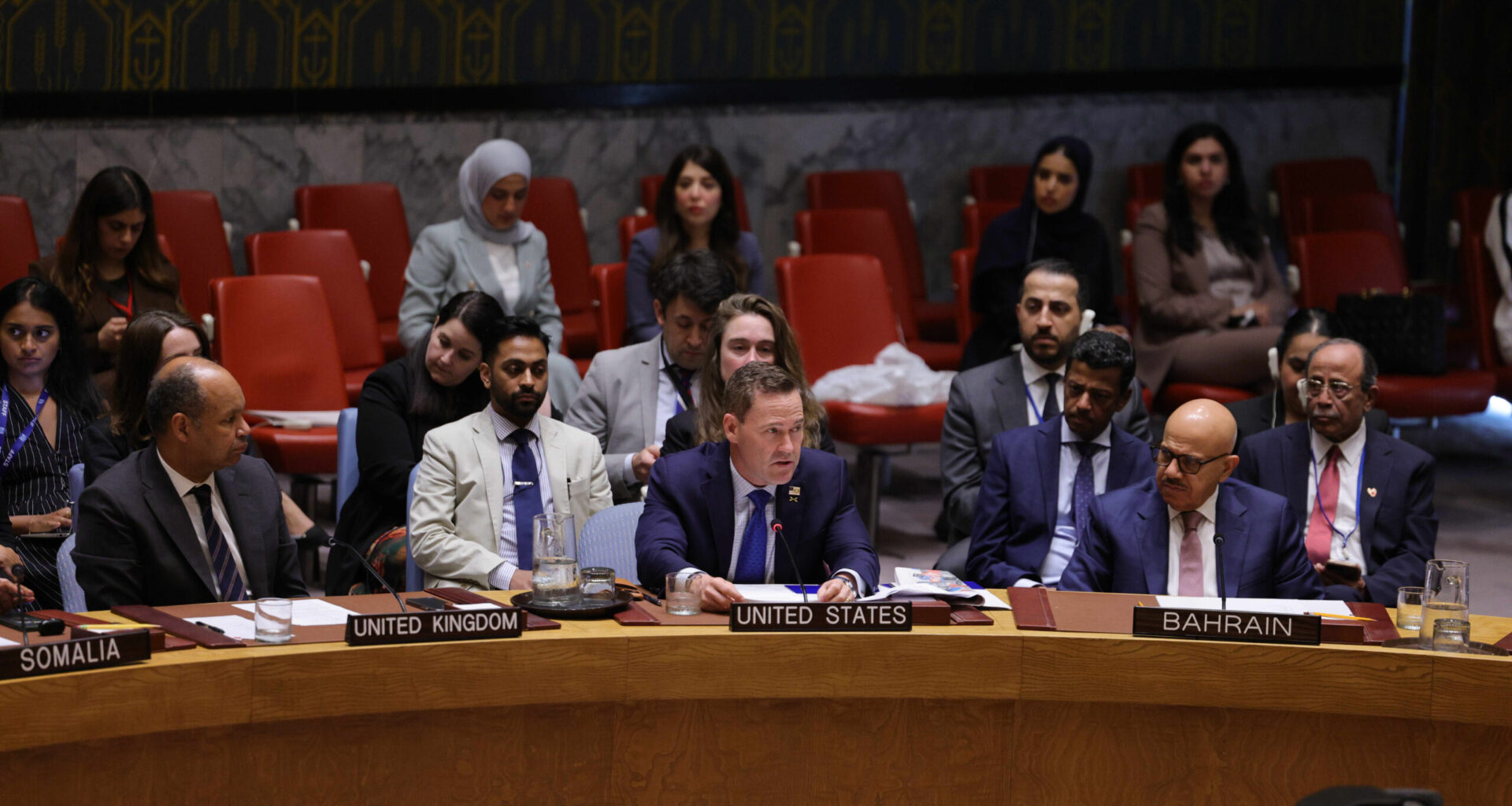
Ambassador Mike Waltz
U.S. Representative to the United Nations
New York, New York
AS DELIVERED
I want to congratulate the DRC for its presidency, and I would like to welcome once again Foreign Minister Al Zayani to the Council. And thank you, Assistant Secretary-General Spehar, for your briefing.
Colleagues, three months ago through Resolution 2817 led by the Kingdom of Bahrain, this Council stood with our friends in the Gulf without opposition, as their hospitals, as their airports, energy infrastructure, resorts were under blistering fire from Iranian drones and missiles.
And, I’ll tell you, personally, on a personal note, I was just in the Gulf, in the Kingdom, along with United Arab Emirates and other partners that have been indiscriminately struck by Iran, their civilian infrastructure repeatedly damaged. I visited some of the locations that the Iranians have hit, and if you have any doubts about Iran’s intentions, I encourage each one of you to go, go and talk with the Bahrainis, visit Manama, visit Abu Dhabi and other locations.
They didn’t just, kind of, fire off a bunch of missiles and drones, hoping that they would hit a few targets. It was deliberate, it was well planned, it was malicious.
I visited the Bahraini Petroleum Company, where I saw where Iran very precisely targeted the fire suppression lines first. They then targeted first responders, so that they could not respond. They targeted a site literally in the middle of a neighborhood. Fortunately, the drone didn’t explode. It would have potentially killed two to three thousand families in a massive, massive explosion.
But they did this in a way to maximize damage. Even when they hit fuel tanks, they targeted the largest fuel tank and was sure to hit the bottom of the tank rather than the top, so that it fully drained, and again the fire suppression apparatus, the safety apparatus had been destroyed, and the first responders, even the fire men and women, had been attacked, so that they couldn’t put out the fires.
They even aimed at chemical storage areas, again, where direct strikes could have killed thousands of innocent people in what Iran will, I’m sure, their representative today, will call neighbors and, colleagues, that’s not how you treat neighbors in my neighborhood, where I come from.
Meanwhile, they’ve stopped every ship from transiting the Straits of Hormuz, and it didn’t matter if the ship was carrying fertilizers to farmers in Africa, aid to Sudan, fuel to Japan, whether they were involved in this conflict or not. We’ve heard talk today of root causes. I don’t think farmers in East Africa were involved in root causes. Civilian, military didn’t matter. Iran sought to punish the world, all of us, all of you. People who had no interest, no party, even no knowledge of their nuclear aspirations.
Just this week, the UN Trade and Development agency found that Iran’s closure of the Strait of Hormuz will have lasting effects on 61 developing economies. Again, let’s go back to the talk of root causes from our Russian colleagues. Okay, hit back on military sites, fire back on United States bases in the region, fire back on Israel, even. But 61 developing countries that will suffer now, or their crops won’t grow, because Iran sought to indiscriminately and seeks to indiscriminately punish the world because of their views in this conflict.
Iran cannot and we cannot allow it to hold the world’s economy hostage. So many innocent civilians around the world are being affected.
So, as a response, Bahrain, our Gulf Arab allies, and others rallied a record-breaking 136 co-sponsors who spoke with one voice: Iran must stop its attacks on its neighbors and leave an international waterway, the Straits of Hormuz, open for all.
Our friends in the Gulf have rallied another 143 co-sponsors on a separate draft resolution circulated in May that once again calls on Iran to stop its illegal mining. We can’t just throw mines, whether it’s on land or in the sea, in response to a conflict, illegal tolls, and respect international law for free passage for all.
So, we’re here today because despite the diplomatic achievements and agreements, Iran still hasn’t shown the world a basic level of decency and respect. Instead, they openly defied this Council, their neighbors, and basic tenets of diplomacy.
Members of this Council told Iran: stop the attacks, open the Strait. Iran’s neighbors respectfully asked Iran: stop the violence, open the Strait. Even their closest partners told them privately: stop the mining, stop the tolling, and open the Strait.
And, just two weeks ago, the United States signed a Memorandum of Understanding with Iran. It’s most basic premise: the Straits, an international waterway, must be open, attacks on civilian shipping must stop.
And we are here today because Iran ignored that.
Last week, Iran fired missiles and drones at civilian infrastructure in Bahrain and Kuwait. Why? Why?
They also fired at commercial vessels transiting Omani territories.
So, again, we just heard, well, Iran has a has a right to defend itself. Okay. Do they have the right to attack Kuwait and attack random civilian ships flagged by Panama and Singapore in international waters? Is that a right under Article 51 of the UN Charter? I would think not.
So, again, let’s be clear, what happened here after 136 countries told Iran to stop, Iran fired again after its neighbors pleaded for de-escalation. Iran fired again after United States sat down for weeks and pursued diplomacy at the highest levels. The Vice President of the United States signed a Memorandum of Understanding. Iran fired again. And after the Iranian people dared to speak out for a new Iran, the regime battered its own people, and they’re still spending millions on internet suppression. Why?
As an aside, as a tragic aside, executions in Iran have surged. Despite the internet blackout, we know this. Javad Zamani, Abolfazl Saedi, two students, young men, were just executed 10 days ago in Iran. You know their crime? As it was rammed through a revolutionary court with no representation, their crime was “waging war against God,” that was their crime, that’s the crime.
And I look at their representative, I don’t know how he lays his head on his pillow at night, but whatever false choice the Ayatollah’s cronies present him, it’s not the only choice.
Amnesty International says these protesters are still the ones who weren’t the 40,000 who weren’t machine gunned in the streets in the period of one weekend. Amnesty International says they’re being held in secret, they’re being tortured into confessions, they have no counsel, and in some cases, being publicly hung to send a message.
There’s an old scripture that says: “I have set before you life and death, blessing and curse.”
Iran cannot keep choosing death and curse.
And today we once again urge Iran to revert to the path of peace and dialogue. The world is not with Iran. Iran’s own people are not with this regime, its neighbors are not with this regime.
Colleagues on this Council and all responsible nations, it is a time for choosing, and please make your stance clear. These attacks are fundamentally unlawful. They are inconsistent with the Memorandum of Understanding, and they are certainly in violation of this Council’s Resolution 2817 and they’re a disservice to the future of the Iranian people.
I cannot stress enough the possibility of real transformative positive opportunity for the nation and people of Iran is on the table, but President Trump’s patience is not unlimited. The world cannot continue to suffer, and Iran must abide by its obligations to this Council that this Council voted for without opposition, and the world must hold this regime to account.
I thank you.
###