
Robin Byrd couldn’t decide whether to go naked.
She had spent her career in front of the camera in a thong bikini, hosting the bawdy New York City cable-access television show that bore her name. But that ended nearly three decades ago. Byrd, now 71, was being asked to walk naked on a beach during the filming of a documentary about her life.
“In people’s fantasies, they see me in the crocheted bikini,” she said in an interview, recalling a signature look that included her “beautiful butt and the boobs and the push-up bras and chaps.”
“And I don’t see that anymore,” she said. “I didn’t want to let them down.”
The hesitation to bare all might surprise fans who watched Byrd juggle performers’ breasts, mimic oral sex or poke a penis in her eye on “The Robin Byrd Show,” the late-night show that she hosted from 1977 to 1998. But sitting in the back of Julius’, New York City’s oldest gay bar, last month, Byrd reflected on the through line of her career: She has never been anyone but herself.
“I’ve been telling people for years to love your body,” Byrd said. Now, she said, “I’m like a Rodin.”
Her journey from runaway teen to trailblazing television personality is the subject of a new documentary, “Bang My Box: The Robin Byrd Story,” which premiered at Tribeca Festival in June and is now streaming on HBO Max.
Over two decades, Byrd brought strippers, soft-core pornography and eccentric New York City characters into Manhattan’s living rooms. For many fans, Byrd was a teacher, imparting sexual wisdom and also sex education, particularly around the AIDS epidemic when few others were talking about it. But her show also offered comfort.
Before Howard Stern, Jenna Jameson or Dr. Ruth, and before terms like “sex positivity” and “inclusive spaces” entered the lexicon, there was Robin Byrd.
“She provided almost like a porn version of Mr. Rogers,” said Michael Musto, the longtime Village Voice columnist who was an occasional guest on Byrd’s show. “She was our friend, she was always there for us if we didn’t have anybody. But she was also going to bring an X-rated burlesque revue.”
New York State law and the city’s cable franchise agreement prevented operators at the time from censoring sexually explicit material on cable television except for programming that was deemed to be obscene. That gave Byrd the freedom to create a bawdy, anything-goes show that was an embodiment of a now-bygone era of sexual permissiveness in New York City.
Whatever brought you to Channel 35 on Manhattan Cable (and later Time Warner), Byrd always invited viewers in her opener to “lie back, get comfortable, snuggle up next to your loved one,” sometimes as she applied lip gloss or powdered her face. “And if you don’t have a loved one, remember you always have me.”
Byrd was born in a hospital on the Upper East Side of Manhattan and adopted at birth. She grew up visiting her father’s antique store in Midtown, where the clientele included entertainers like Liberace and Jackie Gleason. But after he died, an already uneasy relationship with her mother deteriorated further, and she left home at 13.
“I wasn’t part of her ribs, so to speak,” Byrd said. “It was easy for me.”
She slept in Central Park for a few nights before moving in with her girlfriend and her family. Byrd got her G.E.D. and went on to study art at Manhattan Community College, marketing at Baruch College and art at the School of Visual Arts, where she worked as a nude model for art classes to make money.
Her friends suggested that, if she was comfortable being nude, Byrd should enter a “Miss Bare-All America Contest.” High Society magazine saw her entry and asked her to pose for its Christmas issue. Byrd went on to appear in several pornographic films, including “Debbie Does Dallas” (1978).
In 1976, a porn producer asked her to be a substitute host for a New York City leased-access cable program called “The Hot Legs Show.” A year later, she renamed the show after herself.
“I may be a great businesswoman to everybody but it came by chance of knowing my worth,” Byrd said.
Byrd had a hand in every part of the show: hosting, recruiting, directing, editing, lighting. The show took advantage of a new live call-in technology to engage with the audience. The calls were put through unfiltered.
“There was nothing like it” Byrd said. “I didn’t want to see television late at night talking about death and murders and crime and the New York City streets. I wanted to turn you on and tuck you in. I felt that I wanted to change the look of television.”
She also created a signature look for herself. Byrd didn’t want the trouble of having to figure out what to wear every week, so she kept it simple:a crochet bikini and cowboy boots. She even wore the outfit during a segment called “Modern Woman,” which focused on nutrition, exercise and health.
“We weren’t talking about bodies, women weren’t talking about sex, women weren’t talking about how they wanted good sex,” she added. “I just had the vessel of television.”
The wild west of cable-access television was the perfect home for “oddballs and fabulosities,” as Musto put it. And Byrd, he said, was the queen of them all.
“She anchored it with her persona, a wonderful laugh and her wisdom,” Musto said. “It seemed to be set in some netherworld, some wonderful netherworld that you could escape into.”
When Musto finally met Byrd at the Roxy, a popular gay club, in the 1990s, he almost collapsed with excitement. “It was like meeting Liz Taylor,” he said.
But Byrd became a target of a national censorship campaign that reached the U.S. Supreme Court. In 1996, the justices ruled in her favor, after Time Warner tried to scramble sexually explicit shows so that subscribers would have to request access to them.
In the process, Byrd became an “accidental activist,” said Stephanie Schwam, who directed the documentary with Jyllian Gunther.
“She never had a manifesto, she never had a political agenda,” Schwam said. “She just followed her instincts and her instincts were just naturally really radical.”
Gunther, who grew up in New York City watching “The Robin Byrd Show,” said there was “something very modern” about Byrd “because she had this direct, unmediated relationship with her audience.”
The documentary’s title is a nod to “Baby Let Me Bang Your Box,” the song she sang (or lip-synced to) at the close of every episode. She happily sang along as it played at Julius’, her signature mop of once-blond hair now gray, but still bopping to the beat.
The show went off the air in 1998 as the internet was taking hold and as Time Warner kept moving the show farther up the dial (you can still find reruns on Channel 1820 on Spectrum in New York).
Today, Byrd spends much of her time looking after her husband, Shelly Byrd, who has dementia. The couple have been together since 1974, and married since 1983. Shelly was a quiet behind-the-scenes presence throughout her career. Now, she says, it’s her turn to take care of him.
“He’s a Cancer, I’m an Aries, so I’m the boss,” she said. “And that’s what attracted him to me. I like to say he’s the woman I always wanted to marry.”
Byrd splits her time between New York City and Fire Island, which provides a balance for a girl who was “raised on the streets,” as she puts it. In summer, the beach and the birds feed her soul. In winter, Central Park is her backyard.
“I don’t fit everywhere,” she said. “People always say, ‘Oh, you’re so Californian.’ And I’m like, really? Or, I’m so European because I’m so free with my body. But no, I’m a New Yorker.”

Remy Tumin
Breaking news reporter
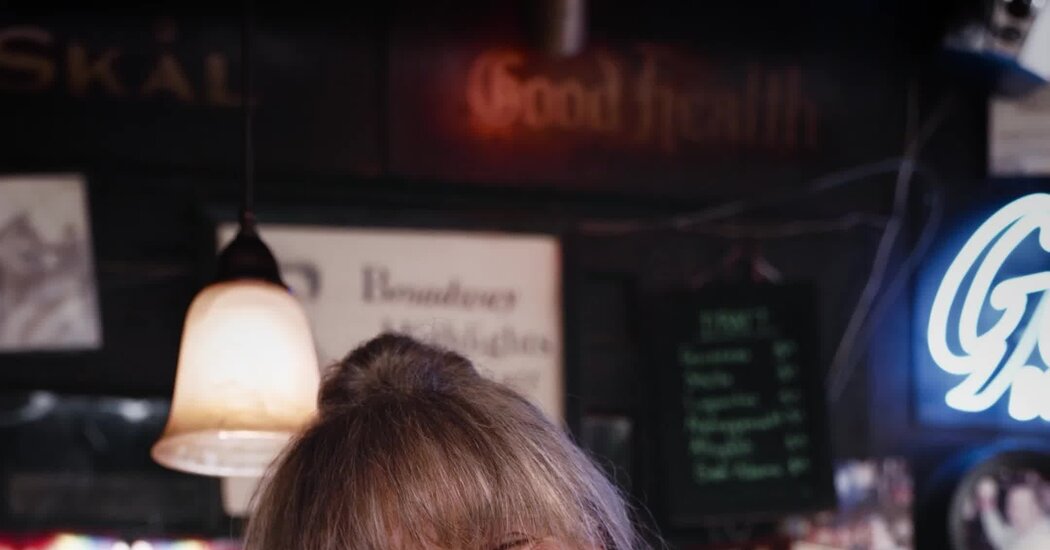
I met Robin Byrd at Julius’ in the West Village, New York City’s oldest gay bar which aired Byrd’s show regularly for customers and became a frequent hangout for the TV personality. “If this space could talk,” she told me as we sat down on a hot June day.
Remy Tumin
Breaking news reporter
I grew up watching (OK, sneaking) Byrd on television as a pre-teen in Manhattan and was surprised by the tenderness a new documentary about her revealed. When I told her as much, Byrd said she has always refused to live up to anybody else’s expectations. “You have to let your freak flag fly.”