
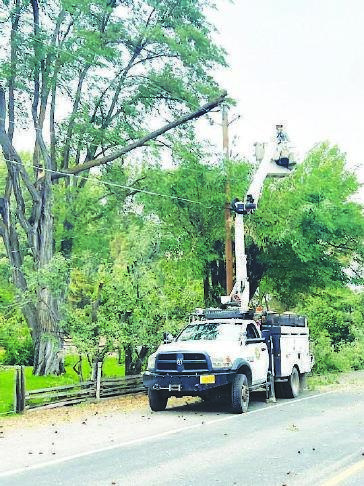
BAKER CITY — Oregon Trail Electric Cooperative announced on Thursday, July 2, that it will not pursue a proposed purchase of PacifiCorp’s service territory in Wallowa County.
OTEC, the Baker City-based cooperative, announced March 19 that it had a non-binding agreement with PacifiCorp for the acquisition.
But on Thursday OTEC issued a press release that stated: “After completing thorough due diligence and assessment over the last four months, both organizations have mutually determined that the potential transaction would not be in the best interest of either
electric service provider. OTEC and PacifiCorp have a strong working relationship and will continue to operate as neighboring utilities.”
The withdrawn deal would have added 5,500 residential, irrigation, commercial and industrial customers to OTEC.
Lea Hoover, OTEC’s director of member and strategic services, said in a previous interview that PacifiCorp had approached OTEC officials to suggest the cooperative buy the company’s Wallowa County service area.
OTEC, which was created in 1988 in Baker City, has about 24,000 members in Baker, Union, Grant and Harney counties, a total of 33,000 meters.
The Wallowa County proposal was the second major possible acquisition OTEC had announced early this year.
On Feb. 19, OTEC announced that it planned to buy Idaho Power Company’s Eastern Oregon territory.
The proposed $154 million deal, which OTEC continues to pursue, would be the first major expansion of OTEC since it was formed in 1988, would add about 20,000 members to OTEC’s rolls, including about 2,900 meters in Baker County.
(There are more meters than customers, since some customers, such as farmers and ranchers, have multiple meters, for homes, outbuildings and irrigation pumps.)
Idaho Power’s service area in Oregon includes parts of eastern and southern Baker County, including Richland, Halfway, Oxbow, Huntington and Unity.
The company also has customers across Malheur County and in parts of Harney County.
Oregon residents make up 3% to 5% of Idaho Power’s customers, with the rest in Idaho, including the rapidly growing Boise metropolitan area.
OTEC’s members are in Baker, Union, Grant and Harney counties.
On May 20, OTEC and Idaho Power filed an application with the Oregon Public Utility Commission for OTEC’s acquisition of Idaho Power’s Eastern Oregon territory.
The parties are asking the PUC to approve the deal by Feb. 20, 2027.
The application states: “The Transaction is consistent with the public interest and will result in no harm to Idaho Power’s former Oregon customers. It will also eliminate and avoid unnecessary duplication of facilities; promote the efficient and economic use, development and operational safety of the Parties’ utility systems; and provide adequate and reasonable service to all territories and 5 customers involved in the Transaction.”
OTEC is represented in the PUC application by Portland law firm Cable Huston LLP and Hawley, Troxell, Ennis & Hawley of Boise. Idaho Power is represented by a company attorney and by the Portland firm McDowell Rackner Gibson PC.
Hoover said in February the proposed acquisition will help OTEC keep its rates competitive even as inflation and other factors increase the cooperative’s costs.
“The economies of scale we’re going to see is the real benefit,” Hoover said in an interview on Feb. 23.
She said OTEC would finance the deal with Idaho Power by taking out a loan from the National Rural Utilities Cooperative Finance Corp., the same Virginia bank that provided the initial $33 million loan for OTEC’s creation in 1988. Hoover said OTEC officials, after analyzing the transaction, believe revenue from its new members would cover the loan repayments.
OTEC paid off the $33 million loan about two years ago, Hoover said. She expects repaying a loan for the Idaho Power deal would take 25 to 30 years.
Hoover said Idaho Power officials proposed the deal with OTEC. Officials from the two utilities started discussing details in the spring of 2025.
The proposed sale includes Idaho Power’s customers, and some of its lines, in Oregon, but none of the company’s power-generating facilities, which include Hells Canyon, Oxbow and Brownlee dams on the Snake River. The transaction also doesn’t include the Boardman to Hemingway 500-kilovolt transmission line Idaho Power is building now.
Rates increases
Both Hoover and Sven Berg, an Idaho Power spokesperson, said in February they don’t expect dramatic changes in bills, for OTEC members or Idaho Power customers who would join OTEC, as a result of the proposed deal.
Both companies cited a 2024 survey from the Edison Electric Institute, which found the monthly bill for a customer using 1,000 kilowatt-hours was $116.27 for OTEC, and $118.60 for Idaho Power.
Hoover said on Feb. 23 that those figures are for the entire bill — including the cost of electricity used as well as the delivery charge, franchise fee and other fees.
She said the utilities calculate bills differently.
Idaho Power charges higher rates as customers use more power, for instance, while OTEC bills include a delivery charge of $38.50 per month for residential customers, Hoover said.
According to the application filed with the PUC, Idaho Power, if the OTEC purchase doesn’t happen, would have to boost its rates for Oregon customers in 2027 by about 17.6%. The company hasn’t increased its base rate for Oregon customers since 2024.
An OTEC rate increase due to the purchase would be “less than one-third” of the projected Idaho Power increase, according to the application, which states that the transaction “is expected to provide a lower and more stable, long-term, rate trajectory for OTEC member/owners” in the Oregon areas that Idaho Power serves now.
According to a joint press release from OTEC and Idaho Power on May 21, OTEC would increase rates after the sale by approximately 5.7% compared to Idaho Power’s current rates for its Oregon customers.
“Either path forward requires some rate adjustment to reflect the current cost of service,” the press release states.
The application states that “Over the long term, OTEC expects to provide electric service at a lower cost than Idaho Power due to its cost-based rates, tax-exempt status and its access to lower-cost of capital.”