
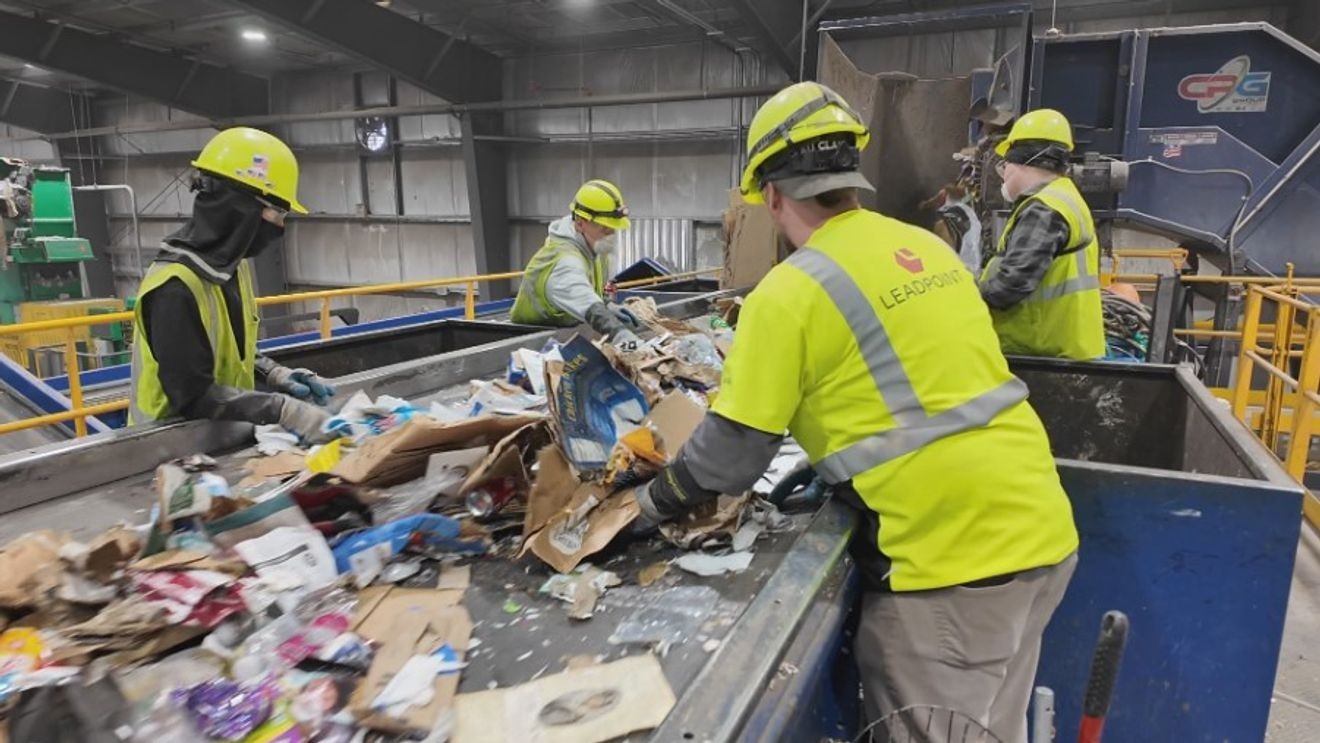
BOISE, Idaho (CBS2) — Recycling contamination rates are up nationally by almost 30% in some cities across the U.S. Much of this is due to well-intentioned individuals who unknowingly toss incorrect items into the bin, something professionals call “wish recycling.” Although these mistakes may seem minimal, they can have huge consequences for recycling facilities.
Republic Services in Boise says some of the leading contaminants cause not only losses in recycling streams but also safety issues for workers.
“Our top three contaminants are batteries, lithium-ion batteries,” said Boise Republic Service Operations Manager Amilcar Antiveros. “That’s always a big one, it’s a huge safety hazard here. Food waste is another one, and a whole lot of metal. You know, kind of like metal poles, metal piping, rotors.”
He explained that food waste can be anything from grease on a pizza box to leftover slices thrown in with the cardboard. Any food that ends up in the facility prevents those items from being recycled and repurposed and instead ends up in the trash.
“All of a sudden, that just contaminates the rest of the cardboard that we have here on site, and now we can’t recycle it,” Antiveros said.
Aside from the contamination aspect, the National Waste and Recycling Association says more than 5,000 fires are reported each year at recycling facilities, mostly due to lithium-ion batteries. These fires can cause devastation to these centers, causing injury and destruction.
“If you do put your batteries here in our system, they could catch huge fires. They could explode into one of our bales. It’s just a huge danger here,” Antiveros said.
Although these batteries should not be recycled, not all of them should be thrown in the garbage either. In January of this year, a vape with a lithium-ion battery was thrown in the trash, causing a garbage truck fire in Boise. Republic Services pointed to resources on the City of Boise’s website, highlighting what is classified as “household hazardous waste,” collection sites, and types of items accepted by the centers.
Plastic grocery bags are another common problem.
While many stores offer collection programs for used bags, Republic Services says they should not be placed in curbside recycling bins.
“We do get a lot of those,” Antiveros said. “Unfortunately, those can clog or jam up our system or get caught on some of our belt motors, our conveyor motors.”
Those jams can slow or stop processing lines and require workers to remove the material before operations can continue.
Some materials that residents often assume belong in their recycling bins may require separate drop-off locations instead. That includes glass, which Boise-area residents can recycle through dedicated collection sites operated throughout the Treasure Valley.
Republic Services says residents should instead focus on recycling accepted materials, including cardboard, paper, aluminum and tin cans, and plastics labeled No. 1, No. 2 and No. 5.
“Just have them as clean as you possibly can,” Antiveros said. “And don’t crush them, just put everything nice and loose in the bin.”
The company also recommends placing recyclable items directly into the bin rather than inside garbage bags, which can prevent materials from being properly sorted.
Antiveros said education remains one of the industry’s biggest challenges.
“I think it’s just educating the community,” he said. “Letting them know what we can and can’t take and actually informing people of all the different drop sites for batteries, glass, and where you can take everything to properly get it recycled.”