
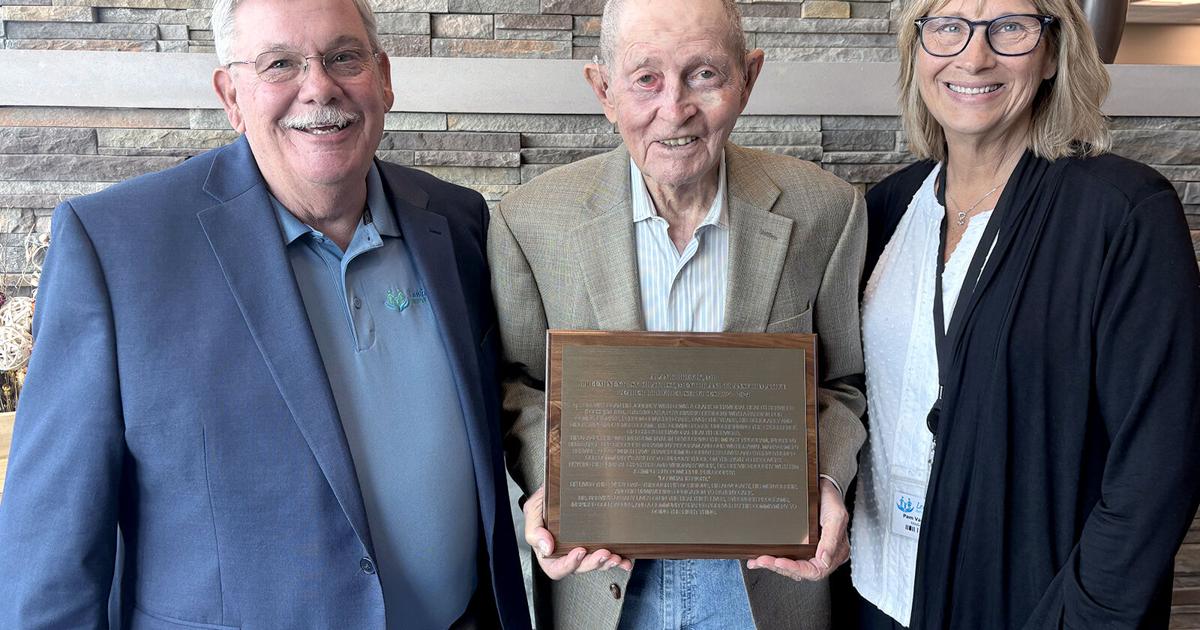
Mental health care has always been associated with Yankton as the community is the home of the Human Services Center (HSC). Many people in that line of work credit Dr. Alan Brevik for his impact on those services in Yankton.
Brevik, 91, is retiring from Lewis and Clark Behavioral Health Services (LCBHS) — although he will still do consulting and mentoring work on a weekly basis.
Brevik, along with LCBHS Executive Director Dr. Tom Stanage and LCBHS Director of Medical Services Dr. Pam Van Meeteren, spoke with the Press & Dakotan about the many changes in behavioral health over those years.
Brevik started at HSC in 1988 as a primary care physician. A little less than a decade later, he would complete a residency in psychiatry.
“I was doing so much psychiatry anyway, I thought I better take a residency,” he said. “So, I started in ‘93 and graduated in ’96. Before that, I had worked for about nine years at Redfield Developmental Center, and I worked with a lot of clients that had mental health problems. They were on a lot of psychotropic drugs, and I devised ways to minimize the dosage or get them off. That was my introduction, really, to a lot of clients with mental health.
“Even though I was a primary doctor, I always was very interested in patients that had mental health problems, and primary care doctors see a lot of anxiety, depression and, now and then, bipolar patients. I saw those, so I had no problem wanting to take a psychiatric residency.”
When Brevik first arrived at HSC, he was still a primary care physician but had to see patients in mental health programs, including those with substance abuse disorders.
“Concentrating on psychiatry and going through their program, the residency was a very good thing for me,” he said. “All that time, I was able to work at the LCBHS some hours, even when I was working at HSC. Then, when I finally retired from HSC — which I did about three times — then I came over and worked at LCBHS three days a week.”
One of the programs Brevik was instrumental in starting was IMPACT (Individualized and Mobile Program of Assertive Community Treatment), which Stanage described as a “hospital without walls.”
“I worked at IMPACT quite a bit,” Brevik said. “I was there when it started. It was a state-run program at that time. To boil it down, it’s an intensive care program, including case management, counseling, med management, helping patients find either housing in the community and for those that desired it or had the ability often to find them jobs. As an example, there are two clients at IMPACT that I took care of for years that are schizophrenic and had full-time jobs.”
Van Meeteren has also worked extensively in the IMPACT program.
“IMPACT was originally under HSC, then it moved completely out into the community setting,” she said. “In a nutshell, Dr. Brevik, along with Dr. Stanage, has been an important voice in shaping mental health care as it is in this area with ECT (electroconvulsive therapy), drug and alcohol detox and treatment, and with the seriously mentally ill population.”
Stanage said IMPACT and many other programs were a direct result of Brevik’s knowledge and expertise.
“When you talk about the IMPACT program; when you talk about our in-patient substance use treatment program; when you talk about our withdrawal management; there was a time when somebody would come to us who was drinking daily, and we’d have to tell them, ‘Maybe you better think twice about quitting,’ because we didn’t have a safe place to do that,” Stanage said. “Dr. Brevik is the person responsible for providing the expertise that allowed our staff to be able to do that — to even start down that road.
“The in-patient program was started because we so desperately needed a place for withdrawal management, and you could not do a standalone detox center. It had to be connected with another program, and Dr. Brevik is the one that really made that possible. He’s the one who really helped us set up the initial crisis care and gave us the mentoring that allowed that to happen for all our staff.”
Brevik recalled his first days working in substance abuse.
“When I first started going, they had an out-patient substance use disorder program, then (Stanage) got a wing at the Benedictine Center,” Brevik said. “So now we had an in-patient program.”
That program also had a crisis center that was called the CORE, which has now developed into the CORE Center at LCBHS.
“Detox and management of that is a science in and of itself, and Dr. Brevik had the knowledge and skill set to do that,” Stanage said. “Otherwise, I don’t know if we would have had the confidence to do it. He is one of the most well-read doctors I’ve known in terms of research and what is evidence-based. Whether it was ECT, whether it was detox, whether it was our addiction services, he really pushed those things, because he knew that they would be a benefit, even though they might have been a little daunting at the time to go down that road.”
Currently, IMPACT serves about 60 clients who have serious mental illnesses.
Brevik spoke briefly about the ECT therapy.
“It’s very effective for those that have severe depressions that don’t respond to medication or psychotherapy,” he said. “It’s the most effective treatment for catatonia. We even had patients at IMPACT that received maintenance ECTs.”
The advancement of anti-depressants and anti-psychotic drugs has also been an enormous benefit to those suffering mental illness.
“If we’re talking about advances that I’ve seen since I’ve been working with mental health patients, there have been several,” Brevik said. “With medications, the antidepressants that changed first were the SSRIs (selective serotonin reuptake inhibitors), which increases serotonin in your brain. It’s also very good for anxiety disorders.”
Brevik said the safety of the new SSRIs is a vast improvement over their predecessors.
“If you prescribed a month supply (of the new SSRIs), and the patient took them all one time, it’s not going to kill them,” he said. “The older medications were called tricyclic antidepressants, and they were very effective because they worked on usually both neurotransmitters — serotonin and norepinephrine. But they could have some very serious side effects. They could have a direct effect on the heart, and if you took a handful of them, they may kill you. That’s why primary care doctors were reluctant to prescribe them, because they were pretty dangerous. Once these newer ones came out, primary care doctors were more open to prescribing those, both for depression and for anxiety disorders.”
Brevik said Thorazine was the first antipsychotic, or neuroleptic, drug that came out in the 1950s. It was first used as a tranquilizer, but it was then found to have benefits for people with schizophrenia. It also had several side effects which could be severe.
The new class of antipsychotics has much fewer side effects, and Brevik says the most effective on the market is clozapine. “I’ve seen miraculous effects with that drug,” he said. “It’s one of the reasons that the IMPACT program has been successful.”
During the interview, it was apparent there was a great deal of respect and trust among the three practitioners.
“What I can emphasize is that (Brevik) was a great educator, mentor and preceptor for all mental health providers,” Van Meeteren said “He was a strong supporter of both nurse-practitioner and physician-assistance work in mental health. He was my supervising physician when I started practicing in 1996, and we worked together in clinical and administrative roles together since he retired.
“There’s still a stigma associated with mental illness. The goal, working with clients, is to get them employment and housing. Dr. Brevik has always been just a solid advocate and promoter of moving clients into highest level of independence possible.”
“We’re a good team,” Brevik said. “Treating mentally ill patients takes a team.”