
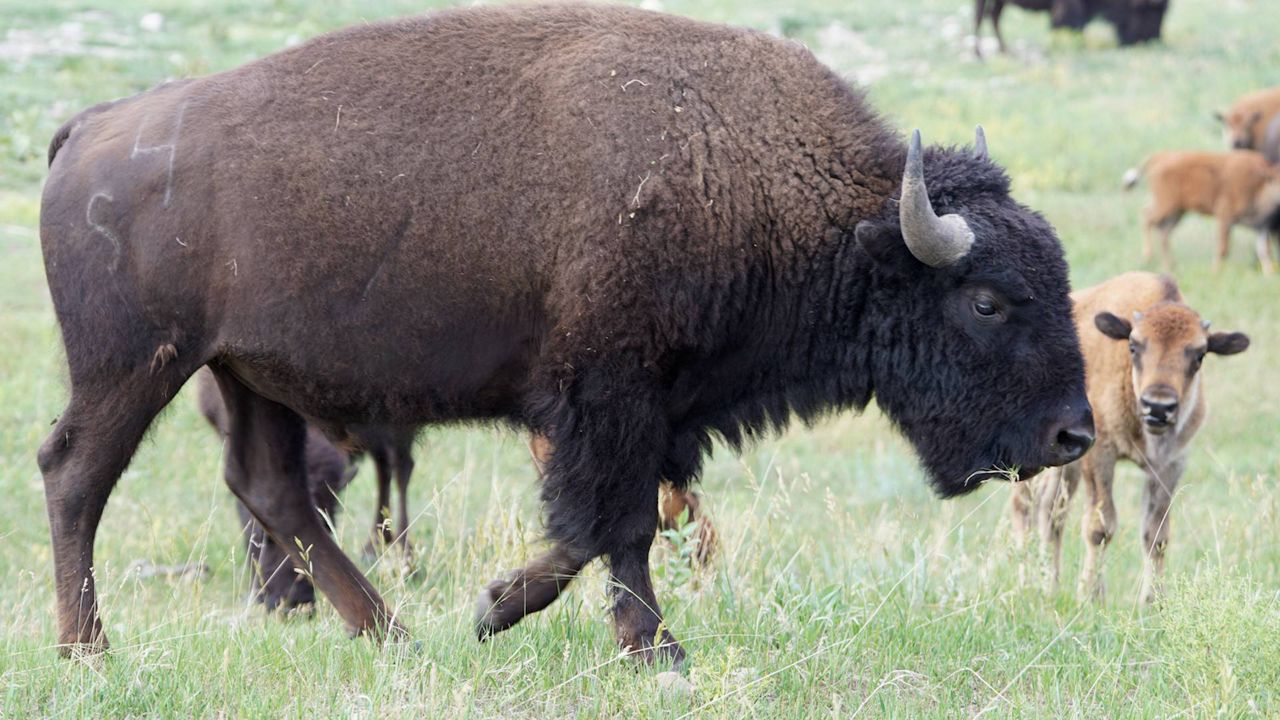
In the heart of South Dakota, an American icon is found in the wild.
What You Need To Know
It’s believed prior to the 1800s there were 30 million to 60 million bison in the U.S., but then what’s known as the “the Great Slaughter” led the population to shatter to fewer than 1,000 by the 1890s
In the 1900s, the country realized bison had to be saved, and today the population is up to around 400,000, including herds at at Custer State Park in South Dakota
For Native Americans, the mammal was a source of food, shelter and more
An exhibit at the Smithsonian’s National Museum of Natural History highlights the bison’s crucial role in the United States’ 250-year story of strength, loss, and recovery
Bison weigh up to 2,000 pounds and stand 6 feet tall. But big doesn’t mean slow — they can run up to 35 miles per hour.
“When you just look at how their mass structure is developed, like, they are made to be a powerful animal,” said Bailey Eitel, range ecologist at Custer State Park.
Around 1,300 bison roam free at the state park in the Black Hills, where Eitel is with them every day.
“Bison are the original grazers out here,” she said. “So it just feels like home when you have something that was meant to be here.”
But bison once roamed from the West Coast to what is now Washington, D.C.
“It would be an epic sight to see (today),” said Kirk Johnson, Sant director of the Smithsonian National Museum of Natural History in Washington, D.C. “It would be one of the great wildlife migrations of the world right here on this continent.”
An exhibit on bison and their role in the 250-year history of the United States recently opened at the National Museum of Natural History.
“They were a major part of the American story that was missing for the last 100 years,” So we are bringing that story back to fill in the gap in the story.”
For Native Americans, the bison were not just a source of food.
“For the Plains Indians, the bison was everything,” Johnson said. “They saw themselves as the same thing — you are what you ea.”
Reuben Jones’ full interview with Kirk Johnson, Sant director of the Smithsonian National Museum of Natural History
But as the young United States expanded west, Native Americans were seen as a roadblock. And that literally put bison in the crosshairs.
“You can listen to or read writings of the U.S. Army in the 1870s saying one way to win the Indian wars is to kill all the bison,” Johnson said. “You take away the food, you take away the Indian. And so it was this double holocaust.”
Before the 1800s, it’s estimated 30 to 60 million bison lived across the continent. But the “Great Slaughter” from 1820 to 1880 decimated the population. And by the 1890s, fewer than a thousand bison remained.
“The extermination of the bison was extremely fast,” Johnson said.
The country realized the bison had to be saved. Thanks to conservation efforts, the population is now up to around 400,000. Most herds are privately owned, but some are publicly managed, like in South Dakota.
“Getting to come here and work and make sure that these animals are healthy on the landscape so that my kids can see the bison and then hopefully their kids will get to see the bison in that same way is really important,” Eitel said.
In many ways, the bison stand as a symbol of the United States — tested, yet resilient.
“The fact that we nearly caused the bison to go extinct should be a real warning bell for us about life on planet earth today,” Johnson said. “Because human population continues to grow, we continue to push out wildlife, the amount of wildlife in the world is continuing to decrease. And the wild world is an important part of our planet. … To think about how we coexist with wildlife globally is critical.”