
In Deschutes County, one group of wolves struggle while another thrives
Published 5:30 am Friday, July 3, 2026
One of Deschutes County’s two established wolf packs appears to have failed to produce pups this year, while the county’s other resident pack likely added another litter despite several wolf deaths, according to the Oregon Department of Fish and Wildlife.
ODFW wolf biologist Aaron Bott said Wednesday that biologists have found no evidence that the Metolius pack, which ranges in the Sisters area, successfully reproduced this spring.
The pack’s breeding male was killed illegally in March 2025, ending that year’s breeding season. Later that summer, a young male wolf known as OR-161 dispersed from the Indigo pack in Klamath County and joined the Metolius breeding female, raising hopes the pair would establish themselves as the pack’s new breeders.
“We were hopeful that the pair would establish themselves as the new breeding pair and successfully reproduce this spring,” Bott said.
However, ODFW has not observed signs that the female gave birth.
“We have been monitoring the breeding female regularly over the past couple of months, and we have not observed evidence that she is lactating, nursing pups, or localizing repeatedly at a den or rendezvous site,” Bott said. “We’ll continue monitoring the group, but based on what we’ve observed so far, I don’t believe they produced pups this year.”

Until a few weeks ago, biologists consistently documented three wolves traveling together in the Metolius pack. Bott said ODFW now believes one of those wolves may have been struck and killed by a vehicle on U.S. Highway 20, although that has not been confirmed.
The outlook appears brighter for the Upper Deschutes pack, which occupies the southern part of the county. Bott said the pack successfully raised a relatively large litter of pups in 2025 and biologists believe it reproduced again this spring, although the new pups have not yet been directly observed.
The Upper Deschutes wolves generate more public reports and sightings than any other wolf pack in Oregon because their territory overlaps with rural residential neighborhoods and heavily used recreation areas, Bott said.
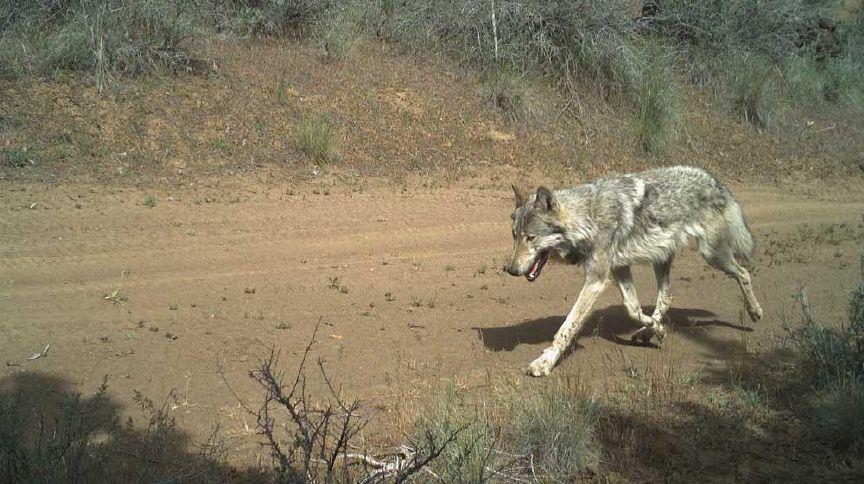
Recent sightings include a young gray wolf, spotted and filmed near Sunriver in February.
The pack has also suffered losses this year. Two wolves have been struck by vehicles, and another was shot by a member of the public who mistakenly identified it as a coyote. The U.S. Fish and Wildlife Service investigated the shooting, and no charges will be filed.
In addition to the county’s two resident packs, ODFW continues to document dispersing wolves moving through Deschutes County as they leave their birth packs in search of mates and new territories.
Statewide, wolf numbers continue to climb. At the end of last year, Oregon had a minimum of 230 wolves, 30 packs and 23 breeding pairs. That is more than double compared to a decade ago when the state counted 110 wolves, 12 packs and 11 breeding pairs.
Despite the growing wolf population, ODFW has not documented any livestock depredations in Deschutes County so far this year. Wolf depredations remain a threat to livestock. In March 2025, authorities confirmed a transient lone wolf killed a three-day old calf in eastern Deschutes County.
The agency recently wrapped up its annual wolf trapping and radio-collaring season. Biologists stop capturing wolves once temperatures consistently exceed about 80 degrees to reduce stress on the animals and will continue monitoring wolf activity throughout the summer.