
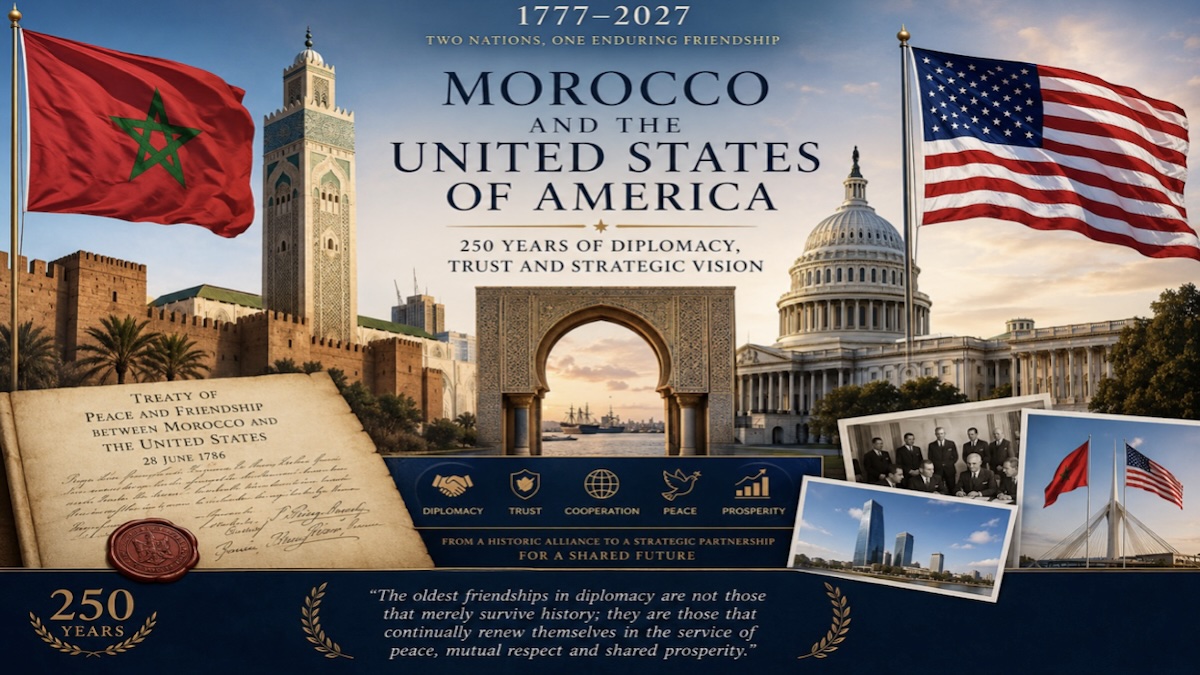
The Oldest Unbroken Diplomatic Partnership in United States History
Key Takeaways
Oldest Unbroken Diplomatic Relationship — The US-Morocco partnership, dating back to 1777 (when Morocco was the first state to recognize American independence), remains the longest continuous treaty relationship in US history. This longevity stems from mutual respect for sovereignty, pragmatic diplomacy, and institutional continuity rather than temporary interests.
Historical Continuity & Adaptation — From the 1786 Treaty of Peace and Friendship through WWII (Operation Torch & Roosevelt–Mohammed V meeting), the Cold War, and into the 21st century, the relationship has evolved across security, trade (Free Trade Agreement), counterterrorism, energy, Africa, and the Atlantic space while maintaining core principles of trust and dialogue.
Strategic Partnership for the Future — Under King Mohammed VI, Morocco has become a key US partner in Africa, the Sahel, and the Atlantic. The partnership is expanding into new areas (energy transition, digital tech, infrastructure, religious diplomacy) and serves as a model of “diplomacy of duration” — a stable alliance built on credibility that can weather global changes.
Introduction
The year 2027 will mark the two hundred and fiftieth anniversary of one of the most remarkable diplomatic partnerships in modern history: the one uniting the Kingdom of Morocco and the United States of America. Few bilateral relationships can claim such longevity, such continuity, and such a capacity to adapt to the upheavals of the international system. Ever since Sultan Sidi Mohammed Ben Abdallah (Mohammed III) decided, in December 1777, to open Moroccan ports to ships flying the American flag, Morocco has been recognized as the first state in the world to grant de facto recognition to the independence of the United States, even as the War of Independence against Great Britain was still under way (Miller, 2013; Parker, 1983).
This founding act was neither accidental nor a matter of simple commercial opportunism. It was part of a long-term strategic vision. The Alaouite sovereign, deeply attuned to the shifting balance of power in the Atlantic world, understood early on that the emergence of a new maritime power offered Morocco the chance to diversify its economic and diplomatic partners while asserting its sovereignty against the competing ambitions of the European powers (Pennell, 2000).
On the American side, this recognition carried considerable weight. The young Republic, diplomatically isolated, was seeking the international recognition indispensable to its political and economic survival. The Moroccan gesture was received with gratitude by American leaders, inaugurating a relationship founded on mutual respect rather than domination or dependency. As the U.S. Department of State notes, the treaty concluded with Morocco remains today the oldest United States treaty still in force, an exceptional symbol of the permanence of the ties between the two countries (U.S. Department of State, Office of the Historian, n.d.; Chtatou, 2020, December 26).
Unlike many alliances forged amid the exceptional circumstances of conflict or a fleeting balance of power, Moroccan-American relations developed gradually around convergent interests that continued to evolve. In the eighteenth century, the priority was essentially to guarantee the safety of commercial shipping in the Atlantic and the Mediterranean. In the nineteenth century, commercial and diplomatic exchanges grew stronger. In the twentieth century, the two countries became allies during the Second World War before developing strategic cooperation during the Cold War. Finally, in the twenty-first century, this relationship expanded into the fields of regional security, counterterrorism, trade, investment, energy, higher education, the energy transition, Sahel stability, and cooperation across Africa.
This remarkable continuity sets Moroccan-American relations apart from many other international relationships. While alliances shift with geopolitical crises, the partnership between Rabat and Washington rests on a deeply rooted historical legacy, regularly renewed by the leaders of both countries (Chtatou, 2019, June 1).
As Susan Gilson Miller (2013) observes, Morocco has always favored a pragmatic diplomacy grounded in the search for a balance between international openness and the preservation of its sovereignty. This constant largely explains why relations with the United States have passed unbroken through changes of American political administration, transformations of the international order, and profound shifts in world politics.
This permanence also reflects the Kingdom’s remarkable institutional stability. For more than three centuries, the Alaouite monarchy has ensured a continuity of the state that stands as one of the principal explanatory factors of Moroccan foreign policy. From Mohammed III to His Majesty King Mohammed VI, each sovereign has maintained ties with Washington, adapting them to the challenges of his era without ever calling into question the foundations of the partnership.
In recent decades, this relationship has taken on a new African dimension. The United States now regards Morocco as an essential partner in the stability of the African continent, particularly in matters of security, the fight against violent extremism, economic development, and religious cooperation. Moroccan initiatives in West Africa and the Sahel — the training of imams, South-South cooperation, the Atlantic Africa Initiative, and support for the development of Sahelian states — illustrate this evolution (Chtatou, 2019, 2023).
Seen in this light, the Moroccan-American partnership today extends well beyond a strictly bilateral framework. It has become a genuine geostrategic lever connecting Europe, Africa, and the Atlantic space, while contributing to the stability of the wider Euro-African region.
This essay sets out to show that two hundred and fifty years of friendship between Morocco and the United States are not simply a matter of diplomatic continuity. They testify to the ability of two states, profoundly different in their history, culture, and political systems, to build a relationship founded on trust, mutual respect, and a convergence of strategic interests. From the recognition of American independence in 1777 to the multidimensional cooperation of the twenty-first century, this relationship illustrates one of the most remarkable achievements of modern international diplomacy (Chtatou, 2020, December 26).
I. Morocco, the First State to Recognize the United States: The Geopolitical Vision of Sidi Mohammed Ben Abdallah
The history of Moroccan-American relations originates in a diplomatic act of exceptional significance that, nearly two and a half centuries later, continues to give the Kingdom of Morocco a singular place in the history of the United States. On December 20, 1777, while the American War of Independence (1775–1783) still raged and the outcome of the conflict remained uncertain, the Alaouite Sultan Sidi Mohammed Ben Abdallah (Mohammed III) decided to authorize ships flying the American flag to enter Moroccan ports freely and to enjoy the protection of his kingdom. This measure constituted the first sovereign recognition of the young American Republic by a foreign head of state, preceding by several weeks the official French recognition that followed the treaties of 1778.
This initiative was in no way a mere gesture of sympathy toward the American insurgents. It reflected the Moroccan sovereign’s remarkable capacity to anticipate the transformations under way in the international order. From the mid-eighteenth century, Mohammed III had launched a broad program of economic and diplomatic modernization intended to strengthen Morocco’s position in Atlantic trade. The founding of the port of Essaouira (Mogador), the reorganization of commercial exchange, and the opening toward new partners already testified to a foreign policy grounded in economic pragmatism rather than confessional or ideological rivalries (Pennell, 2000; Miller, 2013).
As Susan Gilson Miller (2013) observes, Mohammed III was one of the most reform-minded sovereigns of the Alaouite dynasty. His goal was to preserve Morocco’s independence in the face of European colonial ambitions while further integrating the Kingdom into international trading networks. Seen from this angle, the birth of the United States represented less a political revolution than a strategic opportunity to diversify Morocco’s commercial partners (Chtatou, 2019, July 3).
At the close of the eighteenth century, the Atlantic world was undergoing a profound recomposition. British power remained dominant, but the emergence of the United States already heralded a gradual redistribution of economic equilibria. By recognizing the new United States even before the signing of the Treaty of Paris in 1783, the Moroccan Sultan demonstrated a remarkable grasp of the geopolitical currents of his time. His initiative also illustrated a constant of Moroccan diplomacy: giving priority to the state’s permanent interests over circumstantial alliances (Chtatou, 2020, December 26).
Moroccan motivations were also commercial. For several decades, Morocco had maintained substantial trade with the European maritime powers. American independence brought a new potential partner into view, one capable of contributing to the development of Moroccan ports while reducing the Kingdom’s economic dependence on Europe. Opening Moroccan ports to American ships thus answered an economic logic as much as a diplomatic one (Irwin, 1931; Parker, 1983).
On the American side, the situation was particularly delicate. The young Republic possessed neither a navy capable of securing its international trade nor a diplomatic network sufficiently developed to protect its interests overseas. American merchants were therefore actively seeking agreements with the Mediterranean powers to guarantee the free movement of their vessels (Chtatou, 2019, June 1).
In this context, the Sultan’s decision carried considerable weight. By formally authorizing American vessels to frequent Moroccan ports and granting them the sovereign’s protection, Morocco offered the United States an early form of international legitimacy. This recognition helped bolster the young Republic’s diplomatic credibility at a moment when it was still seeking to consolidate its standing on the international stage (Chtatou, 2026, January 18).
This policy of openness was also part of a long-standing Moroccan diplomatic tradition. For centuries, Morocco had maintained relations with the principal European maritime powers through treaties guaranteeing the security of commercial exchange. Mohammed III chose to extend this policy to the fledgling United States, regarding it as a commercial partner destined to play a growing role in the Atlantic economy.
The opening of Moroccan ports was soon followed by negotiations aimed at formalizing relations between the two countries. After several years of diplomatic exchanges, the American diplomat Thomas Barclay was charged with negotiating a treaty of peace and commerce with the Sultan. These negotiations led, on June 23, 1786, to the signing of the Treaty of Peace and Friendship between Morocco and the United States, in which Thomas Jefferson and John Adams, then American ministers in Europe, were also involved. Ratified by the U.S. Congress in 1787, this treaty remains today the oldest United States treaty still in force (Chtatou, 2020, December 26).
Beyond its legal significance, this treaty is a founding document of American diplomacy. It was the first treaty concluded by the United States with a Muslim and African state, inaugurating a tradition of dialogue that has endured across the centuries. It guaranteed freedom of navigation, the reciprocal protection of nationals, procedures for settling commercial disputes, and the safety of vessels of both nations. In a world marked by maritime conflict and imperial competition, these provisions reflected a shared determination to prioritize stability, commerce, and mutual trust.
This nascent relationship was already distinguished by its egalitarian character. Unlike the often asymmetrical relationships that the European powers maintained with the states of North Africa, relations between Rabat and the United States rested on the reciprocal recognition of the sovereignty of both partners. This diplomatic equality largely explains the partnership’s remarkable longevity.
Even today, American authorities emphasize the exceptional nature of this relationship. The State Department’s Office of the Historian recalls that the treaty signed with Morocco represents “the longest unbroken treaty relationship in United States history,” a statement regularly invoked in official commemorations of bilateral relations (Chtatou, 2019, July 3).
As I have shown in my own work on Moroccan diplomacy in Africa, the Kingdom’s foreign policy is marked by a remarkable historical continuity founded on dialogue, stability, and the pursuit of lasting partnerships. This constant, already discernible under Mohammed III, remains today one of the distinguishing features of Moroccan diplomacy. Moroccan-American friendship, born in the eighteenth century amid the Atlantic Enlightenment, gradually grew into a strategic partnership spanning the political, economic, security, cultural, and African domains, never losing sight of the principles of mutual respect and trust on which it was founded (Chtatou, 2019, June 1).
II. The Treaty of Peace and Friendship of 1786–1787: The Legal Foundation of an Exceptional Relationship
If the de facto recognition of the United States by Sultan Sidi Mohammed Ben Abdallah in December 1777 constitutes the founding act of Moroccan-American relations, it was the signing of the Treaty of Peace and Friendship in 1786, ratified by the United States Congress in July 1787, that transformed a diplomatic initiative into a lasting alliance grounded in international law. This treaty remains today the oldest United States international agreement still in force — a unique fact in American diplomatic history (U.S. Department of State, Office of the Historian, n.d.).
A Diplomacy of Trust
At the end of the War of Independence, the United States faced a major challenge: securing its maritime trade. No longer protected by the British Royal Navy, American ships had to negotiate directly with the powers bordering the Mediterranean. For American leaders, Morocco represented a privileged partner because of its political stability, its geographic position at the Strait of Gibraltar, and the clearly expressed willingness of Mohammed III to build relations founded on reciprocity (Chtatou, 2019, July 3).
The choice of the diplomat Thomas Barclay to lead the negotiations proved decisive. An experienced businessman close to leading American figures, Barclay arrived in Morocco in 1786 carrying instructions drafted by Thomas Jefferson, then United States Minister to France, and John Adams, Minister to London. Negotiations moved forward quickly thanks to the conciliatory attitude of the Moroccan sovereign, who wished to institutionalize a relationship already under way for several years (Parker, 1983; Miller, 2013).
Unlike the diplomatic practices of the era, often marked by asymmetries of power, the discussions unfolded in a climate of mutual respect. Both parties pursued a common goal: guaranteeing freedom of trade, the safety of navigation, and the reciprocal protection of their nationals.
A Treaty Ahead of Its Time
The treaty signed on June 23, 1786, contained twenty-five articles governing the principal dimensions of bilateral relations. It guaranteed, in particular:
Freedom of navigation for the ships of both countries;
The protection of crews in the event of shipwreck;
The fair treatment of merchants;
Arbitration procedures in the event of a dispute;
Respect for persons and property;
Cooperation against acts of piracy.
These provisions appear remarkably modern by today’s standards. They reflected a conception of international relations grounded in legal security, freedom of exchange, and mutual trust rather than coercion.
As Richard B. Parker (1983) observes, the Moroccan-American treaty stands as one of the earliest examples of a modern bilateral agreement between a Muslim state and an emerging Western power, negotiated on the basis of strict sovereign equality (Chtatou, 2020, December 26).
 Morocco and the United States mark 250 years of one of the world’s oldest diplomatic partnerships
The Strategic Vision of Mohammed III
The importance of the treaty cannot be understood without considering the personality of Mohammed III. The Alaouite sovereign did not view foreign relations as a mere succession of commercial agreements. They were part of a broader project aimed at consolidating the Kingdom’s independence in an environment dominated by European imperial ambitions.
By diversifying Morocco’s partners, he limited the influence of each of the great powers while strengthening the Kingdom’s diplomatic room for maneuver. This policy of balance, still discernible in Moroccan diplomacy today, remains one of the constants of the Alaouite monarchy’s external action.
In this light, the treaty with the United States can be read as an early expression of a multipolar diplomacy avant la lettre. Far from reflecting a logic of alignment, it testified to Morocco’s determination to maintain balanced relations with diverse partners, guided by the state’s higher interests.
Jefferson, Adams, and the American Perception of Morocco
On the American side, the treaty also helped shape a particularly positive image of Morocco among the leaders of the young Republic. Thomas Jefferson and John Adams saw in the Kingdom a reliable interlocutor, capable of honoring international commitments at a time when diplomatic stability remained rare.
This trust was soon reflected in the establishment of a permanent diplomatic mission in Tangier, the first diplomatic property ever acquired by the United States abroad. Today, the former American Legation in Tangier remains a living symbol of this shared history and a material testament to the antiquity of bilateral relations (Chtatou, 2020, December 26).
A Remarkable Continuity
Perhaps the most remarkable element remains the longevity of the treaty itself. While most alliances concluded at the close of the eighteenth century have disappeared or been thoroughly reworked, the Treaty of Peace and Friendship between Morocco and the United States remains legally in force. This permanence reflects not only the solidity of the institutions of both countries, but also the capacity of their relationship to evolve without breaking from its foundations.
This historical continuity is an almost unique case in international relations. It illustrates what might be called a diplomacy of duration, in which changes of government, technological revolutions, world wars, and geopolitical realignments have never called into question the foundation of trust established at the close of the eighteenth century.
In this sense, the treaty of 1786–1787 is not merely a legal document. It has become a true site of diplomatic memory, a reminder that certain international relationships can transcend political contingencies to inscribe themselves in the long span of history.
III. The Nineteenth Century: The Consolidation of a Lasting Friendship Between Two Young Atlantic Powers
The Treaty of Peace and Friendship of 1786–1787 inaugurated a period of remarkable diplomatic stability between the Kingdom of Morocco and the United States. While the nineteenth century was marked by the Napoleonic Wars, European colonial expansion, the rise of imperialism, and the transformation of the world economy, relations between Rabat and Washington remained exceptionally stable. This permanence stemmed neither from a military alliance nor from economic dependency, but from a lasting convergence of interests, a deep respect for sovereignty, and mutual trust built up over decades (Chtatou, 2019, June 1).
At the dawn of the nineteenth century, the United States was still a young Republic seeking to consolidate its place within the international system. Morocco, for its part, remained one of the few Muslim states to have preserved its political independence against the ambitions of the European powers. This situation favored a relationship grounded in legal equality — an exceptional feature in a century dominated by imperial logics (Pennell, 2000; Miller, 2013; Chtatou, 2026, January 18).
Morocco in United States Mediterranean Policy
After independence, the United States paid growing attention to the Mediterranean. Opening trade routes toward the Levant and North Africa required an active diplomatic presence in the region. Morocco occupied a position of the first strategic order because of its location at the mouth of the Strait of Gibraltar, a true crossroads between the Atlantic Ocean and the Mediterranean.
Unlike the Regencies of Algiers, Tunis, and Tripoli, with which the United States endured several maritime crises in the early nineteenth century, the Kingdom of Morocco remained a stable partner. The Sultan’s fidelity to the commitments made in the 1786 treaty progressively reinforced American confidence. This distinction helps explain why the earliest American military interventions in the Mediterranean targeted the Barbary states in conflict with Washington, while Morocco maintained peaceful relations with the young Republic (Chtatou, 2019, July 3).
This distinction helped shape a particularly favorable image of Morocco within American diplomatic circles. Consular reports of the period describe the Kingdom as a reliable interlocutor, committed to honoring international agreements and concerned with preserving freedom of trade.
Tangier: A Laboratory of American Diplomacy
The city of Tangier gradually acquired particular importance in United States foreign policy. Situated at the crossroads of Atlantic and Mediterranean routes, it hosted one of the first permanent American diplomatic missions outside the American continent.
The establishment of the American Legation in Tangier carried strong symbolic weight. It testified to Washington’s determination to establish a presence in a strategic space where British, French, Spanish, and Ottoman interests intersected. More than that, it reflected the confidence placed in Morocco as a long-term diplomatic partner.
The American Legation in Tangier, given to the United States in 1821 by Sultan Moulay Slimane, remains today a unique symbol: it is the oldest American diplomatic property located outside the United States still devoted to diplomacy and to the memory of this exceptional relationship. This gesture illustrated once again the singularity of the ties between the two countries, founded on a trust that transcended immediate interests (Chtatou, 2026, January 18).
A Diplomacy Grounded in Continuity
One of the major features of Moroccan foreign policy in the nineteenth century lies in its remarkable continuity. The Alaouite sovereigns who succeeded Mohammed III — Moulay Yazid, Moulay Slimane, Abd al-Rahman, Sidi Mohammed IV, and then Hassan I — upheld the commitments made to the United States despite the profound transformations of the international environment.
This permanence reflected a particular conception of the state. Unlike many countries where a change of leadership entailed a reconsideration of alliances, the Alaouite monarchy favored a long-term vision of diplomacy. Treaties bound the Kingdom beyond individuals, reflecting the continuity of the monarchical institution itself.
This stability impressed American observers. In several diplomatic dispatches preserved at the National Archives, United States representatives underscore the constancy of Moroccan policy and the reliability of the commitments made by the Alaouite sovereigns.
Morocco Facing European Colonial Pressure
The nineteenth century was also the age of European imperial expansion. The French conquest of Algeria in 1830, Spanish ambitions along the Moroccan coast, and the rivalry among London, Paris, and Madrid gradually placed the Kingdom in a delicate geopolitical position.
In this context, relations with the United States took on particular significance. Washington was, of course, not yet a global power capable of directly counterbalancing European influence. Nevertheless, the existence of an independent transatlantic partner strengthened Morocco’s diplomatic room for maneuver. Moroccan authorities understood that diversifying external relations was one of the best means of preserving their sovereignty (Chtatou, 2026, January 18).
This strategy of diversification foreshadows what contemporary Moroccan diplomacy pursues today through its partnerships with Europe, the United States, Africa, the Gulf states, and Asia. There is thus a remarkable continuity between the vision of Mohammed III in the eighteenth century and that of the Kingdom in the twenty-first.
The Foundations of a Relationship Built to Last
By the close of the nineteenth century, economic exchange between Morocco and the United States remained modest compared with that maintained with the European powers. Yet the bilateral relationship already possessed an essential asset: political trust.
While commercial interests fluctuated with international markets, the diplomatic capital accumulated since 1777 continued to produce its effects. This trust would prove decisive in the following century, as the United States rose to become a world power and Morocco entered a new phase of its history, marked by the Protectorate, the Second World War, and the recovery of its independence.
Far from being a mere interlude between the founding treaty of 1786 and the great transformations of the twentieth century, the nineteenth century thus appears as a period of consolidation. It was during these decades that habits of cooperation, respect for commitments, and diplomatic closeness were established — habits that still explain, today, the exceptional resilience of Moroccan-American relations (Chtatou, 2019, July 3).
IV. From Operation Torch to the Casablanca Conference: Mohammed V, Franklin D. Roosevelt, and the Rebirth of the Moroccan-American Partnership
If the treaty of 1786–1787 laid the legal foundations of relations between the Kingdom of Morocco and the United States, it was unquestionably the Second World War that transformed this historic friendship into a genuine strategic partnership. Between the Allied landings of November 1942, the Casablanca Conference of January 1943, and the historic meeting between Sultan Mohammed V and President Franklin D. Roosevelt, Moroccan-American relations entered a new phase that would profoundly shape Morocco’s political evolution and redefine the United States’ place in North Africa.
Morocco in Allied Strategy
In the early 1940s, Morocco occupied an exceptional geostrategic position. Controlling the northwestern Atlantic façade of Africa and the southern approach to the Strait of Gibraltar, it represented an essential foothold for any military operation intended to open a second front against the Axis powers.
Following the Allied landings in North Africa on November 8, 1942, as part of Operation Torch, American forces rapidly took control of several strategic positions in Morocco, notably Casablanca, Safi, Fedala (today Mohammedia), and Port-Lyautey (today Kénitra). Although Morocco was then under French Protectorate, American authorities quickly understood that any durable strategy in the region would have to reckon with the central role of the monarchical institution (Chtatou, 2019, June 1).
Operation Torch was thus not merely a military operation. It also marked the starting point of a direct political relationship between Washington and Sultan Mohammed V — a relationship that would profoundly shape the Kingdom’s contemporary history.
Mohammed V: A Recognized Moral Authority
At that time, Mohammed V already commanded considerable moral authority among the Moroccan population. His conduct in the early years of the war, notably his refusal to apply certain discriminatory measures imposed by the Vichy regime against Moroccan Jewish citizens, enhanced his standing both within the country and abroad.
American officials quickly perceived that the Sultan represented far more than a religious or ceremonial authority. He embodied the historical continuity of the Moroccan state and possessed a popular legitimacy that no other institution of the Protectorate could claim.
This perception would play a decisive role in the exchanges between Mohammed V and Franklin D. Roosevelt.
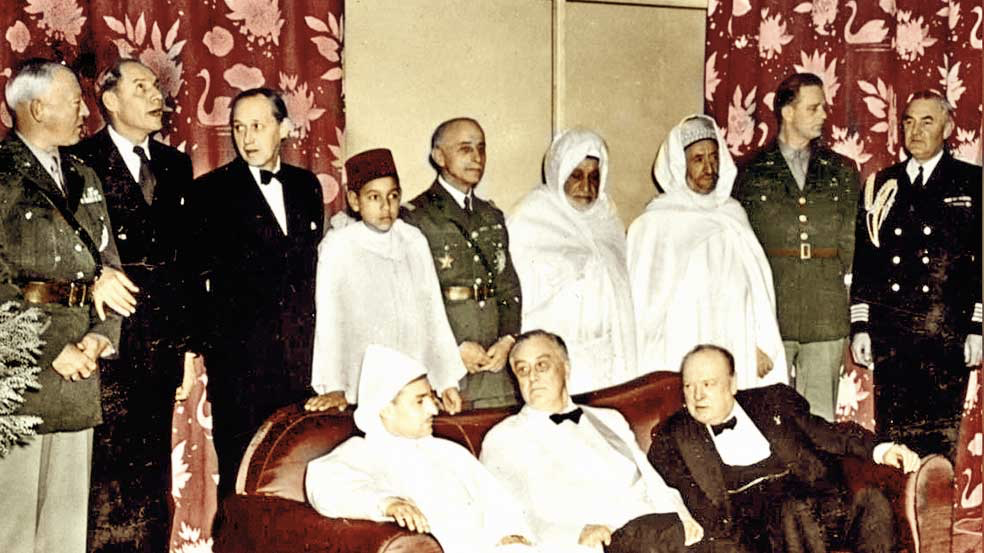 The Anfa Conference and the film Casablanca are linked
The Anfa Conference of 1943
From January 14 to 24, 1943, Casablanca hosted one of the most important strategic conferences of the Second World War. President Franklin D. Roosevelt, British Prime Minister Winston Churchill, and the principal Allied military commanders gathered there to determine the strategy that would carry the Allies to victory.
Beyond the military decisions — notably the adoption of the principle of the “unconditional surrender” of the Axis powers — the conference held particular significance for the history of Morocco.
On January 22, 1943, Roosevelt met Mohammed V at a dinner held in Anfa. This relatively brief but politically decisive meeting remains one of the founding episodes of the contemporary friendship between Rabat and Washington.
According to several diplomatic accounts and the work of Robert Dallek, Richard B. Parker, and Susan Gilson Miller, Roosevelt expressed to the Sultan his admiration for Morocco’s history and suggested that the principles of the Atlantic Charter, grounded in the right of peoples to self-determination, should also apply to territories under colonial rule.
Even though the exact wording attributed to Roosevelt remains a subject of historiographical debate, there is little doubt that this conversation reinforced Mohammed V’s conviction that the United States could become an essential partner on Morocco’s path toward independence (Chtatou, 2019, July 3).
A New American Perception of Morocco
From Casablanca onward, the American view of Morocco shifted noticeably. Until then, Washington had considered the Kingdom essentially through the lens of its strategic and commercial importance. American decision-makers now began to recognize the existence of a nation with its own historical identity, distinct from the French colonial system.
This shift remained cautious. The United States had no wish to weaken its alliance with Free France. Nevertheless, several American officials already understood that the worldwide movement toward decolonization would become one of the great issues of the postwar era.
In this context, Mohammed V gradually emerged as the indispensable interlocutor for any American policy toward the Maghreb (Chtatou, 2019, June 1).
The Beginning of a Strategic Dialogue
The Casablanca meeting did not produce any immediate effect on Morocco’s international status. The French Protectorate would persist for more than another decade.
On the diplomatic level, however, a fundamental change had occurred.
For the first time since the signing of the 1786 treaty, relations between Rabat and Washington were no longer confined to the commercial and consular domains. They became political, strategic, and geopolitical.
This evolution would accelerate after 1945, as the United States assumed its role as the world’s leading power.
Mohammed V and Roosevelt: A Lasting Legacy
Contemporary historiography often regards the January 1943 meeting as one of the major turning points in Moroccan-American relations.
It symbolizes the transition between two periods:
A relationship essentially maritime and commercial in nature, born in the eighteenth century;
And a strategic partnership destined to develop after the Kingdom’s independence.
The importance of this meeting extends well beyond its immediate context. It marks the moment when the United States began to view Morocco not merely as a strategically located territory, but as a political actor destined to play a major role in the future of North Africa.
In many respects, this vision has been confirmed over the decades. Morocco today is one of the United States’ principal partners in Africa, in matters of security as well as diplomacy, trade, academic cooperation, the energy transition, and regional stability.
V. From Mohammed V to Hassan II: Morocco and the United States Amid the Turbulence of the Cold War
Morocco’s accession to independence on March 2, 1956, opened a new chapter in Moroccan-American relations. After nearly half a century of French Protectorate, the Kingdom regained its full sovereignty at the very moment the international system was being restructured around the bipolarity between the United States and the Soviet Union. For Washington as for Rabat, this conjuncture opened an unprecedented field of cooperation, in which the diplomatic legacy of the eighteenth century would combine with the strategic imperatives of the Cold War.
Unlike many newly independent states, Morocco did not enter the international stage as an unknown actor. Its diplomatic history, its centuries-old monarchy, and the permanence of its relations with the United States gave it particular legitimacy. In Washington’s eyes, the Kingdom was not a new state, but a historic partner regaining the fullness of its sovereignty.
Recognition of Independence and the Resumption of Diplomatic Relations
The United States was among the first countries to formally recognize independent Morocco. This recognition was part of the continuity of a relationship that had never truly been broken, even during the Protectorate period.
The administration of President Dwight D. Eisenhower viewed the Kingdom as a potential factor of stability in a rapidly changing North Africa. The rise of nationalist movements, the Algerian War, and East-West ideological rivalry made the Maghreb particularly strategic (Chtatou, 2019, July 3).
For Mohammed V, the challenge was to preserve Morocco’s political independence without becoming locked into automatic alignment. This approach already foreshadowed what would become one of the constants of contemporary Moroccan diplomacy: maintaining privileged relations with the Western powers while preserving autonomy of decision.
This capacity to reconcile international openness with national sovereignty is one of the guiding threads of Moroccan foreign policy since Mohammed III.
American Bases: Cooperation and Sovereignty
In the immediate aftermath of independence, several American military bases remained on Moroccan territory, a legacy of the Second World War. They played an important role in American nuclear strategy and in the surveillance of the Atlantic.
Mohammed V, however, held that the Kingdom’s full sovereignty required national control of its territory. Negotiations undertaken with Washington gradually led to the withdrawal of American installations, without calling into question the friendship between the two countries.
This episode deserves particular attention. Unlike what occurred in other regions of the world, the closure of the American bases provoked no diplomatic rupture. Both governments favored dialogue and negotiation, once again illustrating the solidity of their relationship (Chtatou, 2019, June 1).
This precedent remains telling: even when their immediate interests diverged, Rabat and Washington managed to preserve the foundations of their partnership.
Hassan II: Consolidating a Strategic Partnership
The accession to the throne of His Majesty Hassan II in 1961 opened a period of more than three decades during which Moroccan-American relations acquired an unprecedented strategic dimension.
A keen observer of international equilibria, Hassan II understood early on that the Kingdom’s stability depended as much on its internal development as on its integration into the major Western diplomatic networks.
Amid the Cold War, Morocco appeared as a moderate, stable, and predictable partner. This image contrasted with the political upheavals affecting several states in the region.
Washington now regarded Rabat as a major ally in North Africa.
Security Cooperation
During the 1960s, 1970s, and 1980s, military cooperation between the two countries developed steadily.
It focused notably on:
The training of Moroccan officers;
Intelligence sharing;
The modernization of the Royal Armed Forces;
Maritime security in the Atlantic and the Mediterranean;
The fight against regional threats.
This cooperation did not amount to dependency. Morocco retained an independent foreign policy, maintaining relations with Europe, the Arab world, Africa, and the Non-Aligned Movement as well.
This capacity to build multiple partnerships without sacrificing autonomy remains, to this day, one of the principal features of Moroccan diplomacy.
The Green March and the Question of the Sahara
The year 1975 marked a major turning point with the organization of the Green March, a peaceful initiative that enabled the recovery of the southern provinces following the Spanish withdrawal.
The American position subsequently evolved through several phases depending on the administration in office, oscillating between diplomatic neutrality, support for the UN-led process, and a growing recognition of Morocco’s strategic role in regional stability.
Over the decades, Washington became increasingly aware that the security of the Maghreb and the Sahel was closely tied to the Kingdom’s stability.
This evolution would culminate, decades later, in United States recognition of Moroccan sovereignty over the Sahara — a decision marking a new stage in the bilateral partnership.
Hassan II: A Respected Mediator
Beyond regional issues, Hassan II played a diplomatic role that further enhanced Morocco’s international standing.
His efforts on behalf of Arab-Israeli dialogue, his personal relationships with several American presidents, and his capacity to maintain channels of communication between often-antagonistic actors made the Kingdom a privileged interlocutor for Washington.
This mediating diplomacy belonged to a long tradition dating back to Mohammed III: favoring dialogue, negotiation, and compromise over confrontation.
An Alliance Built on Trust
By the end of the Cold War, the partnership between Rabat and Washington had profoundly changed in nature.
What in the eighteenth century had been merely an agreement to protect commercial exchange had become multidimensional cooperation covering:
Security;
Diplomacy;
Economics;
Defense;
Training;
Cultural exchange;
Regional issues.
This transformation had nonetheless left the original foundation of the relationship intact.
From Mohammed III to Hassan II, Moroccan diplomacy had consistently favored continuity, stability, and respect for international commitments. For its part, the United States had gradually come to see in the Kingdom a reliable, moderate partner indispensable to the balance of the Maghreb.
In many respects, this period constitutes the true laboratory of the strategic partnership that would flourish under the reign of His Majesty King Mohammed VI.
VI. The Reign of His Majesty King Mohammed VI: The Strategic Partnership Between Morocco and the United States in the Twenty-First Century
The accession to the Throne of His Majesty King Mohammed VI on July 30, 1999, marked a new stage in the evolution of relations between the Kingdom of Morocco and the United States. Heir to a centuries-old diplomatic tradition, the Sovereign has adapted the historical foundations of this relationship to the realities of a globalized world marked by the fight against terrorism, geo-economic transformation, the rise of African issues, and strategic competition among major powers (Chtatou, 2019, July 3).
Far from breaking with the legacy of his predecessors, Mohammed VI has deepened it, giving the Moroccan-American partnership a multidimensional character in which security, economics, innovation, African cooperation, and religious diplomacy reinforce one another. This continuity illustrates what might be called a “diplomacy of permanence through adaptation,” a principle that has characterized Moroccan foreign policy since Mohammed III.
An Alliance Reinforced After September 11, 2001
The attacks of September 11, 2001, profoundly altered American strategic priorities. The fight against terrorism became the central axis of United States foreign policy. In this new context, Morocco quickly emerged as a partner of the first order.
Thanks to the stability of its institutions, the modernization of its security services, and an approach combining prevention, international cooperation, and reform of the religious sphere, the Kingdom was recognized as a credible actor in the fight against violent extremism. Bilateral cooperation intensified in the fields of intelligence, training, border security, and the fight against terrorist networks.
The originality of the Moroccan approach, however, lies in the fact that it does not reduce security to its purely military dimension. Under the impetus of Mohammed VI, the Kingdom has developed a comprehensive strategy combining human development, education, religious reform, and regional cooperation. This vision resonates with several strands of scholarship on Moroccan religious diplomacy as an instrument of regional stability (Chtatou, 2019, July 3).
The Free Trade Agreement: A New Economic Architecture
One of the major achievements of this period is the entry into force, in 2006, of the Free Trade Agreement between Morocco and the United States. The first agreement of its kind concluded by Washington with an African country, it reflects the confidence placed in the Kingdom as a reliable economic partner.
Beyond the gradual removal of tariff barriers, this agreement encourages investment, the protection of intellectual property, the modernization of trade standards, and Morocco’s integration into global value chains. It also helps strengthen the Kingdom’s role as an economic platform linking Europe, Africa, and North America.
This economic dimension complements a relationship long dominated by diplomatic and security considerations. It reflects an evolution in which trade becomes an instrument of shared stability and prosperity.
Morocco: A Fully-Fledged African Power
One of the most significant transformations in Moroccan foreign policy in the twenty-first century lies in the Kingdom’s assertive return to Africa. Under the reign of Mohammed VI, this orientation has been reflected in a multiplication of royal visits, investments, economic partnerships, and South-South cooperation initiatives.
For the United States, this evolution reinforces Morocco’s strategic value. Washington increasingly regards the Kingdom as a partner capable of contributing to the stability of the African continent, notably in the Sahel and West Africa.
This dynamic is particularly visible in three areas:
Economic and banking cooperation;
The training of professionals and imams;
The development of infrastructure and connectivity.
As has been shown in scholarship on the subject, Moroccan religious diplomacy — grounded in the Maliki school, Ash’ari theology, and Sufism — today constitutes an original instrument for preventing radicalization and promoting a moderate Islam of the middle way. This intangible dimension of the partnership complements its political and economic components.
The Atlantic Africa Initiative: A New Strategic Frontier
One of the most innovative contributions of contemporary Moroccan diplomacy is the rediscovery of the Kingdom’s Atlantic vocation. The Royal Initiative to facilitate the access of Sahel states to the Atlantic Ocean illustrates this vision. It seeks to transform the Atlantic façade into a space of cooperation, economic integration, and shared development (Chtatou, 2019, June 1).
Seen in this light, Morocco no longer presents itself merely as a bridge between Europe and Africa, but also as a central actor in the Atlantic space. This orientation aligns with several American strategic priorities: securing maritime routes, developing infrastructure, diversifying logistics chains, and strengthening regional stability.
Here we find one of the guiding ideas of this study: Morocco and the United States are two Atlantic powers whose interests naturally converge within a geopolitical space undergoing profound recomposition.
A Relationship Turned Toward the Future
At the start of the twenty-first century, the Moroccan-American partnership extends well beyond the traditional frameworks of classical diplomacy. The two countries now cooperate in fields as varied as advanced technology, the energy transition, sustainable agriculture, higher education, innovation, and scientific research.
This diversification reflects a relationship that has reached maturity. The historical foundations laid in the eighteenth century continue to bear fruit, but they now serve as the basis for cooperation firmly oriented toward the future.
As 2027 approaches, relations between Rabat and Washington thus stand as a rare example of an alliance capable of combining fidelity to its heritage with constant adaptation to the transformations of the international system.
VII. Morocco Under His Majesty King Mohammed VI: A Strategic Ally of the United States in a Multipolar World
Great alliances do not survive for two and a half centuries on material interests alone; they endure because they rest on shared diplomatic values, trust built over time, and a permanent capacity to adapt to shifts in the international system.
The entry into the twenty-first century marked a major turning point in international relations. The disappearance of the bipolar world, globalization, the attacks of September 11, 2001, the rise of new Asian powers, the digital revolution, the energy transition, and transnational security challenges have profoundly transformed the priorities of states. In this new environment, the partnership between the Kingdom of Morocco and the United States did not merely survive; it reinvented itself.
Under the reign of His Majesty King Mohammed VI, Moroccan diplomacy has managed to combine fidelity to a historical tradition more than two centuries old with adaptation to new geopolitical realities. This continuity amid change is undoubtedly one of the main reasons why Washington today regards Rabat as one of its most reliable partners in Africa and the Arab world.
Permanence as Diplomatic Doctrine
One of the major lessons of the history of Moroccan-American relations is that Morocco has never conceived of its foreign policy as a series of reactions to events. On the contrary, it is grounded in a long-term vision in which the state’s permanent interests take precedence over passing circumstances.
This approach originates under Sidi Mohammed Ben Abdallah, is consolidated under Mohammed V, asserts itself under Hassan II, and finds new expression under Mohammed VI. It rests on four principles:
The defense of national sovereignty;
The diversification of partnerships;
The pursuit of regional stability;
Dialogue as the preferred instrument for settling disputes.
This remarkable continuity explains why relations with the United States have passed unbroken through changes of American administration, regional crises, and profound transformations of the international system.
A Partnership Built on Trust
In the literature on international alliances, the notion of trust is often invoked but rarely analyzed. Yet it constitutes, in our view, the true key to understanding Moroccan-American relations.
Since 1777, no major conflict has set the two states against each other. Occasional disagreements have been handled through negotiation, without calling into question the foundations of the partnership. This permanence distinguishes the Moroccan-American relationship from many other alliances concluded in the same era.
Trust here is not a mere sentiment; it has become diplomatic capital accumulated across generations. Each historical period has reinforced this capital: the treaty of 1786, the meeting between Mohammed V and Franklin D. Roosevelt, cooperation during the Cold War, the free trade agreement, the joint fight against terrorism, and cooperation initiatives in Africa.
Morocco: A Power for Stability
One of the most significant developments in the contemporary partnership lies in how the United States now perceives Morocco’s regional role. While the Kingdom was once viewed principally through the lens of its geographic position, it is today recognized as a producer of stability.
This stability rests on several factors: the institutional continuity of the monarchy, a policy of gradual reform, an active diplomacy, and a strategy of regional cooperation. In an environment marked by crises in the Sahel, tensions in the Middle East, and transnational security challenges, this capacity to combine internal stability with international engagement enhances the strategic value of the partnership.
As scholarship on Moroccan religious diplomacy has shown, the Kingdom’s international projection does not rest solely on material means. It also draws on an original form of soft power, grounded in the training of imams and the promotion of the Maliki school, Ash’ari doctrine, and Sunni Sufism as vehicles of moderation, dialogue, and the prevention of extremism.
Africa at the Heart of the Partnership
The African orientation of Moroccan diplomacy is probably the most significant transformation of the past two decades. The Kingdom’s investments, its return to the African Union, its commitment to South-South cooperation, and its economic initiatives have profoundly reshaped its standing on the continent.
For Washington, this evolution carries major strategic importance. The United States sees in Morocco a partner capable of fostering development, stability, and economic integration in West Africa and the Sahel. Infrastructure projects, banking partnerships, agricultural cooperation, and training programs all illustrate this convergence of interests (Chtatou, 2019, June 1).
The Royal Initiative to facilitate the access of Sahelian states to the Atlantic Ocean opens new prospects in this regard. It reflects a vision in which geography becomes a lever for shared development and the Atlantic space is conceived as a place of cooperation rather than competition.
A Diplomacy of Vision
Analysis of Moroccan-American relations leads to an essential conclusion: their longevity cannot be explained by economic or military interests alone. It stems above all from the capacity of the leaders of both countries to situate their decisions within a historical perspective.
Mohammed III understood, before many others, the emergence of the United States as a new maritime power. Mohammed V grasped the importance of his dialogue with Roosevelt at the moment the world was preparing for the postwar era. Hassan II made Morocco a mediating actor during the Cold War. Mohammed VI, finally, situates the partnership within the great issues of the twenty-first century: Africa, the Atlantic, the energy transition, human security, and sustainable development.
This continuity of vision explains why the relationship between Rabat and Washington has never been reduced to an alliance of convenience. It constitutes a historic partnership in constant reinvention.
Toward an Atlantic Community of Interests
Beyond bilateral relations, a new dimension is emerging today: the Atlantic. Long perceived as a maritime boundary, the Atlantic Ocean is once again becoming a space of economic, energy, and strategic integration.
Morocco, thanks to its geographic position and its infrastructure, presents itself as one of the principal points of articulation between Europe, Africa, and the Americas. The United States, a preeminent Atlantic power, shares with the Kingdom a common interest in the security of maritime routes, the resilience of logistics chains, port development, and cooperation with coastal states.
This convergence could form the foundation for a new stage in Moroccan-American relations in the decades to come.
VIII. Morocco and the United States Facing the Challenges of the Twenty-First Century: From a Historic Alliance to a Partnership for the Future
History illuminates the present, but it takes on its full meaning only when it allows us to understand the future.
Relations between the Kingdom of Morocco and the United States cannot be understood solely through the lens of their remarkable longevity. In 2027, the two countries will celebrate two hundred and fifty years of uninterrupted diplomatic relations, yet that longevity would carry little meaning had it not been accompanied by a constant capacity for reinvention. The true singularity of this partnership lies precisely in its ability to transform a historical legacy into an instrument of cooperation in facing the challenges of the twenty-first century.
At a time when the international order is undergoing profound change — the return of great-power competition, the fragmentation of supply chains, the energy transition, the digital revolution, climate change, and growing instability in the Sahel — Morocco and the United States stand out as two actors whose interests converge on an increasing number of strategic issues.
The Atlantic: From Maritime Boundary to Geostrategic Space
For a long time, the Atlantic was viewed simply as a route connecting continents. Today it is once again becoming a major geopolitical space. Trade flows, undersea cables, port infrastructure, energy routes, and new logistics chains give it an importance comparable to that of the age of great exploration.
In this recomposition, Morocco enjoys an exceptional geographic advantage. Positioned at the junction of Europe, Africa, and the Atlantic, it controls one of the principal gateways to the Mediterranean while possessing an oceanic coastline stretching several thousand kilometers. Investments in port, rail, and logistics infrastructure reinforce this Atlantic vocation.
For the United States, this evolution carries strategic importance. The stability of the Atlantic no longer depends solely on traditional transatlantic relations; it now requires stronger cooperation with African coastal states. Morocco is called upon to play a central role in this new regional architecture.
Africa: A Space of Convergence
Africa has become one of the principal areas of convergence between Rabat and Washington. This evolution stems from two complementary dynamics.
On one hand, the Kingdom has profoundly reoriented its foreign policy toward the African continent, favoring cooperation grounded in investment, co-development, and institutional partnerships. On the other, the United States increasingly recognizes Africa’s strategic importance in matters of security, critical resources, demographic growth, and new technologies.
Morocco occupies a distinctive position within this convergence. Its historical experience, its cultural proximity to many African countries, and the credibility acquired through its cooperation policy make it a privileged partner for initiatives aimed at promoting stability and development.
As scholarship on the Kingdom’s African policy has demonstrated, this strategy rests less on a logic of influence than on a vision of solidarity, economic integration, and South-South cooperation. This reading helps explain why Morocco is today perceived as a trusted actor on the continent.
The Sahel: Security and Development
The Sahel region constitutes one of the principal strategic challenges of the twenty-first century. Security crises, institutional fragility, the effects of climate change, and economic difficulties combine there to create a particularly complex environment.
Morocco advocates an approach combining security, human development, and regional cooperation. This vision aligns with several strands of American policy, notably in preventing violent extremism, strengthening institutional capacity, and investing in infrastructure.
The Royal Initiative to give Sahel states access to the Atlantic Ocean illustrates this philosophy. It proposes to turn a geographic constraint into an economic opportunity by facilitating regional integration and access to international markets. For Washington, such an initiative can contribute to the region’s economic resilience and to the diversification of African partnerships.
Moroccan Soft Power: A Strategic Lever
One of Morocco’s most original contributions to regional stability lies in its capacity to mobilize non-coercive instruments of power. Religious diplomacy, academic cooperation, cultural exchange, and investment in human capital complement the more traditional dimensions of foreign policy (Chtatou, 2019, June 1).
In this domain, scholarship devoted to the training of imams, to the dissemination of a Maliki, Ash’ari, and Sufi form of Islam, and to Morocco’s role in promoting moderate religious discourse offers particularly valuable insight. It shows that the Kingdom has developed a conception of security that is not limited to a military response but also integrates intellectual, educational, and spiritual dimensions.
This approach is attracting growing interest from international partners, including the United States, who see it as an indispensable complement to conventional counter-extremism strategies.
Tomorrow’s Challenges
As the mid-twenty-first century approaches, several areas should structure Moroccan-American cooperation:
The energy transition, particularly in green hydrogen and renewable energy;
Digital technologies, artificial intelligence, and cybersecurity;
Securing strategic supply chains;
Academic and scientific cooperation;
The sustainable management of water resources;
Maritime security and the protection of critical infrastructure;
Food resilience in the face of climate change.
These challenges demand partnerships grounded in trust, stability, and a long-term vision. In this respect, the two hundred and fifty years of friendship between Morocco and the United States represent less a legacy than diplomatic capital destined to produce new effects in the decades ahead.
IX. A Diplomacy of Duration: The Moroccan-American Model in International Relations
Alliances forged by circumstance disappear with those circumstances; those grounded in vision endure across centuries.
The study of international relations tends to privilege ruptures: wars, revolutions, economic crises, or regime change. Historians and political scientists analyze the factors explaining the birth or the disappearance of alliances. Far rarer are studies seeking to understand why certain diplomatic relationships survive for centuries without losing their fundamental coherence.
In this respect, relations between the Kingdom of Morocco and the United States constitute an exceptional case study. Since the recognition of American independence by Sultan Sidi Mohammed Ben Abdallah in 1777, the two states have passed through radically different historical contexts: the French Revolution, the Napoleonic Wars, colonial expansion, two world wars, the Cold War, globalization, the September 11 attacks, the transformations of the digital world, and the emergence of a multipolar international order. Yet their relationship has never been interrupted.
This permanence cannot be explained by the convergence of interests alone. Interests change; circumstances evolve; strategic priorities shift. What endures, however, are certain diplomatic constants that have gradually shaped a genuine culture of trust.
An Alliance Between Two States of Tradition
The first factor behind this continuity lies in the very nature of the two states.
Morocco is one of the oldest monarchies still in existence in the world. For more than twelve centuries, the monarchical institution has ensured the continuity of the state, independent of changes of sovereign. This institutional stability favors a foreign policy grounded in the long term.
The United States, though far younger, exhibits a comparable characteristic. Its Constitution of 1787, still in force, has allowed for a remarkable continuity of republican institutions. Administrations succeed one another, but the state’s fundamental principles endure.
Thus, despite their differences in political system, the two countries share a common culture of institutional permanence.
Sovereignty as a Founding Principle
A second convergence appears in the way Morocco and the United States conceive of sovereignty.
The Sharifian Kingdom has never accepted any renunciation of its political identity, even during periods of strong external pressure. For its part, the birth of the United States stemmed precisely from an assertion of national sovereignty against colonial domination.
This shared historical experience explains why both states attach particular importance to respecting the political independence of nations.
The Moroccan-American partnership has never rested on a logic of domination. It was built on the mutual recognition of each other’s legitimacy.
Diplomatic Pragmatism
A third common feature lies in pragmatism.
Since Mohammed III, Moroccan diplomacy has favored dialogue, negotiation, and the diversification of partnerships. The United States, for its part, has often adapted its alliances to the geopolitical realities of the moment while seeking partners capable of ensuring regional stability.
This pragmatism explains why the two countries have been able to overcome occasional disagreements without calling their underlying cooperation into question.
The Atlantic as a Shared Space
One of the central ideas of this study is that the Atlantic is not merely a geographic space; it is a shared historical space.
Morocco is often presented as a Mediterranean, Arab, African, or Amazigh country. All of these dimensions are essential. But it is also a nation shaped by the Atlantic for centuries.
The United States is likewise a power shaped by the Atlantic.
This shared geography has gradually produced a shared strategic community. Maritime routes, trade, the security of the straits, port infrastructure, and new logistics chains continue to reinforce this proximity today.
The Atlantic thus emerges as the true connecting thread of Moroccan-American relations.
A Diplomacy Grounded in Trust
Trust is probably the most precious resource in international relations. It cannot be decreed; it must be built.
For nearly two hundred and fifty years, each generation of Moroccan and American leaders has inherited a capital of trust accumulated by the generations before it.
Mohammed III initiated it.
Mohammed V renewed it.
Hassan II consolidated it.
Mohammed VI extended it to the new challenges of globalization.
On the American side, from George Washington to the present administration, this continuity is equally remarkable.
A Lesson for International Relations
The Moroccan-American experience invites us to qualify certain realist theories of international relations, according to which alliances are merely the temporary expression of the balance of power.
It shows that there also exist relationships built around memory, institutions, trust, and permanence.
In other words, power is not solely material.
It is also historical.
A state that honors its commitments for two centuries acquires a credibility that military resources alone cannot provide.
Morocco perfectly illustrates this idea.
The United States is likewise an example of it.
Toward a Theory of the Diplomacy of Duration
In light of this study, it is possible to propose the concept of a diplomacy of duration.
This notion designates a foreign policy characterized by:
Continuity of fundamental objectives;
Respect for international commitments;
Permanent adaptation to geopolitical change;
The pursuit of dialogue rather than confrontation;
Investment in trust as a strategic resource.
The partnership between Rabat and Washington offers a particularly compelling illustration of this approach.
It shows that international stability does not rest solely on the balance of power; it also depends on the capacity of states to build lasting relationships grounded in credibility, predictability, and mutual respect.
X. The Kingdom of Morocco and the United States: A Strategic Community of Destiny
International relations are not solely a matter of interests; they are also a matter of memory, trust, and vision.
At first glance, everything seems to set the Kingdom of Morocco apart from the United States of America. On one side, a centuries-old monarchy whose roots reach back more than twelve centuries. On the other, a republic born of the American Revolution, a symbol of Western political modernity. One is defined by dynastic continuity; the other by democratic alternation. One belongs fully to the African, Arab, and Mediterranean world; the other is a continental power of North America (Chtatou, 2026, January 18).
Yet this reading is misleading. Behind these institutional and cultural differences lies a remarkable proximity in how the two states conceive of their place in the world.
Two States Turned Toward the Future
The history of Morocco is often presented as that of a state heir to a long tradition. This view is accurate, but incomplete. Since Mohammed III, Moroccan diplomacy has also been marked by a striking capacity for anticipation.
The recognition of the United States in 1777 is the first illustration of this. The Sultan understood, before many European powers, that the young American Republic would become a major actor in the international system. This decision reflected not an ideological logic, but a forward-looking reading of the shifting global balance.
The United States itself was born of a vision turned toward the future. From its earliest years, its leaders understood that their security and prosperity would depend on their capacity to build stable partnerships with powers sharing a common conception of trade, navigation, and international law (Chtatou, 2019, June 1).
Thus, from the outset, the two countries were bound by a shared diplomatic quality: the ability to think beyond immediate circumstances.
Trust as a Strategic Resource
Political science speaks at length of economic power, military power, or technological power. Far less often does it consider trust as a strategic resource.
Yet the history of Moroccan-American relations shows that trust can produce effects as decisive as material resources.
This trust does not stem from any particular cultural affinity. It is the product of historical accumulation.
Each generation of Moroccan and American officials has passed on to the next a diplomatic heritage grounded in credibility, respect for commitments, and the pursuit of dialogue.
At a time when many alliances are weakened by domestic political change, this continuity represents a major strategic advantage.
 In a message to King Mohammed VI on the occasion of Throne Day, President of the United States Donald J. Trump reaffirmed United States recognition
Morocco: A Power for Balance
For several decades, Moroccan diplomacy has pursued a policy of balance that allows it to maintain privileged relations with Europe, the United States, African countries, the Arab world, and several Asian powers.
This strategy does not stem from a logic of neutrality, but from a determination to preserve the Kingdom’s autonomy of decision.
In an international system that has become multipolar, this capacity for balance represents a considerable asset.
For Washington, a partner capable of engaging with a wide range of actors constitutes a valuable diplomatic relay.
For Rabat, friendship with the United States forms part of an open foreign policy grounded in the diversification of partnerships without sacrificing its fundamental interests.
A Partnership in the Service of Africa
The twenty-first century will be largely shaped by the transformations under way on the African continent.
Demographic growth, urbanization, the energy transition, infrastructure, food security, and digitalization: so many challenges that will require innovative partnerships.
Morocco possesses several major assets:
Its geographic proximity to Europe;
Its African roots;
Its opening onto the Atlantic;
Its experience in South-South cooperation;
The credibility gained through its investments on the continent.
The United States, for its part, possesses considerable scientific, technological, financial, and academic capacity.
The complementarity is therefore evident.
The future of the Moroccan-American partnership will not be decided solely between Rabat and Washington.
It will also be built in Dakar, Abidjan, Lagos, Nouakchott, Accra, Cotonou, and across the wider African Atlantic space.
New Frontiers of Cooperation
The shared history of the two countries now opens unprecedented prospects.
Among the most promising areas are:
Artificial intelligence applied to education and health;
Cybersecurity and the protection of critical infrastructure;
Space technologies and Earth observation;
Renewable energy and green hydrogen;
The sustainable management of water;
Medical research;
Universities and innovation hubs;
High-technology industries;
Critical mineral supply chains.
These new fields of cooperation show that the Moroccan-American relationship is far from having reached maturity.
It is likely entering its most promising phase.
An Alliance Grounded in Diplomatic Values
The analysis of two and a half centuries of history ultimately leads to a simple conclusion.
What unites Morocco and the United States is not a political identity.
It is not a religious identity.
It is not a cultural identity.
It is a diplomatic culture.
A culture that privileges:
Keeping one’s word;
Respect for treaties;
Continuity of the state;
Freedom of trade;
Dialogue among nations;
The pursuit of stability.
This culture explains why the relationship between the two countries has withstood changes of regime, world wars, economic crises, and the profound transformations of the international system.
XI. Morocco and the United States: A Philosophy of Trust in International Relations
“Trust is the only diplomatic wealth that grows when it is shared.”
Beyond Geopolitics
Relations between the Kingdom of Morocco and the United States are generally studied from three angles: history, diplomacy, or geostrategy. Each of these approaches illuminates part of the reality, but none, on its own, can explain the exceptional permanence of this partnership.
History describes the events.
Diplomacy analyzes the decisions.
Geopolitics explains the interests.
But one question remains:
Why have two such different states chosen, for two hundred and fifty years, to preserve a relationship founded on trust rather than on the convergence of interests alone?
This question leads us toward a rarely explored dimension: the political philosophy of trust.
Trust as an Institution
In most classical theories of international relations, trust is regarded as a consequence of cooperation.
The Moroccan-American experience suggests the reverse hypothesis.
Lasting cooperation is possible because trust gradually becomes an institution in its own right.
Once two states consistently honor their commitments, each new treaty carries a lower political cost.
Each agreement becomes easier to reach.
Each crisis becomes simpler to manage.
Time then transforms trust into diplomatic capital.
This idea, we believe, deserves to be integrated into the major contemporary theories of international relations.
The Weight of Memory
Nations possess a memory.
Institutions possess a memory as well.
Diplomacies possess one even more so.
When an American official meets a Moroccan counterpart today, he does not start from zero.
He inherits two and a half centuries of shared experience.
He inherits the treaty of 1787.
He inherits Tangier.
He inherits Roosevelt.
He inherits Mohammed V.
He inherits Hassan II.
He inherits Mohammed VI.
This collective memory considerably reduces the uncertainty that usually characterizes international relations.
It constitutes a strategic advantage rarely measured.
An Alliance Without Domination
One of the most remarkable features of Moroccan-American relations is the absence of any imperial logic at their foundation.
The treaty of 1786 was negotiated between two sovereign states.
Morocco was never an American colony.
The United States never sought to turn the Kingdom into a protectorate.
Conversely, Morocco never viewed its rapprochement with Washington as incompatible with the preservation of its full sovereignty.
This fundamental equality no doubt explains part of the partnership’s solidity.
Alliances founded on coercion often disappear along with it.
Alliances founded on consent withstand the test of time far better.
The Role of the Monarchy
Historical analysis also shows how decisively the Moroccan monarchy has contributed to this continuity.
Mohammed III.
Moulay Slimane.
Mohammed IV.
Hassan I.
Mohammed V.
Hassan II.
Mohammed VI.
Despite radically different historical contexts, each regarded the relationship with the United States as an important element of the Kingdom’s foreign policy.
This permanence transcends individuals.
It reflects a genuine culture of statehood.
The Role of American Institutions
A comparable continuity exists on the American side.
Presidents change.
Political majorities shift.
Strategic priorities evolve.
But certain constants remain:
Respect for the treaty of 1787;
Interest in Morocco’s stability;
Recognition of its geostrategic importance;
The determination to develop economic and security cooperation.
Thus, continuity does not stem from leaders alone.
It also stems from the solidity of institutions.
A Lesson for the Twenty-First Century
The contemporary world is marked by a proliferation of crises.
Regional conflicts.
Energy transitions.
The digital revolution.
Climate change.
Unstable logistics chains.
In this context, trust is once again becoming a major strategic resource.
States capable of building lasting partnerships will hold a decisive advantage.
The Moroccan-American experience shows that such trust is built neither in a few years nor through declarations of intent.
It results from patient work, pursued generation after generation.
EPILOGUE
Two and a Half Centuries of Friendship: Morocco and the United States, a Lesson for International Relations
Time is the supreme judge of alliances. Those that survive the centuries rest not on force alone or on circumstance, but on trust, credibility, and a shared vision of the future.
The history of international relations is dotted with celebrated alliances that shaped their era before disappearing under the weight of wars, rivalries, or geopolitical upheaval. The Holy Alliance, the Concert of Europe, the Triple Entente, and the wartime alliances of the two world wars all illustrate the often-transient character of rapprochements between states.
By contrast, the relationship between the Kingdom of Morocco and the United States of America stands out for its remarkable continuity. From the recognition of American independence by Sultan Sidi Mohammed Ben Abdallah in December 1777 to the celebrations of the two hundred and fiftieth anniversary in 2027, the two states have never broken off diplomatic relations. Few bilateral partnerships can claim such permanence (Chtatou, 2019, June 1).
This longevity is no accident. It is the result of a historical construction in which trust has gradually taken the place of a simple convergence of interests.
Time as a Diplomatic Actor
Classical theories of international relations generally emphasize power, military capability, economic resources, or the constraints of the international system. These variables are essential. Yet they do not exhaust our understanding of certain bilateral relationships.
The Moroccan-American case invites us to rehabilitate a variable often overlooked: time.
Time allows trust to accumulate.
It turns diplomatic precedent into habits of cooperation.
It converts commitments into credibility.
It gives rise to a shared memory that reduces uncertainty.
Seen in this light, time is not merely a chronological frame; it becomes a genuine actor in international relations.
A Diplomacy of Permanence
Throughout this study, one idea has steadily emerged: the relationship between Rabat and Washington illustrates what we propose to call the diplomacy of duration.
This diplomacy rests on several pillars:
The permanence of institutions;
Fidelity to international commitments;
Adaptation to geopolitical change without abandoning fundamental principles;
Mutual respect for sovereignty;
The constant pursuit of dialogue.
These elements explain why the Moroccan-American partnership has withstood changes of dynasty, American political alternation, world wars, decolonization, the Cold War, globalization, and the emergence of a multipolar world (Chtatou, 2026, January 18).
 The Treaty of Peace and Friendship between Morocco and the United States, sealed by Mohammed III, signed by Thomas Jefferson and John Adams, and ratified by the United States Congress on July 18, 1787
The Kingdom: A Pivot State
The recent evolution of the international system has given Morocco new importance.
Its exceptional geographic position, at the crossroads of Europe, Africa, the Mediterranean, and the Atlantic, makes the Kingdom a true pivot state. Yet this centrality does not stem from geography alone. It is also the product of a coherent foreign policy grounded in institutional stability, economic openness, African cooperation, and intercultural dialogue.
Under the impetus of His Majesty King Mohammed VI, Morocco has broadened the scope of its diplomatic action: its return to the African Union, the Atlantic Africa Initiative, partnerships with the Sahel states, religious diplomacy, energy cooperation, infrastructure development, and the promotion of African economic integration.
For the United States, this evolution turns the Kingdom into a partner capable of contributing to the stability of a region that concentrates several of the major issues of the twenty-first century.
A Relationship Turned Toward the Twenty-First Century
The 2027 anniversary does not mark the culmination of a history; it marks the opening of a new cycle.
The challenges ahead are considerable:
Artificial intelligence and the governance of emerging technologies;
The security of digital infrastructure;
Strategic supply chains;
Critical minerals essential to the energy transition;
Green hydrogen and new carbon economies;
Food security;
The management of water resources;
Climate resilience;
Academic and scientific cooperation.
In each of these domains, the Moroccan-American partnership possesses considerable assets.
Morocco brings its stability, its geographic position, its African experience, and its strategic vision.
The United States brings its capacity for innovation, its universities, its technologies, and its economic power.
The complementarity is evident.
A History That Continues
Historians sometimes tend to view anniversaries as the completion of a cycle.
We propose here a different reading.
The first two hundred and fifty years of relations between Morocco and the United States are not a conclusion.
They represent the historical capital on which the next fifty years will be built.
In other words, the past does not close off the future.
It authorizes it.
Conclusion: Two Hundred and Fifty Years of Friendship in the Service of a Shared Future
As the Kingdom of Morocco and the United States of America celebrate two hundred and fifty years of uninterrupted diplomatic relations, it is clear that this shared history extends well beyond the framework of a classic bilateral relationship. From the historic recognition of American independence by Sultan Sidi Mohammed Ben Abdallah in 1777 to the strategic partnership of the twenty-first century, the two nations have demonstrated that a diplomacy grounded in trust, mutual respect, and continuity can withstand the upheavals of history.
Few international relationships can claim such permanence. Through revolutions, world wars, the transformations of the international order, the Cold War, globalization, and the emergence of a multipolar system, Morocco and the United States have continually adapted their cooperation without ever abandoning the principles at its foundation. This remarkable continuity reflects a deep convergence between two states that, despite their institutional and cultural differences, have always favored dialogue, stability, and respect for international commitments.
The history of this relationship also highlights the singular role of the Moroccan Monarchy in the conduct of the Kingdom’s foreign policy. From Sidi Mohammed Ben Abdallah to His Majesty King Mohammed VI, by way of Mohammed V and Hassan II, each Sovereign has situated Morocco’s diplomatic action within a long-term strategic vision, reconciling fidelity to the state’s fundamental interests with adaptation to the changing international system. This institutional continuity is one of the principal factors explaining the solidity of relations with Washington (Chtatou, 2019, June 1).
For its part, the United States has consistently recognized Morocco’s importance as a reliable partner, first in the Mediterranean, then in the Maghreb, in Africa, and in the Atlantic space. This recognition has translated into political, economic, military, educational, and cultural cooperation that has continued to expand. Today, the partnership between Rabat and Washington spans fields as varied as regional security, counterterrorism, trade, investment, renewable energy, digital transformation, academic cooperation, and Africa’s development.
One of the major lessons of this study is that the longevity of the Moroccan-American partnership cannot be explained by the convergence of interests alone. It rests equally on a gradual accumulation of trust, credibility, and diplomatic memory. It is this dimension, often neglected by classical approaches to international relations, that helps explain why this relationship has withstood the test of time.
In this respect, the Moroccan-American case invites us to enrich theoretical reflection on contemporary diplomacy. It suggests that, beyond power relations, economic interests, and security considerations, the continuity of institutions, respect for commitments, and the capacity to situate diplomatic action within the long term constitute strategic resources in their own right. This “diplomacy of duration” thus stands as one of the principal lessons that the Morocco-United States partnership offers to the theory of international relations (Chtatou, 2026, January 18).
The challenges of the twenty-first century — instability in the Sahel, Atlantic maritime security, the energy transition, artificial intelligence, cybersecurity, climate change, food security, and water resource management — demand partnerships grounded in trust and strategic vision. In this context, Morocco and the United States possess complementary assets that allow them to envisage even more ambitious cooperation, for the benefit not only of their own peoples but also of Africa, the Atlantic space, and the international community.
The history of Moroccan-American relations invites us to move beyond the circumstantial explanations often favored in the analysis of international alliances. If this relationship has endured two and a half centuries without major rupture, it is because it rests on a rare combination of institutional continuity, respect for sovereignty, diplomatic pragmatism, and openness to the Atlantic.
Morocco and the United States have managed to transform an early act of recognition into a strategic partnership, and that strategic partnership into a shared vision of several of the great issues of the twenty-first century. This capacity for adaptation, without abandoning the founding principles of the relationship, is undoubtedly the best explanation for its exceptional longevity.
Beyond the celebration of a historic anniversary, the two hundred and fifty years of relations between Rabat and Washington remind us that a coherent diplomacy, grounded in one’s word and in mutual respect, remains one of the most effective instruments of international peace and stability. The shared history of the Kingdom of Morocco and the United States demonstrates that it is possible to transform an early diplomatic recognition into a lasting alliance, a strategic partnership, and a shared vision of the future (Chtatou, 2020, December 26).
In December 1777, when Sultan Sidi Mohammed Ben Abdallah decided to recognize the young American Republic, he could not, of course, have imagined the extraordinary transformations the world would undergo in the centuries that followed. Yet his diplomatic intuition would prove remarkably sound (Chtatou, 2019, July 3).
Two hundred and fifty years later, the partnership between the Kingdom of Morocco and the United States remains one of the oldest and most solid in contemporary diplomacy. This continuity is explained less by the permanence of interests than by that of principles: respect for sovereignty, fidelity to commitments, openness to the Atlantic, reciprocal trust, and a constant determination to favor dialogue.
The history of this relationship shows that the most enduring alliances are not necessarily the most spectacular. They are those that know how to evolve without renouncing their foundations.
The Moroccan-American case thus offers a valuable lesson for our time. In a world marked by uncertainty, fragmentation, and strategic competition, it reminds us that trust remains one of the rarest and most precious resources of diplomacy.
In this light, the two hundred and fifty years of friendship between the Kingdom of Morocco and the United States extend well beyond the framework of a bilateral relationship. They stand as an example of what two nations can achieve when they choose, generation after generation, to make their word, mutual respect, and long-term vision the foundations of their foreign policy.
This, no doubt, is the true legacy of 1777.
And it is also the promise of 2027.
Ultimately, the celebrations of 2027 do not mark the end of a story, but the opening of a new chapter. Faithful to a legacy built since 1777, Morocco and the United States are called upon to pursue a cooperation that, while remaining rooted in memory, looks resolutely toward the future. In a world in search of bearings and stability, their relationship remains an eloquent testament to the value of dialogue, trust, and diplomatic continuity.
References
Abun-Nasr, J. M. (1987). A history of the Maghrib in the Islamic period. Cambridge University Press.
Aron, R. (1966). Paix et guerre entre les nations. Calmann-Lévy.
Bull, H. (1977). The anarchical society: A study of order in world politics. Macmillan.
Burke III, E. (1976). Prelude to protectorate in Morocco: Precolonial protest and resistance, 1860–1912. University of Chicago Press.
Chtatou, M. (2019, July 3). Maroc – USA: des siècles d’amitié et de compréhension. Article19. https://article19.ma/accueil/archives/114447
Chtatou, M. (2026, January 18). États-Unis-Maroc: Le Don du Lion (1839) – Symbole, stratégie et construction d’un transatlantique unique. Oulemag.
Chtatou, M. (2020, December 26). De Mohammed III à Mohammed VI: Amitié, respect et coopération entre le Maroc et les USA. AkalPress. https://fr.akalpress.com/5826-de-mohammed-iii-a-mohammed-vi-amitie-respect-et-cooperation-entre-le-maroc-et-les-usa/
Chtatou, M. (2019, June 1). Moroccan-American relations: A true test to time. Eurasia Review. https://www.eurasiareview.com/01062019-moroccan-american-relations-a-true-test-to-time-analysis/
El Mansour, M. (1990). Morocco in the reign of Mawlay Sulayman. Middle East & North African Studies Press.
Founders Online. (1786). The Moroccan-American Treaty of Peace and Friendship, June 28, 1786. National Archives.
Joffé, E. G. H., & Pennell, C. R. (Eds.). (1991). Tribe and State: Essays in Honour of David Montgomery Hart. Middle East & North African Studies Press.
Julien, C.-A. (1970). History of North Africa. Routledge.
Kissinger, H. (2014). World order. Penguin Press.
Library of Congress. (1786). Thomas Barclay Papers: Preamble to the Treaty of Peace and Friendship between Morocco and the United States. Thomas Jefferson Papers.
Library of Congress. (1786). Treaty of Peace and Friendship between Morocco and the United States. Thomas Jefferson Papers.
Miller, D. H. (Ed.). (1931). Treaties and other international acts of the United States of America (Vol. 2). U.S. Government Printing Office.
Morgenthau, H. J. (1948). Politics among nations: The struggle for power and peace. Alfred A. Knopf.
Nye, J. S., Jr. (2004). Soft power: The means to success in world politics. PublicAffairs.
Pennell, C. R. (2000). Morocco since 1830: A history. New York University Press.
Pennell, C. R. (2013). Morocco: From empire to independence. Oneworld Publications.
Roberts, P. H., & Roberts, R. S. (2008). Thomas Barclay (1728–1793): Consul in France, diplomat in Barbary. Lehigh University Press.
United States Department of State, Office of the Historian. (n.d.). A guide to the United States’ history of recognition, diplomatic, and consular relations: Morocco.
Waltz, K. N. (1979). Theory of international politics. Addison-Wesley.
Waterbury, J. (1970). The Commander of the Faithful: The Moroccan political elite. Columbia University Press.

About Dr. Mohamed Chtatou
Dr. Mohamed Chtatou is a Professor of education science at the university in Rabat. He is currently a political analyst with Moroccan, Gulf, French, Italian and British media on politics and culture in the Middle East, Islam and Islamism as well as terrorism. He is, also, a specialist on political Islam in the MENA region with interest in the roots of terrorism and religious extremism.