
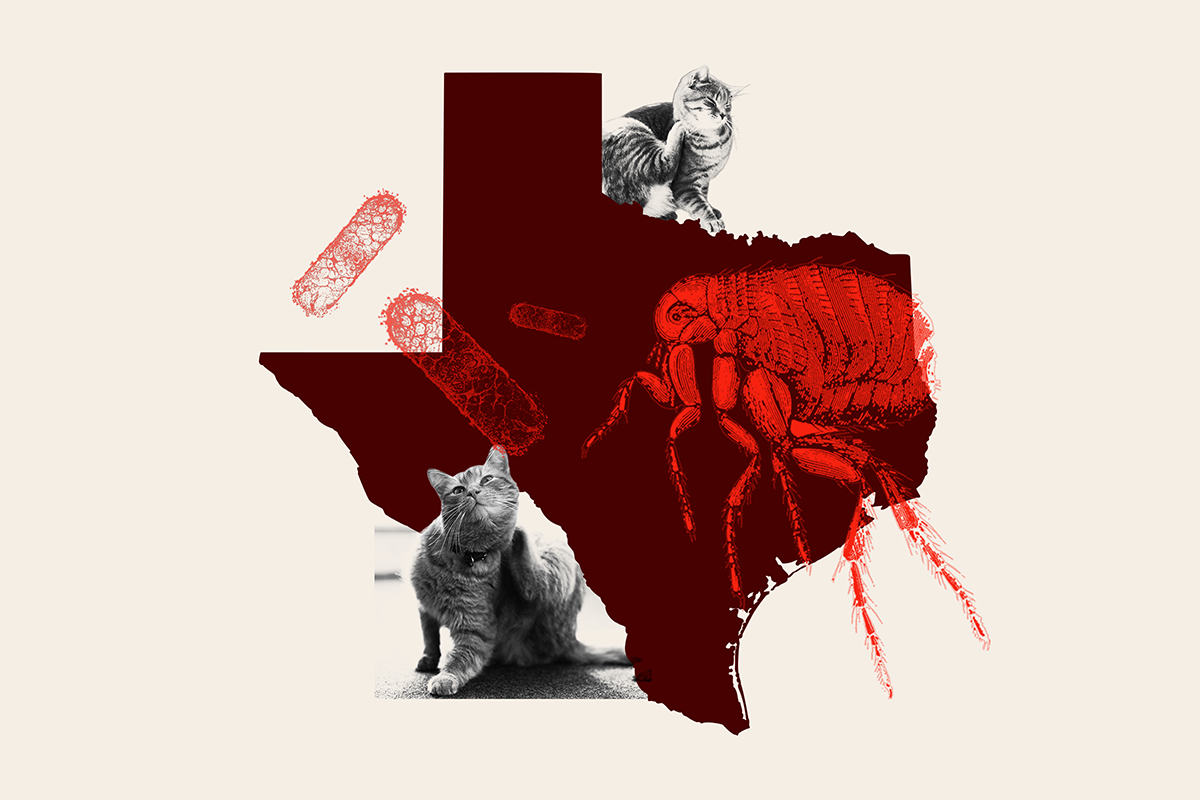
A resurging flea-borne disease is on the rise in parts of Texas, and researchers are warning that domestic pets could be bringing it into homes.
New research from the south of the state has drawn a direct line between fleas living on domesticated cats and the bacterium behind murine typhus—an illness once thought of as eradicated that has in recent years resurfaced, hospitalizing well over a hundred people in Galveston alone.
Researchers from Texas A&M College of Veterinary Medicine and Biomedical Sciences say their findings help explain why a disease once nearly wiped out in the U.S. is now creeping back into households through the family pet.
Read More on Health
A Disease Making an Unwelcome Comeback
Flea-borne typhus, also called murine typhus, is caused by the bacterium Rickettsia typhi and is spread to humans through fleas that have been infected. Symptoms usually appear six to 14 days after exposure and include fever, headache, chills, rash, backache, joint pain and nausea.
Most cases are mild, but, if untreated, the bacterial illness can escalate into a hospitalization, or worse.
Two people passed away from the disease between 2019 and 2023, according to data collated by University of Texas Medical Branch and highlighted by the Centers for Disease Control and Prevention (CDC). In an online report platforming the university’s June-published findings, the CDC shared that the disease is also resurgent in California.
Newsweek contacted Texas A&M University, University of Texas Medical Branch and the CDC via email, but there had been no reply before publication.
Crucially, the disease is not spread person to person. Humans catch it indirectly, typically after flea feces carrying the bacteria enter the skin through a bite or come into contact with mucous membranes such as the eyes or mouth.
The traditional vectors are fleas that feed on infected rodents, but researchers had long suspected that cats, and the fleas that hitch a ride on them, help the bacteria spread in people’s homes.
In Texas A&M’s study, which was published to Parasites & Vectors in May, researchers detected DNA from R. typhi in cat fleas, labeled scientifically as Ctenocephalides felis, in domestic cats across the Rio Grande Valley.
Out of 167 cats sampled, fleas from six of them tested positive for the bacterium.
That may sound like a small fraction, but the region has reported more than 6,700 cases of flea-borne typhus between 2008 and 2023, according to the Texas Department of State Health Services.
Despite that toll, scientists had remarkably little direct data on how common the pathogen actually is among the fleas living on local cats, until now.
Researchers say the findings underscore the value of a “One Health” approach—one that treats animal health and human health as interconnected rather than as separate issues. Cats themselves rarely become seriously ill from R. typhi, the study authors noted, but that does not mean they are off the hook.
Keeping fleas at bay on pets through veterinary treatments remains one of the simplest ways to protect the humans who live with them.
A spokesperson for City of San Antonio Metropolitan Health District told Newsweek: “Metro Health monitors reports of flea-borne murine typhus, which is endemic in Bexar County. Our data dashboard shows rates above pre-pandemic levels in 2023 and 2024.
“Fleas are more active during warm weather. The public is encouraged to take precautions against flea bites by using insect repellants, treating pets for fleas, and keeping rodents and wild animals away from their homes. When addressing rodent infestations, treat for fleas first, so that fleas on the dead rodents do not move to human hosts.”
The Human Toll in Galveston
While the Rio Grande Valley study traces the pathogen’s path through pets, the University of Texas’s separate investigation, published one month later, lays out just how serious the disease is.
Reviewing the college’s microbiology records from April 2019 through October 2023, researchers identified 149 adults with murine typhus. Of those, 119—nearly 80 percent—required hospitalization, and 33 needed intensive care.
Two patients died in the ICU, their deaths attributed to multiorgan failure and a rare, severe immune complication called hemophagocytic lymphohistiocytosis. Older age emerged as a significant risk factor for landing in intensive care, while obesity, diabetes and chronic kidney disease were the most common underlying conditions among those hospitalized.
Severe manifestations with organ dysfunction have been reported in the time that the disease has been known. They include acute kidney injury, meningoencephalitis, myocarditis, respiratory failure, and septic shock. But it is the recent Galveston numbers that reflect a broader, unsettling trend.
A different, 2023 study of Galveston County residents, also headed by University of Texas, found that antibody evidence of past R. typhi infection had climbed from just 1.2 percent of the population in 2013 to 7.8 percent in 2021—a statistically significant jump that hints at how much more common exposure has quietly become.
“There are only a few places in the U.S. where murine typhus is recognized to be transmitted with some regularity and, unfortunately, that includes South Texas,” Dr. Sarah Hamer, a professor in VMBS’ Department of Veterinary Integrative Biosciences, said. “The increased abundance of pet cats and stray or feral cats, socioeconomic conditions that prevent access to affordable flea protection on cats, and warming temperatures likely all promote flea infestation of cats and transmission of the bacteria that causes typhus.”
Newsweek contacted Galveston County Health District, Texas Health and Human Services and representatives for Texas Department of State Health Services for Victoria County via email.
Murine typhus was once a nationwide problem, but aggressive vector-control campaigns in the 1940s decimated rat flea populations and all but erased the disease from the U.S. In Galveston, it appeared to have disappeared for decades.
But its return has been documented in a troubling progression—one that now runs through South Texas neighborhoods and, it appears, through the fleas riding on the region’s much-loved house cats and abundance of strays.
Contact Newsweek editors on this story: Kara Dolman and James Debens