
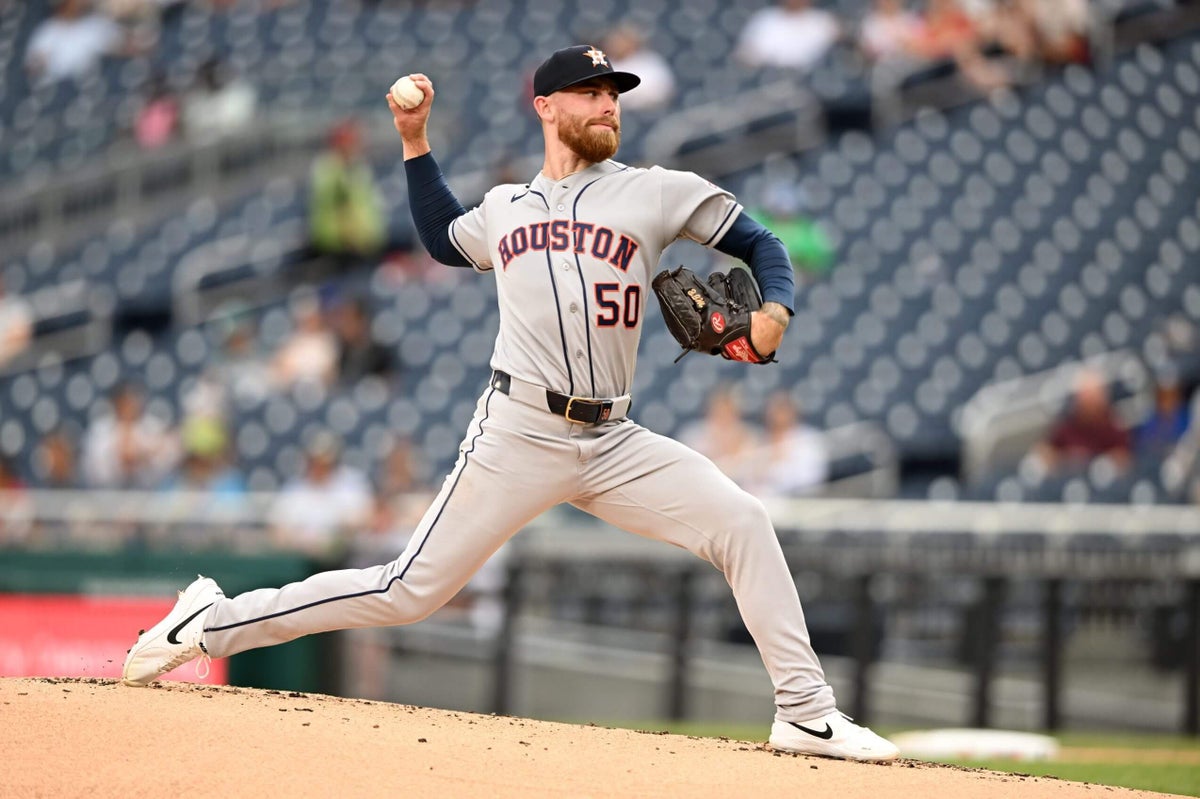
WASHINGTON — There is one badge of honor for Mike Burrows, a pitcher whose brutal first half of the season must have him on borrowed time. No American League starter has a higher ERA, WHIP or is allowing a higher batting average, but Burrows does deliver deep outings.
It is a consolation for his calamitous introduction to the Houston Astros. Burrows is becoming a burden to their rotation, though he is still a savior for their bullpen. The 94 2/3 innings he has thrown are a team high. Fifteen of his first 16 starts featured at least five frames.
For a pitching staff that missed Hunter Brown for two months and failed to replace Framber Valdez with anyone established, that matters. More is expected from a player who cost two touted prospects to acquire, but this is what Burrows has become. It is underwhelming, yet still useful.
So, on Monday, there stood Burrows in the fifth inning of a game he’d already given away. He took the mound in the third with a five-run lead against the Washington Nationals. Burrows handed it back after facing five batters. One of them walked, and four others had hits that left their bats faster than 98 mph. CJ Abrams’ score-tying three-run homer concluded the sort of brutal sequence that has defined Burrows’ dismal stretch.
Why this July will be an exciting month for MLB
Ken Rosenthal and Johnny Sweet
“I just feel like I let our team down,” Burrows said after the 12-11 loss. “They gave me a good lead, and I kinda spoiled it.”
After he did, Burrows began to settle. Between the third and fourth innings, he retired six of seven hitters. The lone runner reached on an infield single that traveled 3 feet. This has been Burrows’ formula — fall apart, find a way to fight through five or six frames, and give Houston’s offense a chance to come back. He seeks quick contact, fills the strike zone and becomes efficient.
“We just have to create some opportunities for him to go to areas where we can get some quick outs,” manager Joe Espada said. “He’s shown signs of that, but we need more consistency out of his pitches.
“There’s signs where he throws a couple of good pitches, where you’re like, ‘OK, that’s the shape that we want. That’s the location we want.’ But it’s creating more consistency. Can we do it for two or three innings in a row?”
Eighteen appearances into Burrows’ tenure with the Astros, the answer is apparent. His struggles have often been softened by an ability to eat innings despite them. Failing to do so Monday altered the conversation, if the shrinking calendar already hasn’t.
When Curtis Mead mashed Burrows’ third pitch of the fifth inning for a solo home run, Washington took a lead it never relinquished. Three of the next four hitters reached base. Substitute shortstop Braden Shewmake should’ve turned a double play against one of them, but Burrows is past the point of blaming poor luck. He had that excuse for the season’s first six weeks. It has since disappeared.
On Monday, Burrows didn’t finish the fifth, surrendered seven earned runs and forced an already overworked bullpen to collect 11 outs — in a game the Astros led 6-1 entering the bottom of the third. That is difficult to defend.
“We need more consistency,” Espada said. “He’s working his tail off. We got to give him credit, but we have to help him through this process and try to get him right.”
Whether that work can come in a major-league rotation is for Espada and the Astros’ pitching coaches to ponder. When posed with the question after Monday’s game, Espada replied, “Yeah, of course. That’s how you get it done.”
Role changes are rarely announced 15 minutes after a game, but Burrows’ body of work should warrant a deeper look at the viability of his spot in the rotation. His ERA rose to 5.99 after Monday. He has surrendered 21 home runs across his 18 appearances. Twelve of them have come with a runner or runners on base.
“I don’t think there’s any diminished confidence,” Burrows said. “I’m in the zone. I’m not afraid to make these guys swing. You get beat a couple times a game. If it’s right at someone, it’s going to be a great start. If it finds its way away from them or over the fence, that’s when some runs come. You can’t be perfect. You just try and execute pitches and get outs.”
The number of adjustments Burrows is attempting to make — be it raising his arm angle, changing his position on the mound or altering his pitch sequencing — is difficult to execute while still preparing to start every fifth or sixth day.
“It’s challenging to just walk in the next start and be somebody that you weren’t (in the) last start. That’s tough,” Burrows said. “Continuing to work and going out there every six days is what everybody does. Whether it’s something small or something a little more major in an adjustment, try not to make it all at once and try not to lose the mindset of going out there and competing every fifth day. Just have to juggle that and work your way through it.”
Alleviating that stress is one possible solution. Last month, Burrows received a “breather” in the bullpen for one turn through the rotation. He also has minor-league options remaining, though the optics of demoting another offseason acquisition would be ominous for general manager Dana Brown, who is in the final year of his contract.
Soon, though, the Astros could be forced to act. Ronel Blanco and Lance McCullers Jr. will make minor-league rehab appearances Tuesday as part of a piggyback appearance at Triple-A Sugar Land. McCullers has built his pitch count to 60 during his first two rehab starts. Blanco, who will pitch in relief of McCullers on Tuesday, has also reached 60 pitches in his recovery from Tommy John surgery.
Expecting either Blanco or McCullers to pitch for the Astros before the All-Star break feels foolish, but their looming second-half return will emphasize questions about Burrows’ spot in the starting rotation. Bear in mind Cristian Javier is also in the bullpen and stretched out as a traditional starter — one with far more major-league pedigree than Burrows.
That fact is often overlooked. Burrows had just 99 1/3 innings of major-league experience when Houston acquired him this winter. As Espada said Monday night, Burrows is “still a young pitcher” who requires some “help through this process.”
The best setting for him to receive that help remains a fascinating issue. The Astros entered Monday trailing the Texas Rangers by one game for the final American League playoff spot. Burrows’ next scheduled start is Sunday against the Rangers in Houston’s first-half finale. It is a consequential series, even if this is just the second week of July.
Whether Burrows is the right starter to appear in it is a legitimate question.