
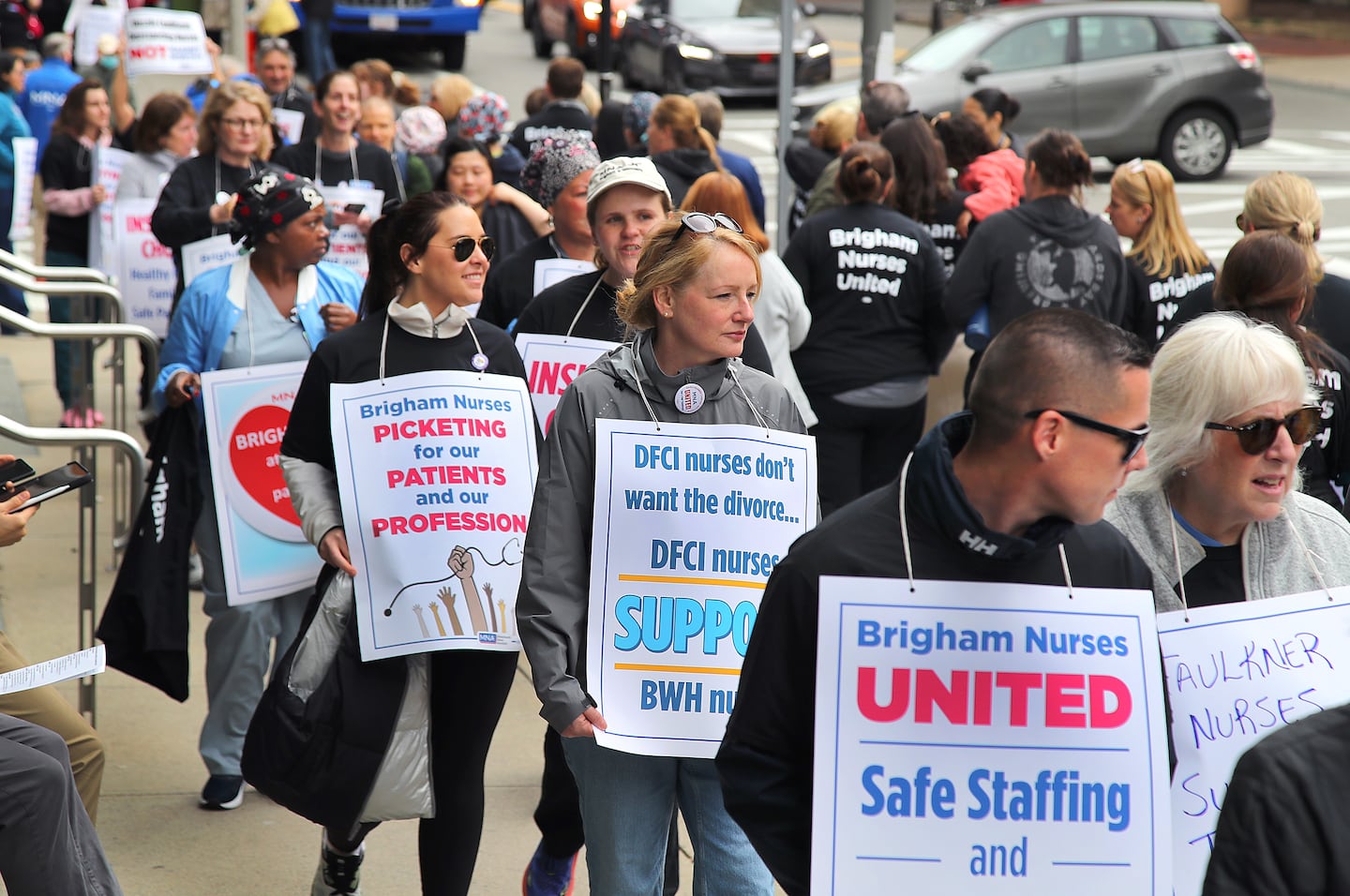
The dispute has the potential to disrupt care at and tarnish the reputation of one of the state’s most prominent and highly rated hospitals. MGB representatives said they have secured temporary nurses and that patient care should not be affected.
Governor Maura Healey convened representatives from MGB and the nurses association on Monday to discuss the demands of each side. No additional bargaining sessions were announced.
Jennifer DeVincent, a nurse in the labor and delivery unit at Brigham and a union representative, said the hospital is “shelling out money to hire these scab nurses” but refuses to provide cost-of-living increases to unionized nurses and is requiring association members to contribute more for their health insurance.
“[Brigham] is paying for flights, hotels, food” for replacement workers, she said. “It’s just crazy.”
MGB spokesperson Jessica Pastore said in a statement that ensuring safe patient care during a strike requires significant preparedness and resources.
“Those costs are real, but they are temporary and directly tied to a defined work stoppage period,” Pastore said. “That is very different from agreeing to an above-market wage adjustment that becomes part of the permanent cost structure and compounds year after year.”
MGB’s labor strife doesn’t end there. A newly formed MNA chapter of MGB Home Care workers will also walk out on Wednesday, although their strike is scheduled to last seven days. The union represents about 450 nurses, occupational therapists, physical therapists, speech language pathologists, social workers, and dietitians who go to patients’ homes to provide care.
In a letter to the MGB board of directors released Monday, Brigham nurses union leaders wrote that the board and hospital executives are responsible for the strike, which would be the first ever mounted by nurses at the Brigham.
“Your decision is not based on financial necessity. It is a choice,” the July 3 letter said. “You have chosen executive compensation instead of investing in the permanent nursing workforce.”
The nurses association has said nurses are struggling while 14 current and former MGB executives received a combined $35.9 million in compensation in fiscal 2024.
Among the executives the union has called out are Dr. Anne Klibanski, the health care system’s chief executive, who earned $8.4 million that year, and chief operating officer Dr. Ron Walls, who earned $3.2 million. The union also said the private equity and venture capital backgrounds of many MGB board members contrast with the “the daily reality of bedside nurses.”
In an emailed response to the union obtained by The Boston Globe, MGB board chair Scott Sperling said the board remains committed to reaching an agreement with the union.
“We continue to believe that the best outcome for patients, nurses, and the broader community is one achieved through continued negotiations and without a work stoppage,” Sperling wrote. “The decision regarding whether to proceed with a strike rests with the MNA and its membership, and we sincerely hope that path can be avoided.”
The contract is largely stuck on cost-of-living increases — which Brigham nurses have received under past contracts in addition to yearly pay bumps tied to their work experience — and health insurance premiums. The hospital’s proposal includes annual 5 percent step increases and pay raises for employees at the top of the step scale, which some nurses characterize as a union-busting tactic intended to drive a wedge in the bargaining unit.
Pastore, MGB’s spokesperson, said the across-the-board increases requested by the union would cost the hospital $128 million over the 18 months of the contract. The hospital does not yet have an estimate of how much the temporary nurses will cost during the work stoppage, she said.
MGB has said the union is misleading the public by omitting that Brigham nurses receive an automatic pay increase of 5 percent every year as they progress through a 22-step pay scale.
“A 5 percent yearly raise is not 0 percent,” says one of several charts that Brigham distributed to the Globe a few weeks ago.
Nurses at the Brigham currently start at $86,700 annually, while midlevel nurses make around $147,000, according to documents shared by MGB.
Brigham nurses are the second-highest paid nurses in the state, after those at nearby Dana-Farber Cancer Institute, said Joe Markman, a spokesperson for the nurses ssociation, citing union data.
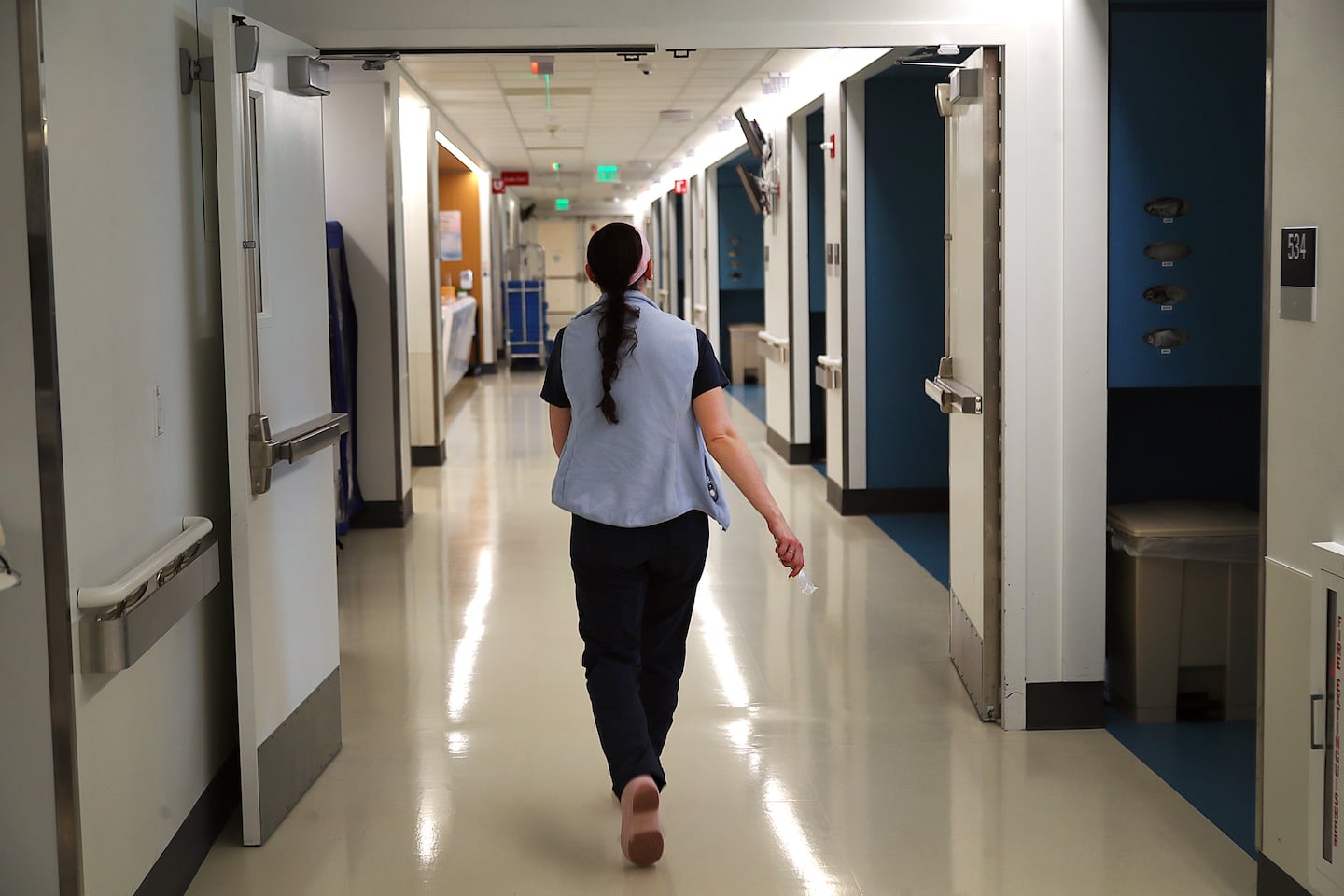 A nurse walked through a hallway at Mass General Brigham’s Newton-Wellesley Hospital in May.John Tlumacki/Globe Staff
The 4,000 nurses at the Brigham represent about 18 percent of the hospital’s workforce but account for more than 40 percent of its annual labor costs when adding up base pay, per-diem hours, overtime pay and differential pay for working less-desirable shifts, according to MGB.
Christopher Friese, a professor of nursing at the University of Michigan who did a postdoctoral fellowship at Dana-Farber from 2005 to 2008, said Brigham nurses are “paid very well.” But, he said, they handle medical cases that nurses at other hospitals don’t “because the care at the Brigham is among the most complex delivered in the state.”
“Nurses at the Brigham are highly expert and are delivering care that’s highly complex, and they’re doing it in a city with rising expenses,” he said. “I think that’s why the nurses are probably asking for these adjustments.”
MGB began orientation for temporary nurses over the weekend, Pastore said. The Brigham will employ nearly 1,300 temporary nurses during the work stoppage, including nurses specialized to work in high-acuity settings, like the neonatal intensive care unit.
Pastore said disruptions to care will be minimal, although some appointments may be rescheduled or moved to another MGB location. Patients who are scheduled to see Brigham nurse practitioners at MGB’s health care centers in Foxborough, for example, may have to reschedule their visits or choose to see another clinician.
There are no across-the-board cancellations of elective procedures, Pastore said. There may be some procedures affected, she said, but the number will be small and the hospital will contact any involved patients directly with details.
Additionally, MGB informed a handful of nurses scheduled to work the July 9 FIFA World Cup game at Gillette Stadium that they will not be allowed to complete those shifts, regardless of whether the strike happens. The Brigham, which has been providing medical support to the massive soccer tournament’s games in Foxborough, will staff the game with other, nonstriking Brigham clinicians in order to meet contractual obligations with FIFA. The hospital did not specify who will staff the games in place of the Brigham nurses.
Amid the MGB Home Care strike, some ancillary services, including dietitian and speech language therapy appointments, will be paused.
Despite the plans to minimize impacts to patient care, some patients are concerned the temporary nurses won’t be adequate replacements for the nurses who have worked at the Brigham for decades.
Among those worried was Charlotte Dobbs, a Watertown woman who gave birth to identical twin girls on June 12, seven weeks prematurely.
Her daughters have been in Brigham’s Neonatal Intensive Care Unit since then and have received extraordinary care from seasoned nurses, said Dobbs, 42, who is a chief of staff for a small technology company. Just Sunday, a nurse with 40 years of experience knew that one of the twins’ heart rates was going to drop — a common symptom among preemies — by reading subtle cues in the baby’s behavior.
“An experienced NICU nurse is worth their weight in gold,” said Dobbs, who is sympathetic to the nurses’ contract demands.
“I’m not privy to the Brigham’s financial situation, but from my perspective as a parent, the workforce they have is tremendously valuable,” she added. “These aren’t interchangeable people who can be swapped out with other people.”
The Brigham nurses and MGB Home Care unions aren’t alone in their conflict over contracts. Last week, nurses at the UMass Memorial Medical Center’s University Campus in Worcester authorized a 14-day strike over concerns about staffing shortages and workplace safety. That union has not yet set a strike date.
The Globe is interested in speaking with staff, patients, and others who are impacted by the strike. If you’re willing to speak to a reporter, please email Marin Wolf at marin.wolf@globe.com and/or Jonathan Saltzman at jonathan.saltzman@globe.com.
Marin Wolf can be reached at marin.wolf@globe.com. Jonathan Saltzman can be reached at jonathan.saltzman@globe.com.