
BOONSERM PREMTHADA’S GOYA TOWER RISES IN PHANG NGA
In Phang Nga, southern Thailand, elephants form part of both the cultural memory and ecological landscape. Nearby, a limestone mountain known as Khao Chang, or Elephant Mountain, is said to resemble a reclining elephant turned to stone. Designed by Boonserm Premthada with Bangkok Project Studio, Goya Tower continues this connection in built form, standing at the entrance to the Matalay Project as a new public lookout named after a female elephant born in the area.
The observation tower invites visitors to climb through a sequence of cylindrical columns, curved walkways, light, and shadow. As they ascend, views of road, garden, forest, sky, and sea gradually unfold across the surrounding landscape, extending the experience beyond the summit and into the slow rhythm of the climb.
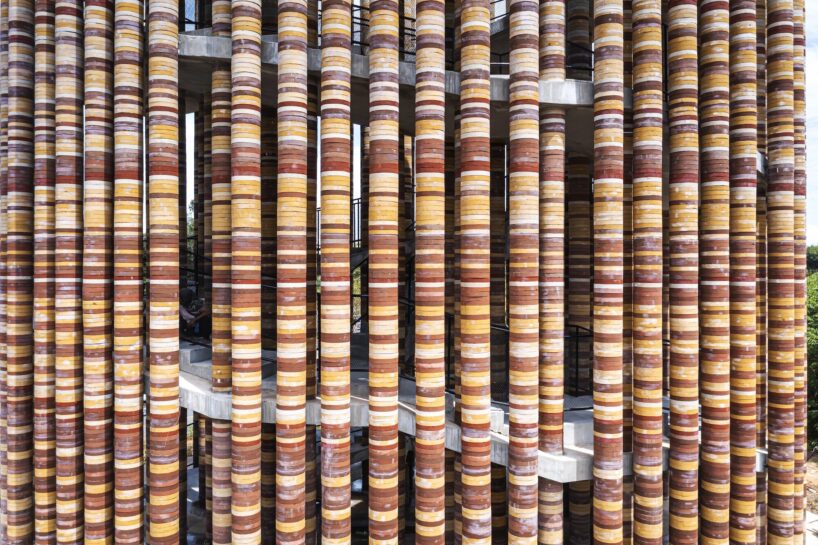
the observation tower invites visitors to climb through a sequence of cylindrical columns | all images courtesy of Spaceshift Studio
HANDMADE ORGANIC BRICKS SHAPE THE TOWER
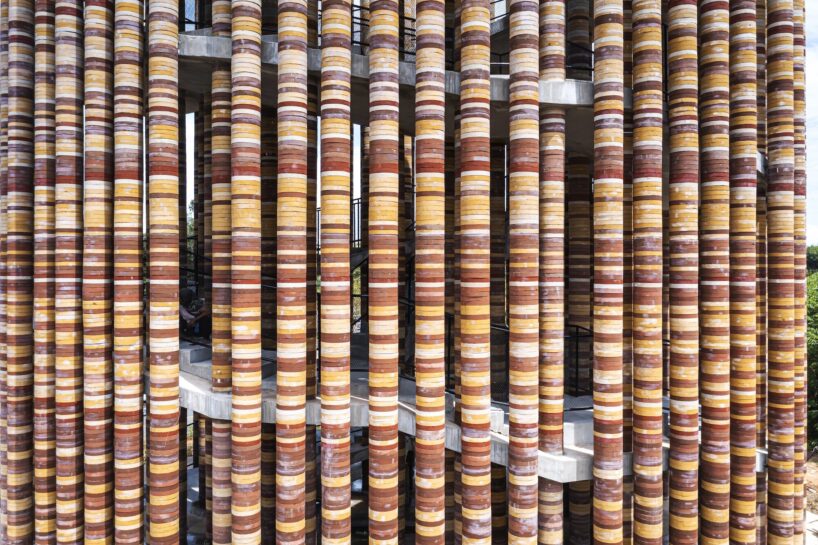
The project began with a simple question: could what elephants leave behind become architecture, and could it support a creative economy for elephant-raising communities? Each circular brick is made by hand using elephant dung, measuring 33 centimeters in diameter and 5 centimeters in thickness. Produced in five natural colors and never fired, the bricks rely instead on hands, sunlight, and time.
During construction, each brick is threaded onto a central steel rod and stacked according to a carefully designed color pattern. Through repetition, weight, and touch, the organic material becomes both structure and surface. With Goya Tower, Premthada’s research moves beyond object or museum collection to become a full-scale public space — one that visitors can enter, touch, climb, and inhabit.
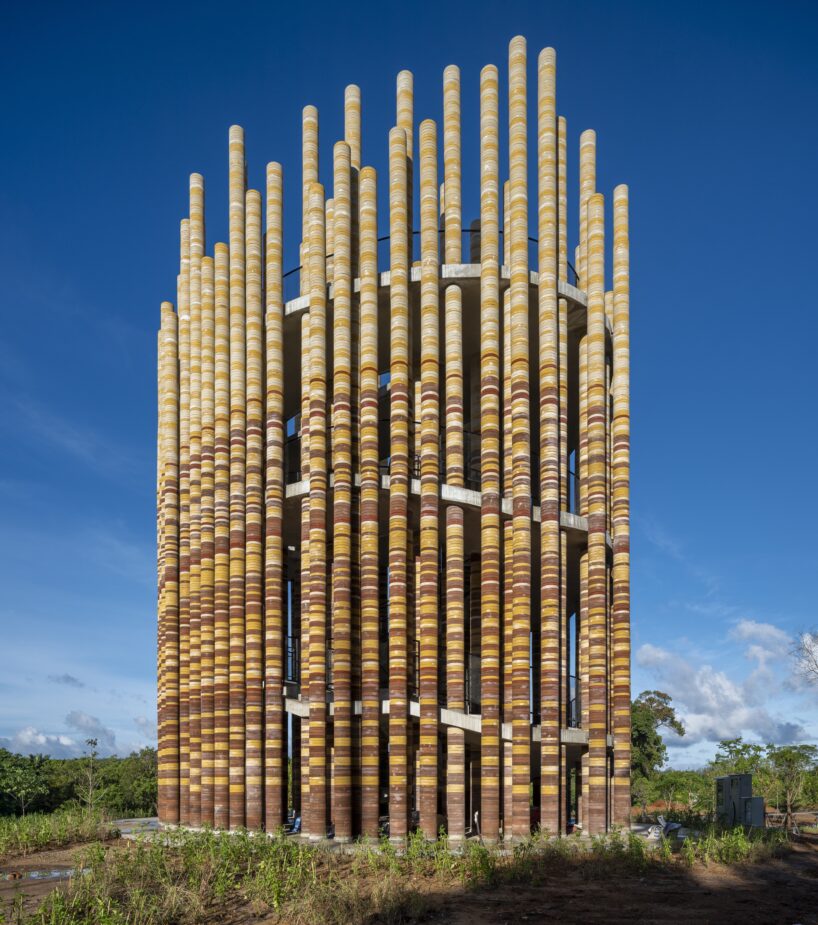
boonserm premthada shapes the observation tower as a sequence of cylindrical columns and curved walkways
FROM TA KLANG VILLAGE TO FULL-SCALE ARCHITECTURE
The material research behind Goya Tower began far from Phang Nga, with a single elephant-dung brick carried in a backpack from Ta Klang Village. What first appeared as an unlikely experiment, met with laughter and doubt, gradually developed into a long-term investigation into how elephant-raising communities could generate new forms of craft, value, and architectural production.
Over time, the elephant-dung brick entered the collections of institutions including MoMA and M+ Museum, but Goya Tower brings this research back into the landscape. Here, the brick is no longer only an object to be preserved or displayed; it becomes part of a larger cycle between animals, humans, and the land, suggesting an architecture shaped not by humans alone, but also by elephants, sunlight, and the landscape of Phang Nga.
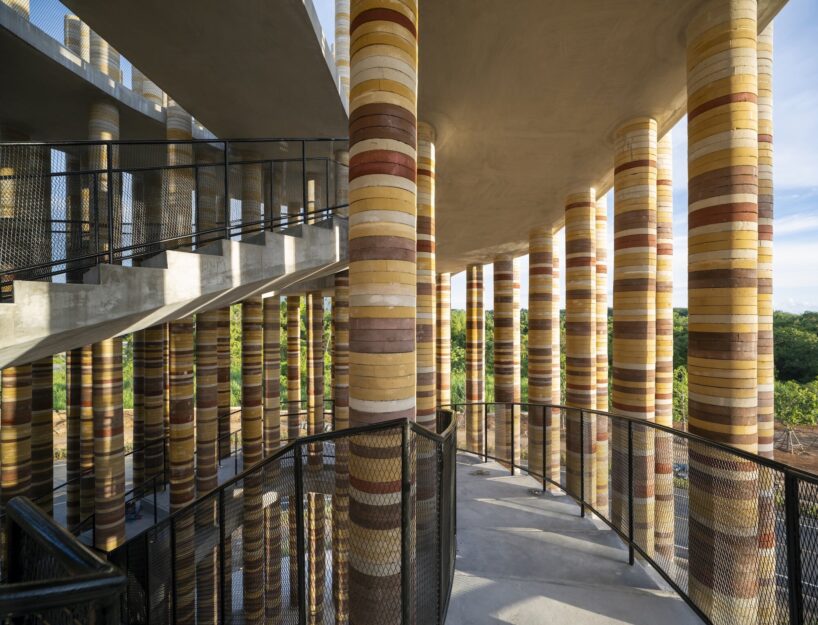
the tower invites visitors to climb through changing light, shadow, and views of the surrounding landscape