
The U.S. may have exited the World Cup, but World Cup-related college football questions haven’t exited the Mailbag just yet. They’re too fun. Just don’t expect me to answer them with any soccer expertise.
Which coaches are in position to become legends and legacy coaches, like Bobby Bowden at Florida State or Frank Beamer at Virginia Tech, who are closely associated with the program? Do you think any of the top young coaches will stay long enough to build a legacy? — Travis
Today’s coaches are more upwardly mobile and don’t have the same longevity at their schools. Part of that is the rigors of the job, but also the conference landscape, where everyone is trying to get to the Big Ten or SEC (or the NFL). If he were coaching today, would Beamer have stayed at Virginia Tech for 29 years? Would Bill Snyder have remained at K-State his entire career? Or would both have eventually said, “I need to be somewhere with more money”?
But three current coaches have already achieved legendary status: Dabo Swinney at Clemson, Kirby Smart at Georgia and Kirk Ferentz at Iowa. I could see all three receiving statues even if they retired tomorrow. Kyle Whittingham was headed toward the same status at Utah but threw a curveball by taking the Michigan job. How long he stays there and how well he performs may have a considerable impact on his legacy at Utah.
Not there yet but could be one day: BYU’s Kalani Sitake, who made a statement about his loyalty there by spurning Penn State. Sitake is 84-45 in 10 seasons at his alma mater with four double-digit-win seasons. The next milestone on his resume would be reaching the College Football Playoff. Mind you, BYU already has an all-time great in LaVell Edwards, who won 257 games and the school’s lone national title. But a school is allowed to have multiple coaching legends. See Alabama.
Among the younger coaches, Arizona State’s Kenny Dillingham checks a lot of boxes: He’s an alum, he’s only 36, and he’s already won a conference championship. There’s a plausible scenario where he coaches there for 25 years and wins hundreds of games. That said, he’s been a head coach for just three seasons. That’s a long way to go.
Is Bowden vs. Spurrier the best rivalry ever in college football?
Joe Rexrode
Stewart: With Big 12 Media Days this week, I was thinking about your podcast discussion on how the league has emerged from the departures of Texas and Oklahoma. Which team(s) in the conference have the strongest brand appeal, and can they fill the Texas/Oklahoma void? — Rob W.
As we know, “brands” in college football take decades, if not centuries, to establish. Oklahoma is one of the winningest programs in the history of the sport, and Texas has four national championships. No one else in the current Big 12 comes close to them historically. Mostly, they seem to have limited bursts of relevance.
Arguably, the biggest brand in the conference is BYU. Some of that is due to its large LDS following. But the main reason people recognize BYU’s jerseys is the 1984 national championship, Ty Detmer’s 1990 Heisman win, and all those great quarterbacks under LaVell Edwards. That era established BYU as a decent TV draw, and it stuck from there, even during its decade-plus of independent purgatory.
Utah surpassed BYU in on-field success for much of the 2000s, thanks to Urban Meyer, Alex Smith, Kyle Whittingham, Eric Weddle, and so many others, but the Utes have never quite ascended the mountaintop. They were still often overlooked in the Pac-12, even when winning conference championships, largely because they’ve never had their version of BYU’s ’84 team. If Utah were ever to make a deep CFP run, it would raise its profile higher than all those BCS/New Year’s Six bowl trips.
TCU has shown glimpses of what it’s capable of, first with Gary Patterson’s 2010 Rose Bowl team and then with Sonny Dykes’ 2022 team, which made a surprise run to the national championship game. But any momentum from that run quickly faded after the 65-7 loss to Georgia and three undistinguished seasons since. Ditto for Deion Sanders and Colorado, as the Buffs’ breakthrough 2024 season was immediately followed by a 3-9 record.
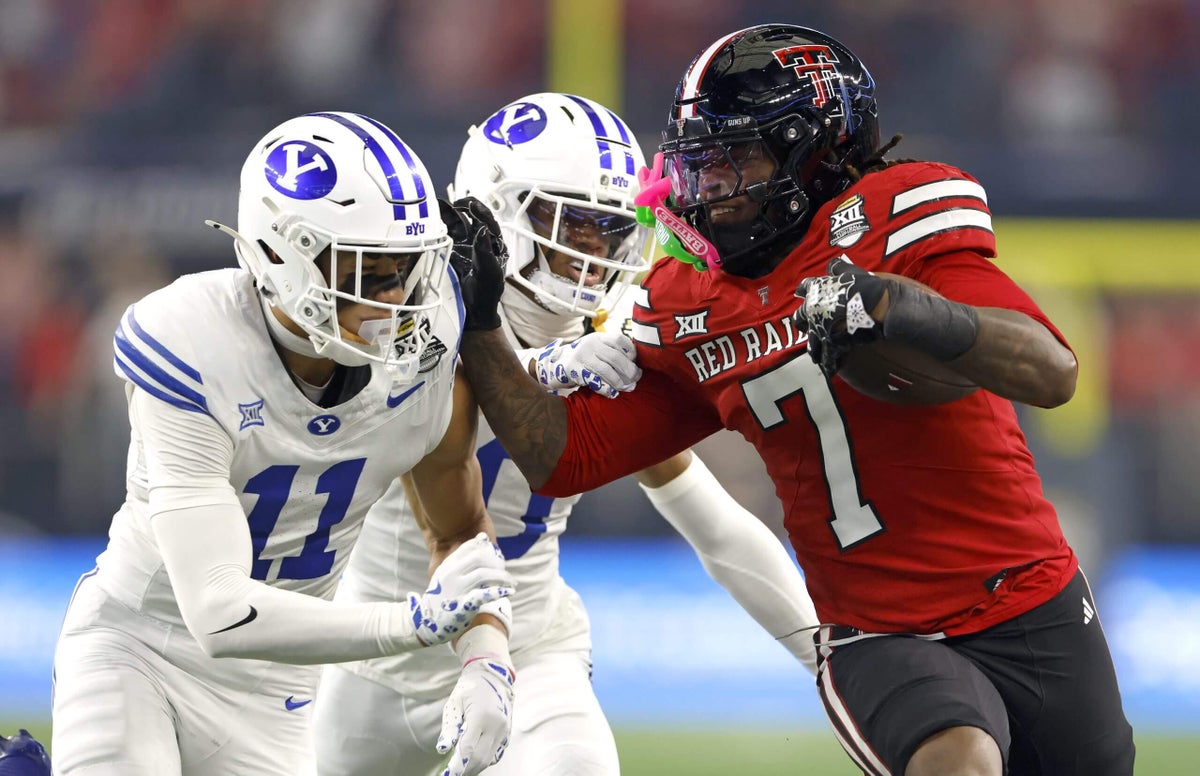
But now, there’s Texas Tech. No Big 12 program has generated more attention over the past 18 months or so, even if the most recent round of publicity involved a self-inflicted crisis. The Red Raiders are in the midst of an experiment to see whether a billionaire’s largesse can help build a century-old Texas/Oklahoma-type brand virtually overnight.
There’s only one sure way to instantly earn that recognition level: Win a national championship.
Indiana had one of the worst football brands for most of the sport’s history. That completely changed in the span of two seasons. Indiana is now the hottest brand in the sport. We’re yet to see whether the Hoosiers can sustain it, but as of now, they’re the shining beacon for the Texas Techs.
During that podcast discussion, Ralph Russo seemed fairly certain that Tech is about to become the beast of the Big 12, outspending everyone else to keep winning conference titles. I’m not ready to go there yet, but there’s no question that Texas Tech — or BYU or someone else — emerging as a new-age national contender would benefit the Big 12’s brand far more than sticking Monster Energy in front of its name.
I am really excited for the return of “Pac-12 After Dark” this year. For those of us out West, the defense-optional games and the team with the ball last wins were a perfect cap to a long day of college football. Which game or games on the schedule do you think will bring back those memories? — Mike B.
Obviously, ESPN’s 10:30 p.m. ET game has lived on the past two seasons, even if most of the games involved Big 12 or ACC teams. But I’d agree that we’ve mostly been missing the true Pac-12 After Dark spirit, between the teams involved (why are Florida State and Miami playing in the Bay Area to begin with?) and the lack of 67-63 games.
It will be nice to get some late-night “Pac-12” action, even if it’s mostly former Mountain West teams.
Unfortunately, the league’s first appearance is a dud: Portland State at San Diego State on the USA Network. It’s barely even After Dark, kicking off at 9:30 p.m. ET/6:30 p.m. PT. But never fear, the MWC is giving us UNLV-Hawaii at 10 p.m. ET on The CW. That’s got shootout written all over it. The Warriors are on the rise — they went 9-4 in 2025 in Timmy Chang’s fourth season, led by returning QB Micah Alejado. UNLV, meanwhile, boasted a top-20 scoring offense in Dan Mullen’s debut season. We’ll see if he can resuscitate former Oklahoma and Auburn five-star quarterback Jackson Arnold’s career.
In Week 2, CBS Sports Network brings us FBS newbie Sacramento State at Pac-12 newcomer Fresno State. Quick, can you name the conference FBS newbie Sac State joined? … It’s the MAC. Really. No idea what to expect in that one, other than it’s going to be overshadowed by Arkansas-Utah on ESPN and even Louisiana-USC on BTN, the latter of which kicks off at 11 p.m. (!) ET.
Week 3, meanwhile, is a late-night degenerate’s dream come true: SEVEN games at 10 p.m. ET or later, including what is surely the first-ever MAC After Dark home game (North Dakota State at Sac State on ESPN). There’s also a Big Ten intraconference showdown (Purdue-UCLA at 11 p.m. on BTN) and the requisite Boise State game (vs. South Dakota at 10 p.m. on CBSSN).
And in the Pac-12 specifically, San Diego State hosts reigning CFP darling James Madison at 10 p.m. on The CW. The Dukes, now led by Billy Napier, will field an almost entirely new team, which seems highly optimal for a defense-optional performance.
Two takeaways from this exercise: 1) With USA Network now in the college football channel mix, along with a full lineup on The CW, our remotes will be working overtime this season. 2) Thank goodness, for the sake of writing Final Thoughts, that I’m usually on Pacific time.
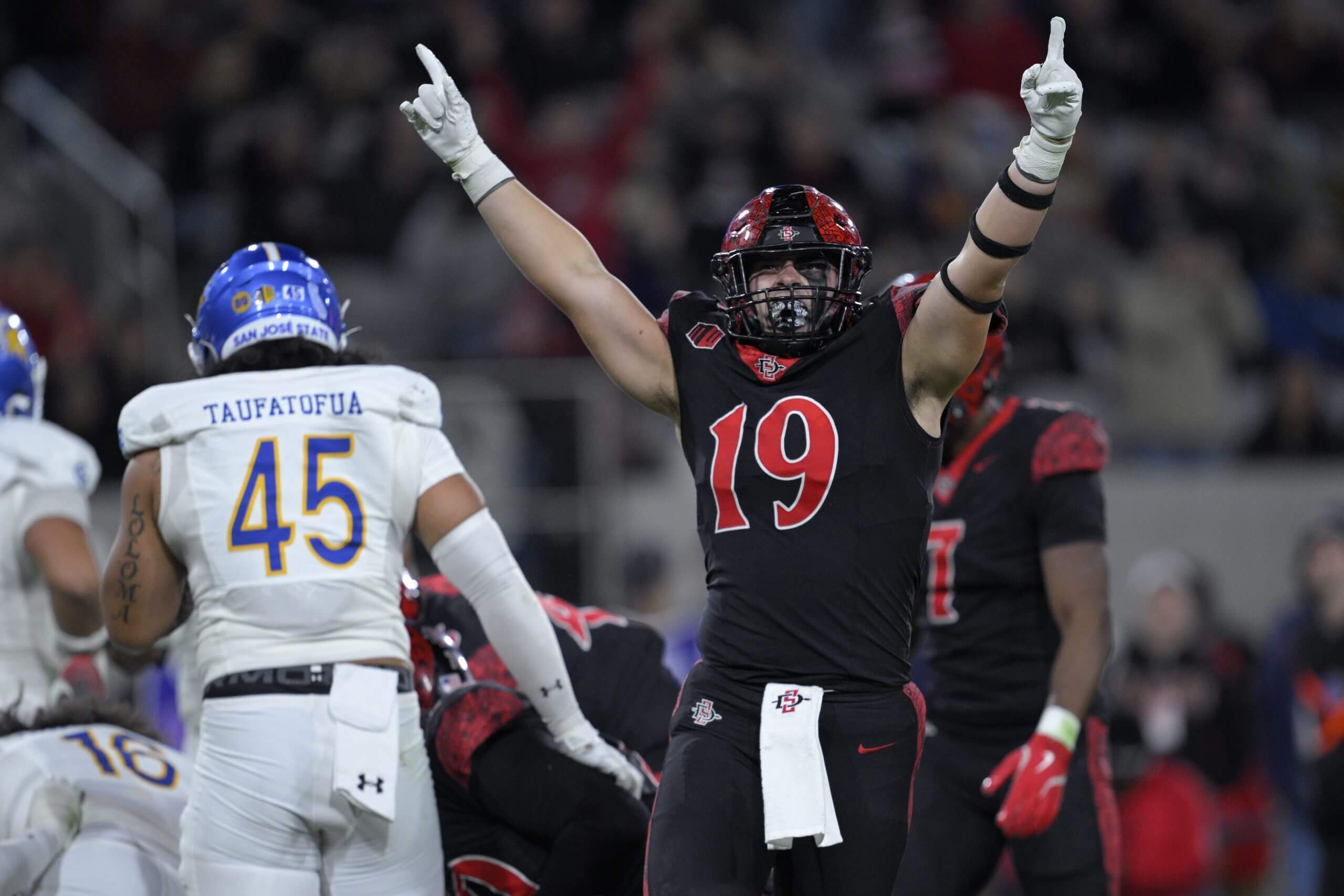
San Diego State will be a part of the new “Pac-12 After Dark” this season. (Orlando Ramirez / Getty Images)
You’re now Stewart Infantino. Build your World Cup of college football with teams representing the following countries:
• Three clear favorites (Spain, France, Argentina)
• Three host teams with an outside chance at a deep run (U.S., Mexico, Canada)
• Three good, but not great teams haunted by past program success (England, Brazil, Germany)
• Three plucky upstarts (Morocco, Cape Verde, Norway)
• Bonus: Didn’t make it this year, but next year is definitely their year (Italy) — Joseph Y., Pittsburgh
Fun question, but please do not give me that guy’s last name. I am impervious to bribes or lobbying by world leaders.
Three clear favorites: Indiana, Ohio State, Oregon. If we can’t have three from the same continent (conference), then Notre Dame.
For the host teams, we need teams closer to No. 16 than to No. 1. Think Iowa (whose entire identity as a program is “closer to No. 16 than No. 1”), Utah and USC.
The description of England/Brazil/Germany sounds like Penn State, LSU and Tennessee.
Three plucky upstarts: Texas Tech, BYU and Vandy.
Italy: Nebraska
How would you explain what makes college football special to someone who’s only ever known the NFL? I grew up in Oregon and am a diehard Ducks fan, but I now live in Vancouver, Canada, where college football barely registers and the NFL is supreme. — J.S.
I’m a firm believer that the only way for someone to truly “get” college football is to experience it in person.
Have them spend a fall weekend in Tuscaloosa, Ala., or Ann Arbor, Mich., and see firsthand how a big game completely takes over the community. Spend Saturday morning in the tailgate lot at LSU or Ole Miss, sampling the food and listening to conversations among friends and families who’ve gathered there on fall Saturdays for decades. Sit in the stands pregame at the Horseshoe when the band forms “Script Ohio” or at Jordan-Hare when the eagle takes off. Remain in the stands at the end of the third quarter for “Jump Around” at Camp Randall or “Shout” at Autzen.
Because the single biggest element that distinguishes college football from the NFL isn’t the game itself; it’s the pageantry.
If that’s not feasible, though, invite them over for a full Saturday of game-watching. Explain that umpteen things will happen that day that no one could have predicted that morning, and, much like the World Cup, at least one fan base is going to try to get their coach fired over one inexplicable loss. Make sure the lineup includes at least one rivalry game where the fans truly hate each other. And make them stay up for the late game.
As much as I’d love for every sports fan to fall in love with college football, it’s rare to see someone become a diehard without either growing up around it or attending a college where football is king. I myself got hooked my sophomore year at Northwestern in 1995, witnessing how one dream season could galvanize the campus and bring together alumni from across the country.
But I recognize that the more traditional path is usually, “My grandpa was a Penn State fan, my mom and dad were Penn State fans, so I’m a Penn State fan.”
Could a team of Group of 6 All-Stars win the national championship? — Martin D.
Five years ago, I would have said absolutely. Now I highly doubt it because most of last year’s G6 All-Stars are now playing in the P4.
Let’s look at some numbers from last year’s NFL draft. National champion Indiana produced 10 draft picks, including the No. 1 pick (Fernando Mendoza) and two other first/second-rounders (Omar Cooper Jr. and D’Angelo Ponds). They’ll likely add five or more next year, all key players on that team.
Meanwhile, 15 players from G6 schools (including non-Notre Dame independents) were drafted. Roughly the same number, though the highest was selected No. 27 (San Diego State CB Chris Johnson), and only one other was taken in the second or third rounds (Toledo S Emmanuel McNeil-Warren at No. 58). Most problematically, no G6 quarterback was drafted, unless you count North Dakota State’s Cole Payton, who went in the fifth round. That’s quite a mismatch.
And these are just the first-stringers. The discrepancy would be even more pronounced with the depth pieces.
To illustrate how much the landscape has changed since NIL and the last round of conference realignment: In 2021, 40 Group of 5 players were drafted (including non-Notre Dame independents). They included the No. 2 pick, BYU quarterback Zach Wilson; two other first-rounders, Tulsa LB Zaven Collins and Houston DE Payton Turner; and two second-rounders, UCF safety Richie Grant and Western Michigan WR D’Wayne Eskridge.
Suffice to say, the 2020 Group of 5 All-Stars (players who would have been drafted in 2021) was likely much more talented top to bottom than the 2025 edition. Only problem: So were the national champions from that era. Not confident that team would have been able to hang with 2020 Alabama.
Stewart, looking back at the ‘90s series, I wanted to know if you had opinions on any of the following:
1) Is there a year that stands out that may have produced a much different champion had there been a Playoff?
2) Is there a player who would have greater utilization/impact than he had then given the style of play?
3) Is there a team that could be transported 25-35 years later to this year and be a Top 5 contender (whether by scheme or talent)? — Colin K.
If you read my ranking of the Top 15 teams from the ‘90s, you may notice I had neither of the 1990 co-champions: Colorado (which went 11-1-1 and famously needed a fifth down to avoid a second loss) and Georgia Tech (which capped its 11-0-1 season with a Citrus Bowl win over No. 19 Nebraska). Clearly, both were mortal, making that season ripe for a lower-ranked team to rip through the Playoff. Best bet: Miami, which went 10-2, losing to BYU and Notre Dame, but finished the season on a six-game win streak capped by a 46-3 Cotton Bowl rout of third-ranked Texas. (The one where the Canes committed 16 penalties and still rolled.)
In terms of a player who came along too early, definitely Michael Vick. In my memory and on YouTube, he is the most lethal running quarterback ever. Yet he averaged just 58.5 rushing yards during the ’99 regular season, averaging barely 10 carries a game. Frank Beamer didn’t fully unleash him until the title game, when he ran 23 times for 97 yards. Think what he could have done in a 2000s hurry-up spread, where guys like Cam Newton, Johnny Manziel and Lamar Jackson racked up 1,400-1,600 rushing yards in a season.
As for the last question: Comparing eras is largely impossible, since players only get stronger and faster. But if you assume the best players from that era were as good as the best players today, I’d say most of the top teams from that era would be top-5 contenders today, since they could keep all their players together for four to five years.
Imagine if in the second half of a Playoff game, an SEC team loses its star defensive player to a borderline targeting call following video review. Before its next Playoff game, the NCAA announces that while the targeting call hasn’t been rescinded, the SEC player can play in the first half of the next game, without explaining its reasoning. How would you, as a college football commentator, react? — Marc S.
Love where you went with this, but technically this could already happen.
Starting in 2022, conferences could appeal a second-half targeting ejection to the national coordinator of officials (then Steve Shaw), and if successful, the player no longer had to sit out the first half of the next game. After Ohio State’s Arvell Reese was ejected late in the Buckeyes’ win over Nebraska, the Big Ten appealed on the Buckeyes’ behalf. Shaw determined the targeting call was incorrect, and Reese played the entire game against Penn State the following week.
Meanwhile, starting this season, there will be no first-half suspensions unless it’s the player’s second targeting call of the season, and even those can be appealed.
No hazy loopholes, no need for presidential intervention.
Takes notes, FIFA.