
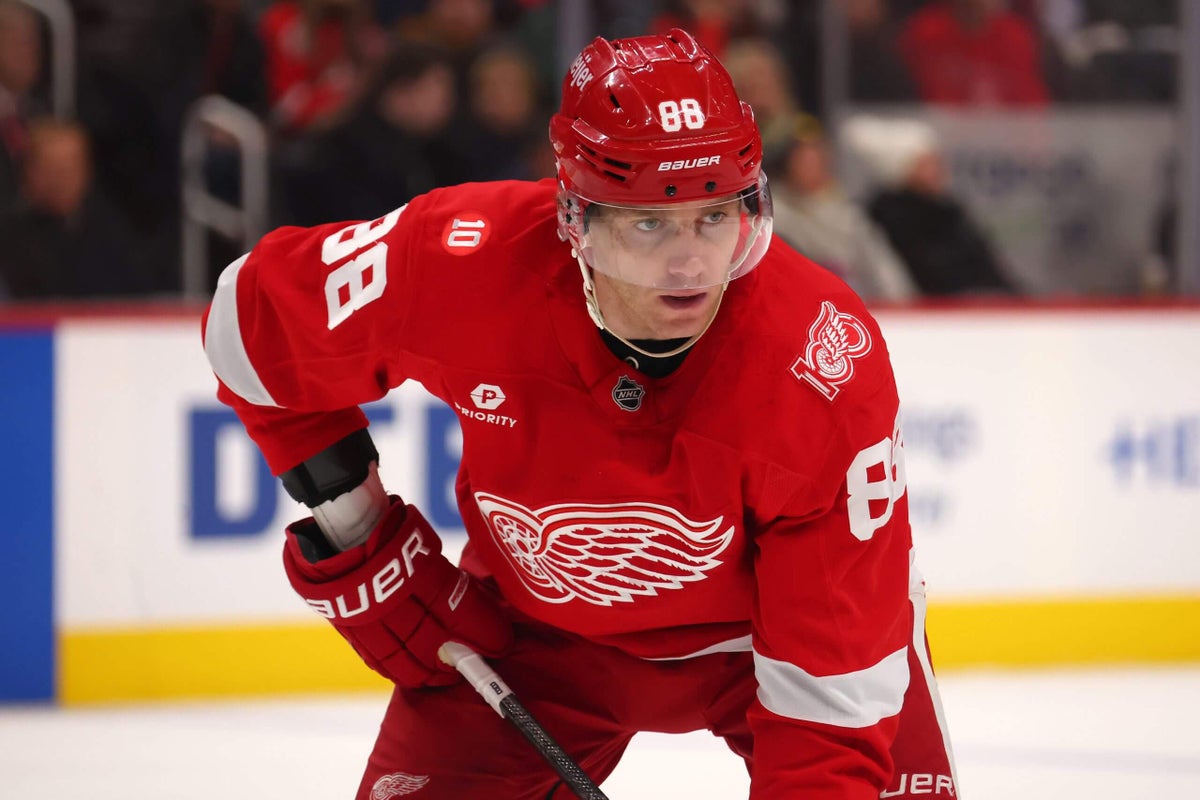
With free agency having (largely) come and gone, and Dylan Larkin’s trade request still unresolved, it’s totally unclear when Detroit Red Wings general manager Steve Yzerman will make what will likely be the biggest move of his tenure.
That looms over everything about this Red Wings offseason.
But it’s not the only bit of business still needing to be done. And while the Larkin domino is certainly the biggest in Detroit, three other major decisions are coming that will have huge impacts on the Red Wings in 2026 and beyond.
NHL free agency: Early winners and losers
Shayna Goldman and Madison Eades
Patrick Kane
A week into free agency, Kane still hasn’t picked where he’ll play in 2026-27.
As recently as the draft, Yzerman acknowledged the Red Wings still want the future Hall of Famer back in Detroit this season. And certainly there remains room for him in the top six, even after the signing of Viktor Arvidsson. But given all that, it’s also fair to believe that if Kane was dead-set on returning, he likely would have signed by now.
As long as Kane is still out there, the Red Wings can hold out some sliver of hope that he’ll wind up returning to the city where he’s signed three consecutive one-year deals. But they realistically have to be planning for the possibility he’ll land elsewhere. And if that happens, it’s another blow to whatever competitive chances they currently have in 2026-27.
While Kane has his warts at this stage of his career, he was still a big part of the Red Wings’ offensive push last season, especially at five-on-five. His 2.03 points per 60 ranked second on the team, trailing only his linemate Alex DeBrincat. That’s a strength of Arvidsson’s game too, but ideally, the Red Wings would be adding Arvidsson to what they already had. Kane was also a key piece of Detroit’s power play, as the team’s most creative facilitator.
So if Kane leaves, even if Arvidsson ends up replacing Kane’s production — albeit in a different style, as an interior scorer compared to Kane’s playmaking — that likely ends up being more like a lateral move. And with the expected subtraction of Larkin (eventually), that would amount to going backward on the whole.
The Red Wings could still pivot elsewhere in the event Kane leaves — Eeli Tolvanen is 27 and only one year removed from a season with more than 20 goals and 200 hits — but players with Kane’s level of intelligence and playmaking are hard to find, and harder to replace. And really, it would leave Detroit to again rely heavily on internal improvements from their young players.
That could happen. Marco Kasper should bounce back from a down sophomore season. Emmitt Finnie had 21 individual expected goals last season but converted only 13 — making a step forward seem possible there, too (though playing on a line with Larkin, of course, helped). Maybe Michael Brandsegg-Nygård’s heavy game and big shot make the bottom six more threatening.
The continued infusion of youth should bring a certain energy to the lineup. And by adding Arvidsson and Keegan Kolesar, perhaps the Red Wings start to shift their broader lineup identity too.
But any way you frame it, losing Kane — in addition to whatever plays out with Larkin — would be a blow, and another reason to expect a step back in 2026-27.
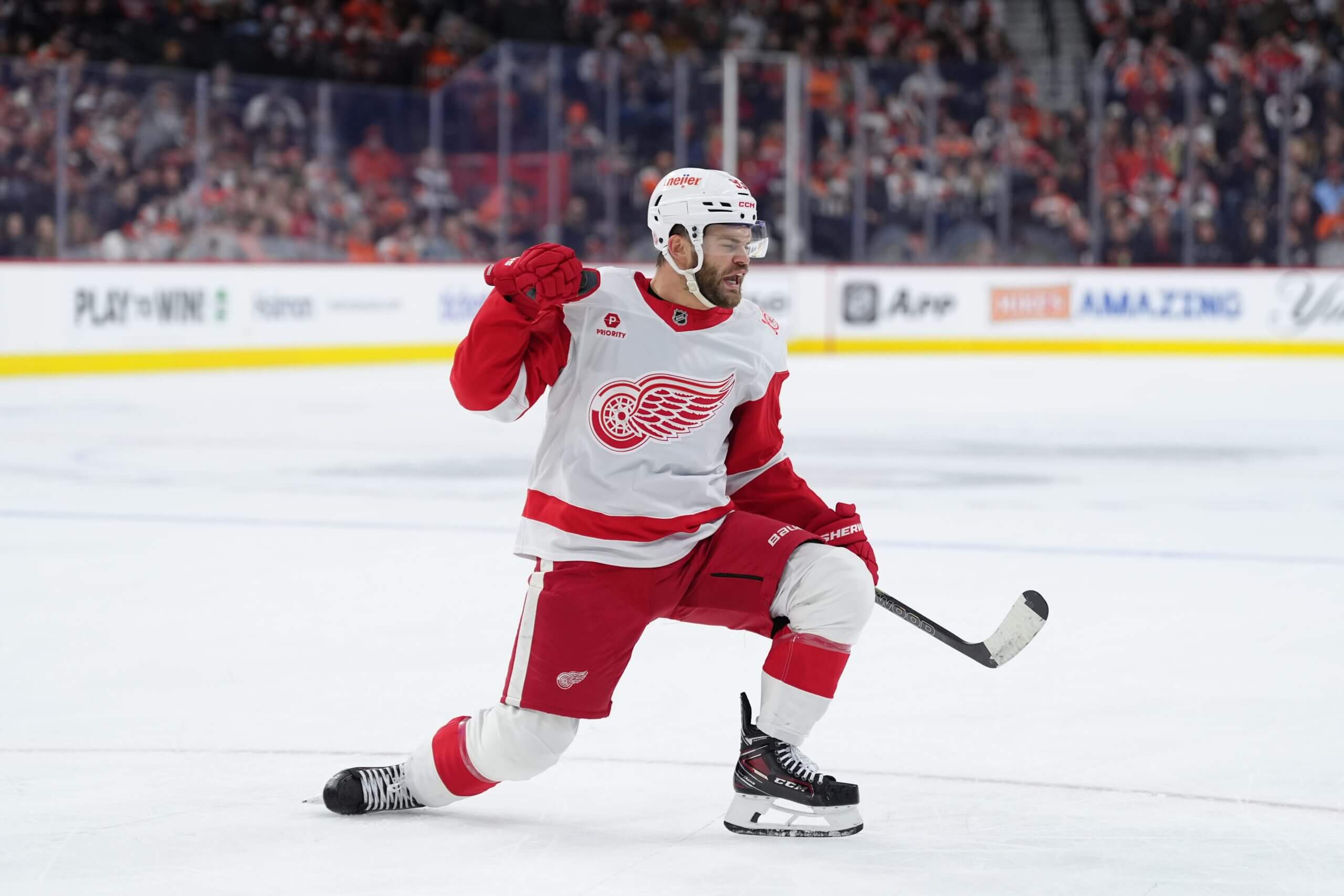
Alex DeBrincat has a year left on his current contract. (Kyle Ross / Imagn Images)
Alex DeBrincat
While Kane and DeBrincat’s friendship makes it tempting to link these two situations, Kane’s age (37) means DeBrincat’s decision about his future needs to be made independently.
One year from becoming an unrestricted free agent, and thus eligible for an extension, DeBrincat is in line for a huge raise on his next deal — and maybe more than we even realized a month or two ago. At the time, the main parameter-setting contract was Adrian Kempe ($10.625 million for eight years), and Alex Tuch’s eight-year deal at $10.5 million reinforced that for a late-20s scorer.
DeBrincat has outproduced both of them, though, and after seeing what kind of money NHL teams were willing to throw around for Jason Robertson and now Leo Carlsson — although Carlsson is much younger and a center, so certainly not a perfect comparable — it’s fair to wonder what could be out there a year from now for DeBrincat, a three-time 40-goal scorer who was 11th in NHL goals and 19th in points last season.
In other words, the Red Wings need to come correct with their offers to DeBrincat, even if that number is over (and possibly well over) $11 million. It’s a lot of money, but it’s the new way of the world in the NHL. And if they don’t pay it, the odds are good that someone else will a year from now.
Where Kane (and Larkin) could come into play here is in sizing up Detroit’s competitive timeline. If both indeed depart, leading to a step back, what would that mean for the 28-year-old DeBrincat’s interest in sticking around? He’s a hometown product, and while he hasn’t had to live through quite as much losing in Detroit as Larkin, the Red Wings’ direction in his remaining prime years could matter. That’s a factor that money can’t totally account for.
I’ve said all along that I think the Red Wings have to do everything they can to keep DeBrincat. Doing so feels critical for retooling quickly enough to contend in Moritz Seider’s and Lucas Raymond’s primes (they are already 25 and 24, respectively).
The Red Wings don’t technically have to sign DeBrincat to an extension this summer, with a year left on his current contract. But getting a deal done sooner would prevent this one from looming all year. And with the cap set to rise again in a year, it may save Detroit some money, too. Letting a player get too close to the open market is always a risk.
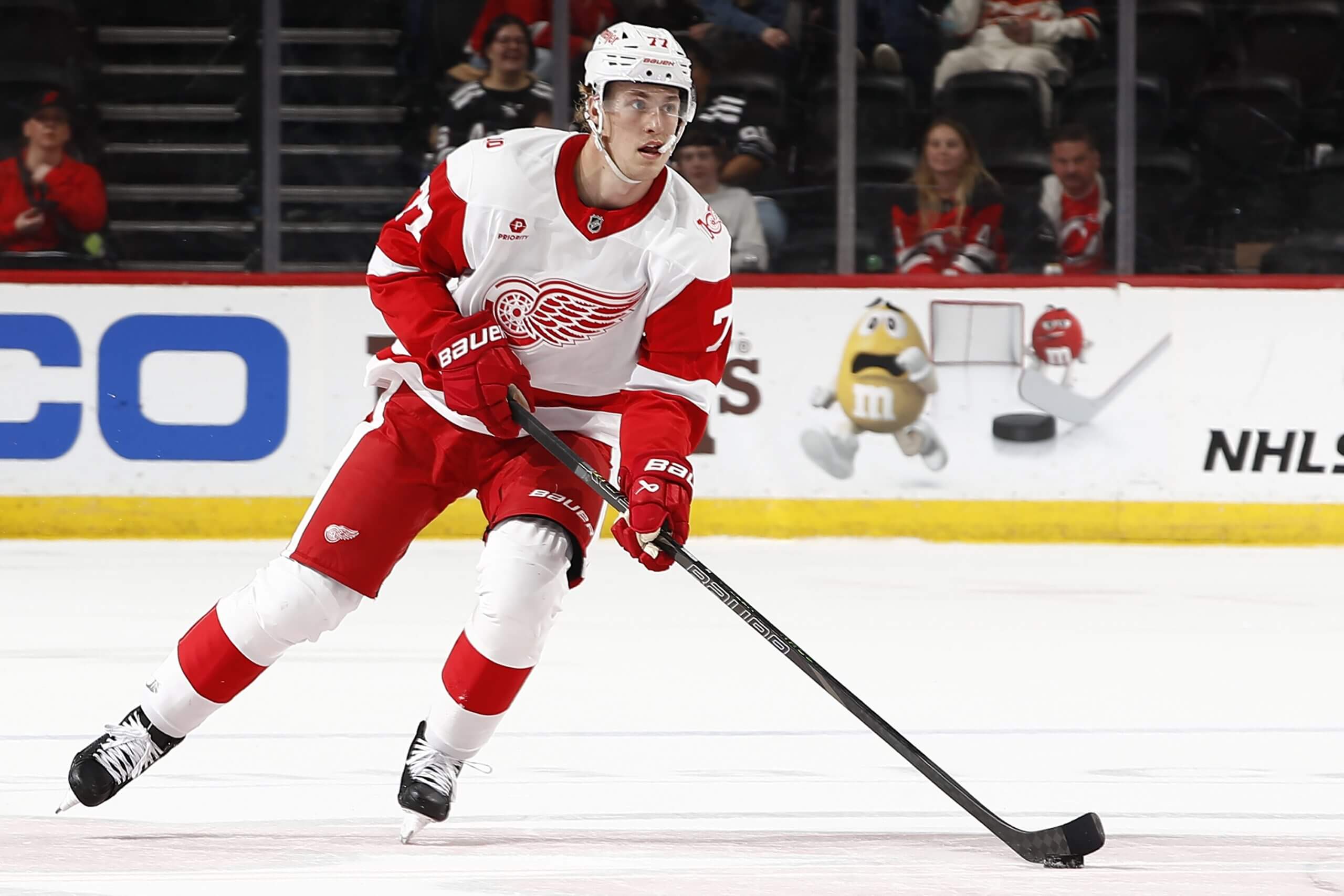
Simon Edvinsson is a key part of the Red Wings’ present and future. (Sarah Stier / Getty Images)
Simon Edvinsson
Edvinsson, meanwhile, does need his contract situation resolved this summer. He’s a restricted free agent and is also in line for a major pay raise.
Of course, he’s not going to get the staggering $12.5 million AAV Bowen Byram received from the Chicago Blackhawks. But young defensemen are getting paid in a big way right now, even on medium-term deals.
Pavel Mintyukov ($7.2 million AAV) and Brandt Clarke ($7.4 million) both got large numbers on five-year deals, and that’s with neither cracking 20 minutes per game last season. Meanwhile, Edvinsson, while not producing quite as much as Clarke, was north of 22 minutes, including taking tough defensive matchups.
On a five-year deal, Edvinsson probably still slots in above both because of his role. But really, the Red Wings should be looking to go even longer with Edvinsson. At the rate the cap is going up, the best course of action is to extend young players as long as possible.
For that reason, Luke Hughes’ $9 million AAV still looks like a meaningful bar on a long-term deal. That would put Edvinsson above Seider on the Red Wings’ pay scale, but again: that’s the reality in the NHL right now. It’s a different cap structure. And as Anaheim is learning in the most painful way with Carlsson, grinding young players just for the sake of saving some money doesn’t always end well.
Seider and Lucas Raymond’s contract negotiations dragged into mid-September in 2024. And while that did result in two great contracts for the Red Wings, Detroit still left a year on the table with Seider, signing him for seven years instead of eight and keeping his AAV down at $8.55 million. They’ll end up paying way more for that last year when his next deal comes around.
There’s a lesson there. And an even bigger one with DeBrincat, whom Detroit signed for just four years after acquiring him. How badly are they wishing they had gone eight years with him right now?
Edvinsson is a key part of the Red Wings’ present and future. And while the number he can command on a long-term deal will be high, it won’t be as high as whatever it would be after a bridge.