
The government’s proposed revisions of the Imperial House Law are drawing fire from not only opposition parties but also from activists and experts outside the Diet.
These critics argue that the changes discriminate against women and highlight the inconsistencies in conservative opposition to allowing separate surnames for married couples, which is often justified in the name of “family unity.”
The proposed revisions, which are being discussed by ruling and opposition parties in the current Diet session, are premised on maintaining the male-line male succession to the throne.
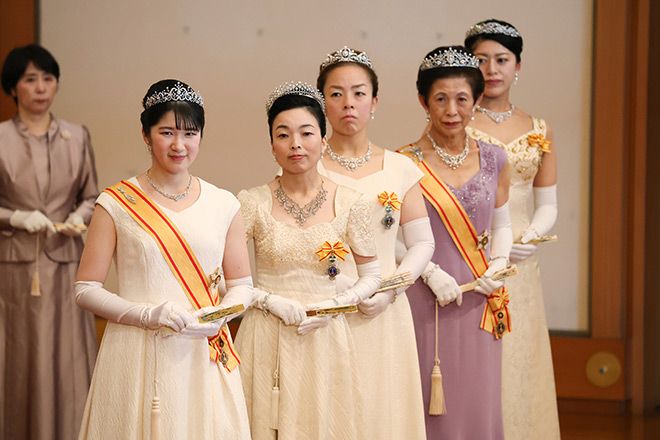
They would also enable female members of the imperial family to remain part of the imperial household after marriage, while their husbands and children would remain commoners.
However, while female imperial family members do not have surnames, their husbands or children would have them.
As a result, the families would effectively have different surnames between spouses and between parents and children.
A woman in her 70s living in Hiroshima Prefecture has long advocated legal reform to allow married couples to choose separate surnames, and has joined litigation as a plaintiff seeking such a change.
“Members of the conservative wing of the Liberal Democratic Party who have insisted that a shared surname is the very bond that holds a family together—won’t family bonds disappear in the families of female imperial family members?” she posted on X in early June after following media reports on the Imperial House Law debate, noting the irony.
Through her years of advocacy activities, the woman has frequently encountered arguments against separate surnames, including the assertion that allowing them would inevitably lead to parents and children having different surnames.
Watching the current Diet debate, she wonders, “What would those who angrily argued that family unity would be lost if parents and children had different surnames say now?”
Part of the reason for her distrust, she said, is because she feels that women are being treated as a mechanism for a “convenient adjustment.”
Among the public, more than 90 percent of those who change their surnames upon marriage are women.
She thinks women have been the ones forced to bear the disadvantages, such as the loss of personal identity in the name of family unity.
In her view, ideas such as “unity” and “family bonds” appear to be invoked selectively, only when it is convenient, in discussions involving ordinary citizens, while being largely disregarded in discussions about the imperial family.
“It really is contradictory,” she said.
GENDER EXPERTS SUBMITS PETITION TO OPPOSITION LAWMAKERS
Concerns have also been raised from an academic standpoint.
On July 8, experts specializing in Japanese women’s history and gender history submitted a petition to opposition lawmakers at the Diet.
Signed by 16 people, the petition points out that there were eight women who reigned as emperor across 10 generations in Japanese history.
It also criticizes the notion of “male-line males” as a “new tradition” created during the Meiji Era (1868-1912). It calls for a more careful deliberation.
“If decisions are made by only a limited group of people without considering important perspectives such as human rights and gender equality, it will leave lasting problems for the future,” said Kazuko Hirai, a visiting researcher at Hitotsubashi University’s Center for Gender Research and Social Sciences, the petition organizer.
Mari Nagano of the Women’s Action Network, who was present when submitting the petition, also criticized Diet discussions on imperial succession, saying that they were “filled with ideas of gender discrimination and male supremacy, which is deeply problematic.”
Asuna Hirai, a former high school teacher and writer, likewise expressed strong concern, saying that “the government’s emphasis on male-line male succession constitutes gender discrimination and sends a negative message to the children who will shape society in the future.”
UNEQUAL RULES FOR IMPERIAL FAMILY MEMBERS
Miho Mitsunari, a professor of gender law at Otemon Gakuin University, argues that to preserve the male line, the government’s proposed revision of the Imperial House Law is trying to impose a unique set of rules on female imperial family members that creates an imbalance between male and female members.
She criticizes the government for emphasizing family unity among ordinary citizens while treating the imperial family as an exception solely for the purpose of maintaining the male line, saying that such selective application is “difficult to understand and lacks persuasive power.”
Mitsunari further warns that “The symbolic emperor system can function only if it is operated in a way that the public understands and supports. If public sympathy diminishes, it could create a critical situation for the imperial institution itself.”
(This article was written by Taichi Higa and Mana Nagano.)