
After months of focusing on drought, the biggest challenge for many Central Maryland lawns has shifted.
Thank you for reading this post, don’t forget to subscribe!
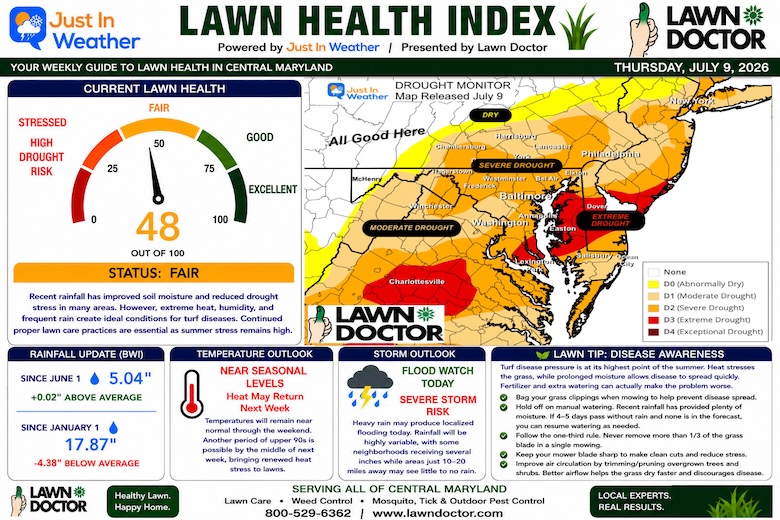
Recent rainfall has dramatically improved soil moisture across much of the region, but the combination of hot temperatures, tropical humidity, and frequent rain has created ideal conditions for summer turf diseases to spread.
This week’s Lawn Health Index rises to 48 out of 100 (Fair). While drought stress has eased in many areas, disease pressure is now at its highest point of the summer.
Drought Conditions Continue to Improve… Slowly
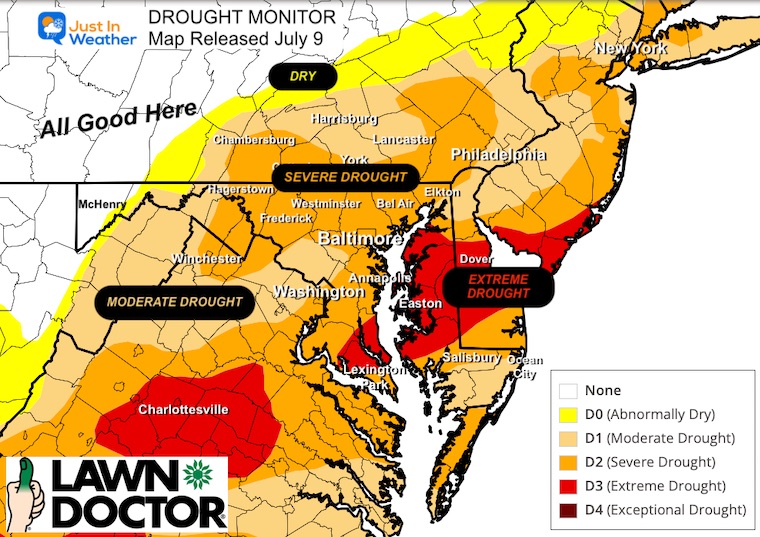
The latest U.S. Drought Monitor, released Thursday, July 9, continues to show Moderate to Severe Drought across much of Central Maryland, while Extreme Drought remains across portions of the Eastern Shore and southern Delmarva.
Although drought classifications haven’t changed much this week, recent rainfall has made a meaningful difference.
Baltimore (BWI) Rainfall
Since June 1
5.04 inches
0.02 inches ABOVE average
Since January 1
17.87 inches
4.38 inches BELOW average
Since January 1 2024
That tells an important story.
The rains over the past several weeks have erased the short-term rainfall deficit since June began, but Maryland is still working to recover from a much larger precipitation shortage that developed earlier this year.
The Lawn Health Index Improves to 48
The Lawn Health Index increased from 44 to 48 this week.
The improvement reflects healthier soil moisture and reduced drought stress following several rounds of beneficial rainfall.
However, the index remains below average because another factor has become increasingly important…
Summer turf disease.
Heat + Humidity + Rain = Ideal Disease Conditions
Many homeowners are noticing brown patches developing across their lawns.
It’s easy to assume the grass simply needs fertilizer or more water.
In many cases, that’s not true.
The combination of:
Recent heavy rainfall
High humidity
Warm overnight temperatures
Summer heat
creates the perfect environment for fungal diseases to develop.
Heat stresses the grass while prolonged moisture keeps the blades wet for extended periods. Those conditions allow fungal pathogens to spread quickly across cool-season turf.
Adding fertilizer or watering more often can actually make some diseases worse by encouraging additional growth while the fungus remains active.
Why Maryland Lawns Are So Vulnerable
Most lawns across Central Maryland consist primarily of Tall Fescue and Kentucky Bluegrass, along with some Perennial Ryegrass.
These are all cool-season grasses.
They thrive during spring and fall but naturally struggle through the hottest part of summer.
When prolonged heat combines with excessive moisture, these grasses become especially susceptible to fungal diseases such as brown patch and other common summer lawn diseases.
Fortunately, many lawns recover naturally as temperatures cool later in the season.
Lawn Doctor Tips: Reducing Summer Disease Pressure
While no maintenance practice can eliminate disease once environmental conditions become favorable, a few simple adjustments can help reduce additional stress and slow its spread.
Bag Grass Clippings
If disease is present, bagging clippings helps reduce the movement of fungal spores across the lawn.
Hold Off on Watering
Recent rainfall has supplied plenty of moisture.
Unless your lawn goes four to five days without measurable rain and none is in the forecast, additional watering is usually unnecessary.
Follow the One-Third Rule
Never remove more than one-third of the grass blade during a single mowing.
Removing too much at once increases stress and slows recovery.
Keep Mower Blades Sharp
Sharp blades produce clean cuts that heal faster.
Dull blades tear the grass, creating additional stress and making disease problems worse.
Improve Air Circulation
Trim back overgrown trees and shrubs that block airflow.
Better circulation helps grass dry more quickly after rain or heavy morning dew, creating a less favorable environment for fungal diseases.
Looking Ahead
Temperatures will remain near seasonal levels through the weekend.
However, another stretch of upper 90s is possible by the middle of next week, bringing renewed heat stress to lawns.
Today’s forecast also includes a Flood Watch and the risk of severe thunderstorms. As we’ve seen several times this summer, rainfall will likely be highly localized. Some neighborhoods could receive several inches of rain while communities just 10 to 20 miles away receive little or none.
That variability is one reason lawn conditions can differ dramatically across Central Maryland, even within the same county.
For now, the encouraging news is that recent rainfall has greatly improved soil moisture compared to just a few weeks ago. The focus now shifts from drought recovery to helping lawns navigate one of the most disease-prone periods of the year.
With a few simple mowing and maintenance adjustments—and a little patience—many Maryland lawns will be well positioned to recover as we move toward late summer and eventually into the cooler conditions of fall.
Presented by Lawn Doctor
Learn more about lawn care services throughout Central Maryland at Lawn Doctor of Annapolis
Subscribe for email Alerts
Weather posts straight to your inbox
Sign up and be the first to know!
THANK YOU:
Baltimore Sun Magazine Readers’ Choice Best Of Baltimore

Maryland Trek 13 Is Set For August 2 to 8
Help Support The Programs at Just In Power Kids
The annual event: Hiking and biking 329 miles in 7 days between The Summit of Wisp to Ocean City.
Each day, we honor a kid and their family’s cancer journey.
Fundraising is for Just In Power Kids: Funding Free Programs For Kids And Families Facing Childhood Cancer.
I never have and never will take a penny. It is all for our nonprofit to operate.
Click here or the image to donate:

STEM Assemblies/In School Fields Trips
Click to see more and ‘Book’ a visit to your school

RESTATING MY MESSAGE ABOUT DYSLEXIA
I am aware there are some spelling and grammar typos and occasional other glitches. I take responsibility for my mistakes and even the computer glitches I may miss. I have made a few public statements over the years, but if you are new here, you may have missed it: I have dyslexia and found out during my second year at Cornell University. It didn’t stop me from getting my meteorology degree and being the first to get the AMS CBM in the Baltimore/Washington region. One of my professors told me that I had made it that far without knowing and to not let it be a crutch going forward. That was Mark Wysocki, and he was absolutely correct! I do miss my mistakes in my own proofreading. The autocorrect spell check on my computer sometimes does an injustice to make it worse. I can also make mistakes in forecasting. No one is perfect at predicting the future. All of the maps and information are accurate. The ‘wordy’ stuff can get sticky. There has been no editor who can check my work while writing and to have it ready to send out in a newsworthy timeline. Barbara Werner is a member of the web team that helps me maintain this site. She has taken it upon herself to edit typos when she is available. That could be AFTER you read this. I accept this and perhaps proves what you read is really from me… It’s part of my charm. #FITF
Please share your thoughts and best weather pics/videos, or just keep in touch via social media.