
MENDOCINO CO., 7/11/26 — Drill a well in Redwood Valley, and a gallon a minute can pass for good news. Twenty gallons a minute, by local standards, is a gusher. Drill one a few miles south, inside the city of Ukiah, and some wells pump more than 1,000.
Same valley, same rain. The difference is what’s under the ground.
Sean White has run the Ukiah Valley’s water from both ends of the pipe. He managed the Russian River Flood Control district, the agency that sells the valley its river water. Then he ran the City of Ukiah’s water utility until he retired in December. The city keeps him on as a “retired annuitant” — pension-system speak for a retiree hired back part-time — and he works a few hours a week.
So when the district he used to manage announced it had, for the first time, no more river water to sell, the obvious question landed on him. Ukiah says it has plenty of water. Is that true?
“I’m not freaking out,” White said in a phone interview last week. “For the city itself, we’re, I think, in pretty good shape.”
The catch is in the words “the city itself.” The city of Ukiah and the Ukiah Valley are not the same thing. The city is the town in the middle of the valley. The valley around it — the vineyards, the pear orchards, seven small water systems, rural homes up and down the valley floor — lives on two kinds of water: river water sold under contract, and the groundwater below. The river water is spoken for, with a waiting list. The groundwater is huge — if your well can reach it. The city’s wells do. Much of the rest of the valley’s don’t.
For anyone in the valley outside city limits, that means there is no new river water to be had, at any price. A new home on rural land, a new vineyard block, a hookup to one of the seven small water systems — anything that needs water the valley hasn’t already promised to someone now goes on a waiting list. And the river behind every one of those promises is about to get smaller.
The lucky spot
Ask why people settled where they did in the first place, White said — in the footprint of what is now the city, back when nobody had power tools to drill deep. “Groundwater was abundant and shallow here,” he said. “And it kind of remains that way today.”
The city holds surface rights “senior to everybody,” he said — a claim dating to the 1870s, before California required water permits — plus later rights senior to most users. Its wells sit on what he calls the sweet spot of the basin. All but one well are 260 feet deep, sealed down past the two layers that cap the deep aquifer. The one shallow well is permitted and treated as surface water.
The scale is the argument. The basin’s groundwater plan puts storage in the valley’s two main aquifers at somewhere around 400,000 acre-feet. Lake Mendocino, White noted for scale, holds about 125,000. Pumping across the whole valley draws about 8,000 acre-feet a year, he said, and the city takes 2,000 to 2,500 of that.
“So we’re in a good spot,” he said. “Our forefathers figured that out way before computer models.”
What refills the aquifer, he said, is mostly not the river. It’s winter runoff from the western hills. Through the droughts of the early 2020s, “you’ll see our surface water get drawn down a small amount, especially compared to what you see in the Central Valley,” he said — but the wells come back as soon as the rain does, even when a drought runs for years.
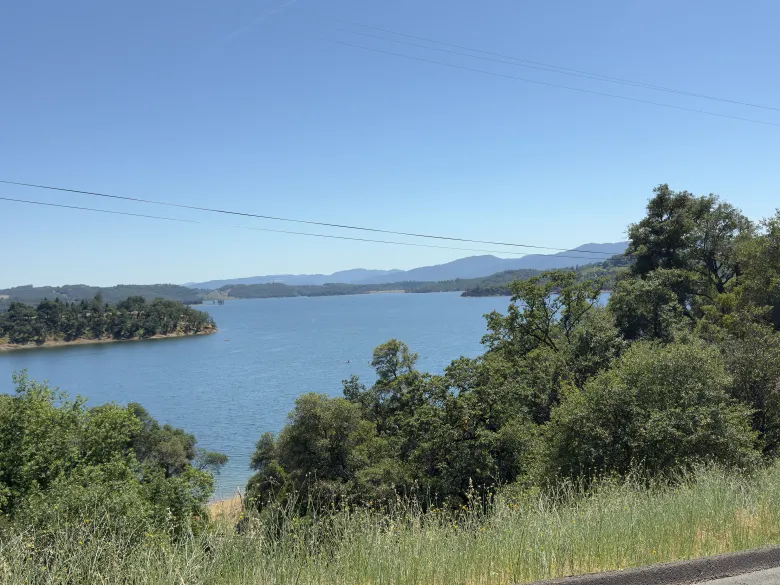 Lake Mendocino stretches south from its Highway 20 shoreline near Ukiah, Calif., on May 23, 2026. The reservoir is where the Russian River Flood Control and Water Conservation Improvement District draws its 7,940 acre-foot allocation, which was fully subscribed for the first time in 2025 and now falls short of requests. (Roger Coryell/Bay City News)
Redwood Valley lost that lottery, and White is blunt about it. The community “has essentially no aquifer,” he said. A well there might “make a gallon a minute, or maybe 20 gallons a minute, which is like a total gusher in Redwood Valley,” he said. “And some of our city wells are over 1,000 a minute. That’s how big the disparity is.”
People who can’t drill their way to water buy it. Which brings in the district that just ran out.
Start with the seller
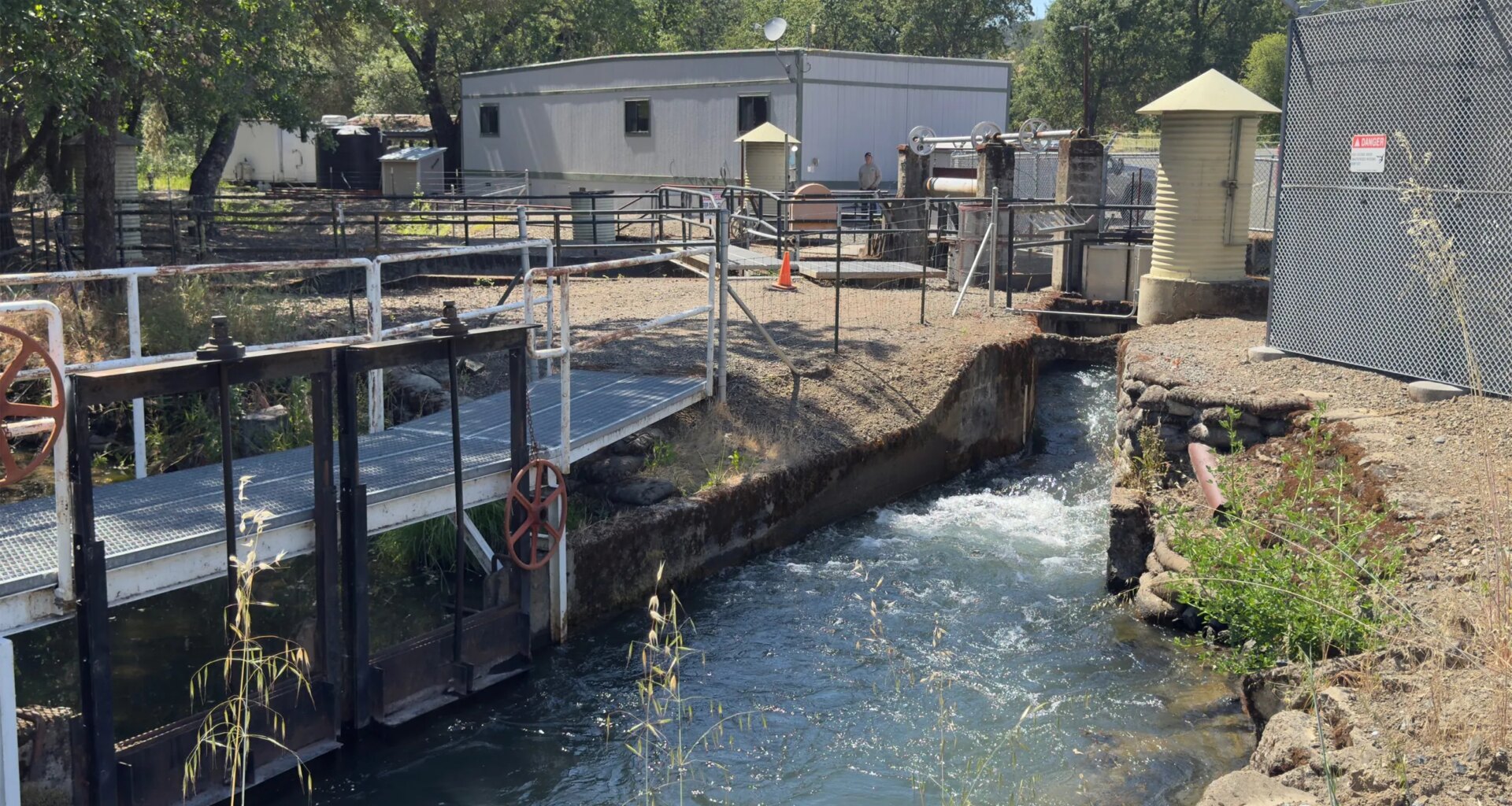
The Russian River Flood Control & Water Conservation Improvement District — “flood control,” in valley shorthand — holds a state license to sell up to 7,940 acre-feet a year out of Lake Mendocino. An acre-foot covers one acre of land a foot deep, about 326,000 gallons. That water supplies seven small water systems and dozens of vineyards, orchards and rural homes across the Ukiah Valley.
Flood control is sold out. It said so plainly in a June 1 report: in May 2025, for the first time, every acre-foot of the 7,940 was under contract. New requests went on hold. When a little water opened up in February, the waiting list already wanted more than there was.
Flood control’s board has started writing rules for scarcity. A policy adopted June 1 says no applicant gets priority when requests outrun supply. The wholesale rate rose from $66 to $72 per acre-foot — about 9% — and the board held the increase that low only by pulling $35,020 from its water-supply reliability reserve.
Redwood Valley County Water District is the wholesale water customer with the least to fall back on. It sits on no usable aquifer and holds no water right of its own; flood control’s supply is essentially its lifeline.
Now flood control and Redwood Valley’s water district are set to merge boundaries. Mendocino County supervisors voted Tuesday to approve flood control’s plan to annex 9,610 acres of Redwood Valley water district territory, sending the plan toward a hearing before the county’s boundary commission, expected in September. That’s separate from — and shouldn’t be confused with — the city of Ukiah’s own annexation fight, which is a different proposal entirely. This one would put Redwood Valley’s territory inside flood control’s borders instead of outside them looking in as a customer.
What annexation cannot do is create water. The 7,940 acre-feet were fully spoken for before the paperwork started. Flood control’s boundary will grow; the supply behind it will not.
The assumption underneath everything
The water is running short now because a big share of it was never Russian River water at all. For a century, the Potter Valley Project — a hydropower complex owned by Pacific Gas and Electric Co. — has sent Eel River water through a mountain tunnel into the East Fork Russian River, where it fills Lake Mendocino. The flood control district says so itself: diversions from the Eel provide “a substantial portion” of the water it sells. PG&E is retiring the project and tearing out both of its dams. Federal regulators accepted its plan Oct. 31, 2025. Less Eel water through the tunnel means less water in Lake Mendocino — the same lake every one of those sold-out contracts draws from.
Here’s the soft spot: every official document that calls the valley’s water “sustainable” assumes that flow keeps coming.
The valley’s groundwater agency wrote the plan behind every “sustainable” in this story. That agency — the Ukiah Valley Basin Groundwater Sustainability Agency — is a joint powers authority formed in 2017 by the County of Mendocino, the City of Ukiah, the flood control district and the Upper Russian River Water Agency, whose seat has since passed to the new Ukiah Valley Water Authority. The state approved the plan in 2023, with homework attached.
The plan finds the basin “will be sustainable over the next twenty years if planned projects and management actions are implemented as needed.” That verdict rests on a water budget that holds surface-water diversions “constant and equal to that of the water year 2018” — a year when the Potter Valley Project ran at full tilt — and never models the diversion going away.
The agency conceded as much in its responses to public comments: that analysis “could not fit within the scope” of the plan. The state Department of Water Resources ordered the fix: count the Eel River imports and show how reliable they really are, with answers due in the plan’s first periodic update in 2027.
Asked whether the city has modeled its groundwater with less Eel water, or none, White pointed to the modeling behind the plan. Consultant Larry Walker Associates ran the aquifer through a range of scenarios, he said, including what he recalled as a critically dry September with “essentially no water — no releases from Lake Mendocino.” Even then, he said, the upper Russian’s main stem kept a trickle of groundwater-fed flow “and the groundwater was okay.”
He was careful not to sound too comfortable. “I don’t want anyone to think that we think we’re in some opulent position and don’t have to think about it or whatever,” he said, “because that just will induce irresponsible behavior.”
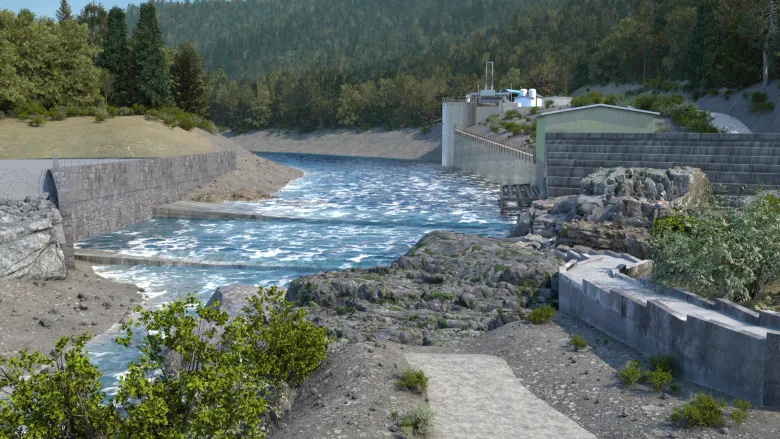 A rendering of the New Eel Russian Facility which will replace the existing Potter Valley Project water diversion facilities in Mendocino County, Calif. (Sonoma Water via Bay City News)
The diversion to come
What replaces the old project is a diversion without the dams. A new joint agency, the Eel-Russian Project Authority — Sonoma County, Sonoma Water and Mendocino County’s Inland Water and Power Commission — wants to build the New Eel-Russian Facility at the Cape Horn Dam site, with roughly $9 million in state grant money for design and permits. The Round Valley Indian Tribes hold a seat on its board. The Tribes’ Eel River water rights are senior to everyone else’s, which means any new diversion runs on their terms.
Nobody can yet say how much water the new intake will move, or when. The licensed 7,940 acre-feet stays on paper either way. How much wet water stands behind the paper depends on what actually comes through the mountain — and everyone now waiting in the district’s line is, one way or another, waiting on that answer too.
Ukiah, meanwhile, is planning like a city that expects to be fine. On June 17, the Ukiah City Council voted without dissent to adopt the city’s 2025 Urban Water Management Plan — the supply-and-demand forecast the state requires of city water systems every five years. It projects supply “sufficient to meet demands through 2050.” The city delivered 3,030 acre-feet of drinking water to more than 5,000 connections in 2025; about 72% of its supply in recent years has come from wells. Nobody from the public spoke. The same night, the council cleared environmental review for a new city well of 600 to 1,000 gallons per minute — adding pumping power even as it declared plenty.
White, who prepared the plan and fielded council questions at the hearing, told the council the city is “effectively at net zero use right now” — recycling and recharging more water into the aquifer at its wastewater plant than customers take out.
Good water, borrowed river
Every drop of river water is under contract, and the river itself is about to get smaller. The aquifer is huge, but the settlers of the 1870s claimed the best of it, and the city inherited their spot — deep wells and senior rights, and a supply that, if White has it right, refills off the hills whether or not the Eel keeps coming through the mountain.
The decisions that matter most for the valley’s water were made before anyone now living was born: where to settle, where to drill, when to file a claim. The valley isn’t out of water. It’s out of water nobody else has a claim on — unless, like the city, you staked yours 150 years ago.
Related