
ROCHESTER, N.Y. — For kids diagnosed with developmental disabilities and behavioral disorders, the continuity of care is essential. But as wait times continue to increase, workforce shortages remain high, and now the closure of services from a Rochester facility has left families worrying about the long-term effects of the development of their children.
What You Need To Know
Accessible behavioral health services is a crisis gripping kids, parents and health providers across the nation.
Families that have overcome the long waitlists and living in limbo are now struggling once again after a Rochester facility has closed its services due to lack of staffing.
Families impacted address the pediatric behavioral health gap that employers just can’t make its way out of.
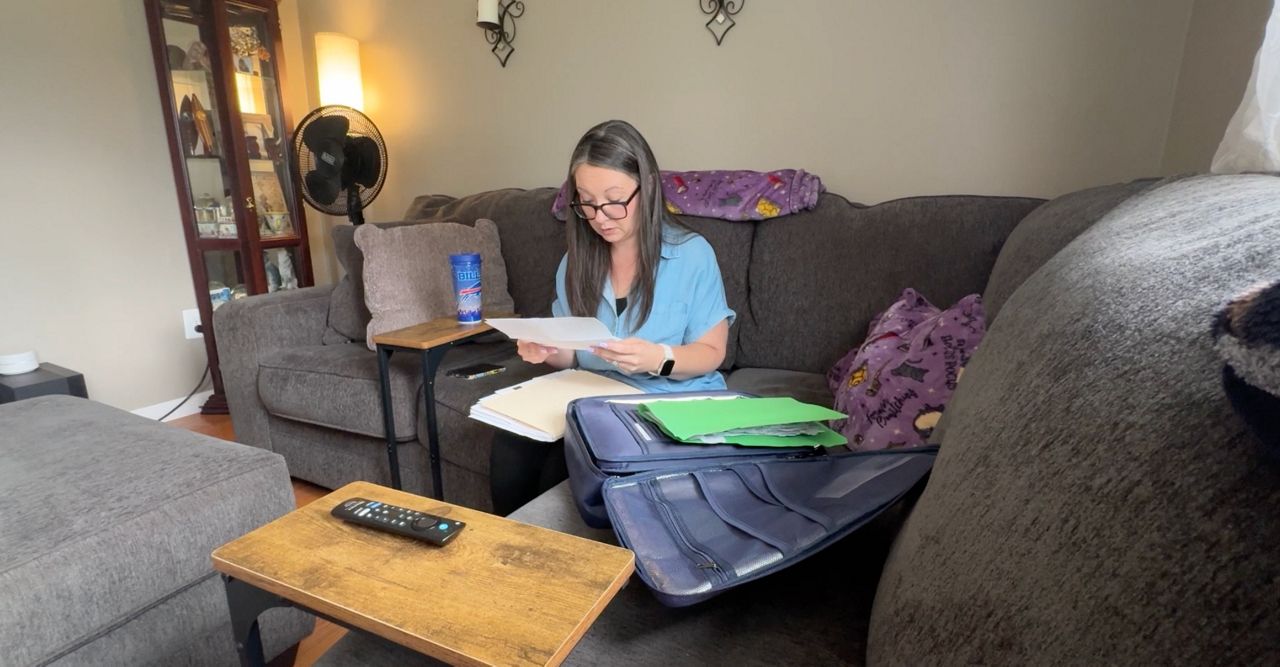
Page by page, Jessica Barend’s son’s livelihood is all on record.
“They didn’t ever have proper history,” Barend said. “And I got to a point where I would have them start reading the medications before I would, because I want to know, what do your records show? Because there’s been a history of not having the right records. They don’t read the reports before they call and ask questions and ask what happened in a situation when they’re under a mental health evaluation. And that’s exhausting. To have to constantly repeat all of the things. I’ve actually joked about making a recording of all of my son’s documentation to be able to just send to hospitals in the future, if there happens to be a case where he does need to be seen again, because it’s exhausting and it’s mentally taxing. And it’s reliving trauma every day that I quite literally already relive every day.”
Bouncing from multiple health agencies for nearly a decade.
“We have been dealing with some ADHD as well as some other diagnoses since he was in about first grade,” Barend said. “At that point, the school had recommended an IEP just because of some of his behavior problems. So, I quit my job, and I was going to school with him every day to make sure that he could get the education piece, and also witnessed what the teachers were seeing because he wasn’t acting like that at home. And then after that, it was like he just didn’t ever want to sleep. That’s when things actually started happening at home, where he was becoming aggressive and just raging, outrage just so unstable that, you know, he had his first mental health stay at Jamestown Kent County Hospital and they did the first evaluation on him. CPS ended up getting involved because they were concerned about how someone with a child would have these issues so extreme, what’s to them seemed like out of nowhere, but it really wasn’t out of nowhere. It had always been kind of like that. He had been in and out of [residential treatment facility] programs. When he spent his time at Lake Breeze, that was after the second discharge from the psychiatric center in Buffalo. He was dysregulated within a week because they were not giving him his medication for several days in a row. They were not giving him the antipsychotics that he needed at that point; he was on lithium. So to not have the lithium was after having him gone for over three months away from our family. They stabilized him. He was released, and he was immediately dysregulated because they never provided his medication.”
Barend has been on the front lines of this battle, through it all.
“He was so dysregulated to the point where he was taken by police to the hospital because of the way he was acting,” Barend said. “That night, that really caused a break between my relationship with my son. And I can honestly say that I think at that point, I realized things were going to be very difficult for a very long time with him. I think that there’s a lot of speculation that the problem with kids is that it’s the parents’ problems, but we don’t look enough at genetics. My son’s father’s side of the family, bipolar does run very high. Two members of his immediate family have it, and I was late diagnosed in my 30s. The mental health that exists in this area is not established to set up parents for success or kids.”
Fighting kickbacks from agencies to lack of direction, miscommunication and inaccessible services in the area led Barend’s son to spend three different occasions as a patient at the children’s psychiatric center in Buffalo.
“The only children’s psychiatric hospital that has a long-term stay in upstate New York,” Barend said. “So, there’s a long wait for beds. It’s very difficult to get in there, and you must have a lot of documentation. So, there’s a lot of roadblocks. My son is stable now, and I give credit to the psych center in Buffalo for that because they have the only structured program in the community at all.”
Finding the need to only become more complex as they enter adulthood.
“We have to address the problem as early as possible, because early intervention is the way that you stop adults from becoming adults that are committing crimes on the community,” Barend said. “They’re hurting themselves; they’re hurting children. They are being rereleased when they shouldn’t be released. We have domestic abusers who see that, ‘that’s OK, because that’s the way that they were raised.’ And then they continue to get released. And then those people that they abuse become, on a different level of mental health needs, on top of the fact that they become they start self-medicating because they’re depressed and because they feel ashamed and because there’s so much stigma against all of these things that they self-medicate, and then they become addicts and then they become abusers themselves, eventually.”
It’s a situation parents and advocates fear more families will find themselves in after Rochester Regional Health officials announced the closure of development and behavioral pediatric services at least in part due to staffing changes.
“I was shocked,” parent Tina Carney said. “My husband received the phone call from the office. And I did not see that coming … appointment was being moved up because the practice was closing within a month.”
Last month, parents received a letter from the facility sharing its decision to close its development and behavioral pediatric services — giving parents like Careny less than a month to prepare for the loss of services.
“I don’t understand,” she said. “When I read the news about it, it said that a provider was relocating. I didn’t know that that was happening. And I know that there’s a huge demand for mental and behavioral supports, especially for youth in our community. This is going to leave a huge gap for supports and I really didn’t see that coming because I know that the demand is so great.”
According to Rochester Regional Health, this follows the departure of one of its physicians who had worked alongside a small, specialized team that cared for a limited number of patients.
However, Spectrum News 1 spoke to Dr. Jara Johnson, the lead physician of the development and behavioral pediatrics program who said she had departed from RRH due to being burnt out from the workload, little compensation for her work and health-related issues.Johnson had stated she had been with the team since 2017, but stepped down around the same time families received the letter. According to her, she said the facility knew of the transition six months in advance, whereas families and staff had less than a month to prepare for the dissolving of the program — leaving many families to continue to navigate their next steps on their own.
“It’s not clear to me that the staff, that Rochester Regional Developmental Behavioral Pediatrics were honored for their expertise, for their professionalism, for their excellent care that they have consistently provided us over the last several years. And I want them to be taken care of so that they can take care of others. None of us can pour from an empty cup.”
RRH is not the only one to struggle with severe staffing shortages. Health Management Associates reports three in four children in New York state eligible for outpatient Medicaid behavioral health services were not receiving them, and an estimated 6,000 providers will need to help address the shortage.
“This is a solution,” Carney said. “This practice helped me help change my family’s life. And now it’s not there. Our kids are not OK. All of our kids. Like, there’s a huge mental health crisis happening right now. And we’re all seeing symptoms of it. We’re all living it. And this was one of the solutions for it, and now it’s gone.”
The New York State Health Department shared in a statement following the news:
“The Department is aware of the national shortage of development-behavioral pediatricians, also impacting New York, along with other practitioner shortages in the behavioral health field. Clinics and medical practices do have an obligation to notify patients and provide options for their future care when a practitioner leaves. The Department continues to work to ensure that New Yorkers have access to these medically essential services.”
The Department of Health hopes that through its efforts they will be able to help reduce barriers within the healthcare industry, especially for underserved communities. In June 2026, the DOH was recently awarded $212 million for the first year of an anticipated five-year award for the Rural Health Transformation Program. They stated the funding will be used to address workforce shortages, invest in technology innovation and cybersecurity in rural hospital as well as to establish regional, integrated networks linking hospitals, Federally Qualified Health Centers, and behavioral health providers, among others.
Keeping every contact, medical records and milestone, Barend hopes her son’s journey is not just celebration, but also a reminder of the struggles many families face.
“He just started driving lessons,” Barend said. “So, I’m a very proud parent. And at this point, we’re working on GED prep because he has given up on the school system and the support he’s given up on the communities that are saying that they’re there to support him, that have completely let him down in every way possible. And he’s ready to just move on and be on his own at this point because of that trauma that he experienced with, over a decade of trying to get help and testing medications. Rochester Regional is making a huge mistake, and I think that having only Strong be the only pediatric center, including their new walk-in facility, is not enough.”
Throughout the country, many hospitals and treatment centers are also working to meet clients where they are to help make the health system a little more efficient.
In a statement, Rochester Regional Health said:
“Patients currently receiving care are being connected with appropriate providers, with coordinated handoffs to support continuity.
This is a routine transition related to a physician departure. Our priority is to support patients and families with clear guidance throughout the process. Patients with questions about next steps should contact the practice directly.
Rochester Regional Health continues to provide comprehensive pediatric care for more than 58,000 patients across eight pediatric practices, along with additional care through our family medicine practices. We also operate five school-based health centers in the City of Rochester, a school-based telehealth program in partnership with University of Rochester Medicine, and a pediatric mental health division serving 3,300 families across clinics and 57 school-based sites in 10 school districts.”