
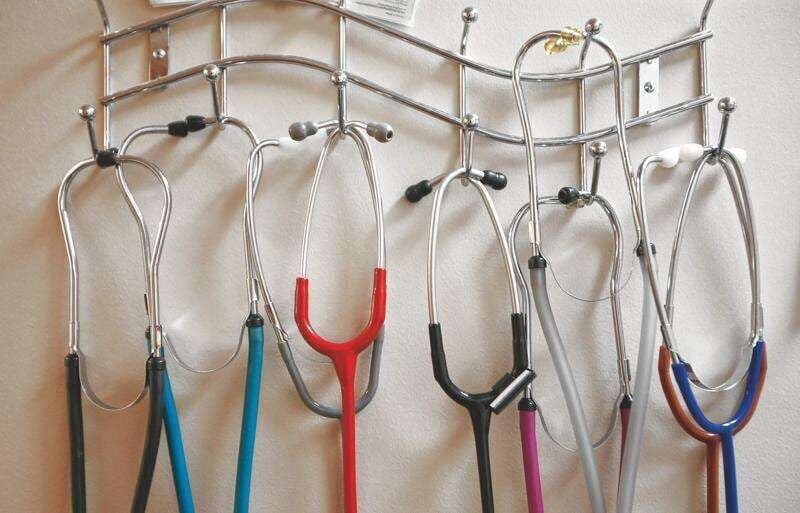


Stethoscopes hang in the hallway of a Cedar Rapids clinic in 2017.
The Gazette
Iowa has a physician shortage that’s projected to only get worse. The state ranks 44th in the nation for its doctor-to-patient ratio and is expected to be short more than 1,600 physicians by 2030, according to the Cicero Institute, a public policy organization.
It’s a multilayered problem. A shortage of residency slots in the state limits the number of doctors who can continue their training in Iowa. Also, about a fifth of Iowa’s doctors are past retirement age, according to the Association of American Medical Colleges.
But an Iowa bill signed into law last month — and supported by the Iowa Medical Society — would let doctors 60 years and older apply for “emeritus” licenses that would allow them to keep practicing medicine while they teach and supervise medical residents — that is, doctors who’ve graduated from medical school but are still in training.
Lillian Erdahl, president of the Iowa Medical Society, said the measure was part of the organization’s Operation I.O.W.A. plan to address the state’s physician shortage.
Lillian Erdahl, Iowa Medical Society
Submitted photo
“Finding enough teachers to support the expansion of the residency programs was one of the challenges we identified,” Erdahl said. “We’re hoping that this will make it easier for physicians to continue in teaching roles rather than stepping completely away from medicine as they near retirement age.”
While proponents say the emeritus license will make it easier for physicians to keep contributing, others say eliminating the continuing education requirements will undermine healthcare in Iowa.
Background
Erdahl said the medical society, in developing its Operation I.O.W.A. plan, repeatedly heard from older physicians that part of what pushed them into retirement was the process of reapplying for their medical licenses, which have to be renewed every two years.
Doctors must complete 40 hours of continuing medical education every two years to keep their medical license active. Continuing education includes online courses or training or attending medical conferences.
The emeritus medical license would last for three years and would not require those 40 hours of continuing education. Applicants could only renew their emeritus license once.
The bill also halves the cost of applying for a medical license, $250 for an emeritus license vs. $500 for a standard one.
State Rep. Shannon Lundgren, R-Peosta, said the legislation offers a way for older physicians to practice less as they transition to retirement without leaving the profession entirely.
“So many of our doctors want to step back from that full-time practice … it just means that load gets bigger for the ones that are practicing,” Lundgren said.
The emeritus licenses “allow us to keep those physicians still practicing here in our state but allowing them to step back a little bit.”
Rep. Shannon Lundgren, R-Peosta
It would be a triple win, she said:
Doctors with an emeritus license would still be practicing — albeit in a reduced capacity — for a few more years while they teach and supervise the next generation of doctors.
More emeritus physicians teaching could mean more hospitals and medical practices could offer residency slots to young doctors.
More residency slots means more professionals caring for patients while they train in Iowa.
Lundgren said the bill received bipartisan support in the Iowa House and that she heard nothing but positive feedback from her constituents and the doctors she talked to.
“I don’t think that I received one phone call that was not in favor of this licensing practice,” Lundgren said.
Continuing education
Rep. Austin Baeth, D-Des Moines
Submitted photo
State Rep. Austin Baeth, D-Des Moines, is an internal medicine physician and said his opinions usually align with the Iowa Medical Society’s recommendations.
But not when it came to Senate File 469, the emeritus license bill.
While other states offer emeritus licenses, Iowa will be the first to do so without continuing education requirements, Baeth said.
“These are our doctors who are tasked with training the next generation of doctors,” Baeth said. “To exempt them from learning the latest medical science is just ridiculous.”
Wendy Buresh, 74, a retired family physician in Cedar Rapids, said that lack of continuing education requirements “worries me.”
Buresh said she was confident she could still teach a medical student how to do a physical exam, since those basics probably haven’t changed much.

Wendy Buresh, retired Cedar Rapids doctor
But she said she couldn’t tell students how to treat a patient because she hasn’t kept up with the current best practices — the tests, medications and dosages recent research indicates are most effective.
“The biggest thing is, you have to know what you don’t know,” Buresh said. “That’s, I think, where the emeritus stuff worries me. If you have practiced for 35 years, but you don’t know what you don’t know … how does that impact what you say or do with the people you’re teaching?”
Further, Buresh said, meeting continuing medical education requirements is more annoying than burdensome.
“I think that if you’re unwilling to do at least that minimal amount, should you really be interacting with and teaching residents and medical students?” she said.
Erdahl, with the Iowa Medical Society, said the emeritus legislation was developed with feedback from multiple stakeholders, including hospital administrators and physicians. Although the bill removed the continuing education requirement, it doesn’t bar doctors from pursuing those opportunities.
“We got input from a lot of people who felt that this would not be a worry, as these are experienced physicians who have been in practice for a long time and will take responsibility to ensure that they are prepared to accurately teach their residents,” Erdahl said.
Lundgren echoed Erdahl’s statement, adding that the emeritus licenses would only be given to above-board doctors who have decades of experience behind them.
“These are not fly-by-night folks that are going to get this type of a license,” Lundgren said. “These are people that have literally lived, worked and breathed in this industry for a very long time. So I think we can leave that judgment up to them if they feel like they want to learn something new without holding that over their head.”
Other ideas
It’s yet to be seen how many emeritus licenses the Iowa Board of Medicine will issue.
Erdhal said she isn’t aware of anyone who planned to apply for an emeritus license, adding the Board of Medicine will need some time to determine how to implement the law.
Erdahl said the emeritus license is just one idea the Medical Society has on addressing the state’s doctor shortage. Operation I.O.W.A. also proposed increasing Iowa physician reimbursements, implementing medical school loan payment programs, and reducing burdensome “prior authorizations” from patients’ insurance companies.
“I want to emphasize that this is not our only effort,” Erdahl said. “This is one of many things that we’re doing to try to grow the physician workforce.”
Baeth, the Des Moines doctor and lawmaker, said he supports measures to fix the other issues the medical society identified, the things that doctors need to stay in the state.
“I highly doubt there will be a single additional doctor who practices in Iowa because of this (emeritus) law,” Baeth said. “Instead, it is, I fear, going to be harmful for the practice of medicine.”