
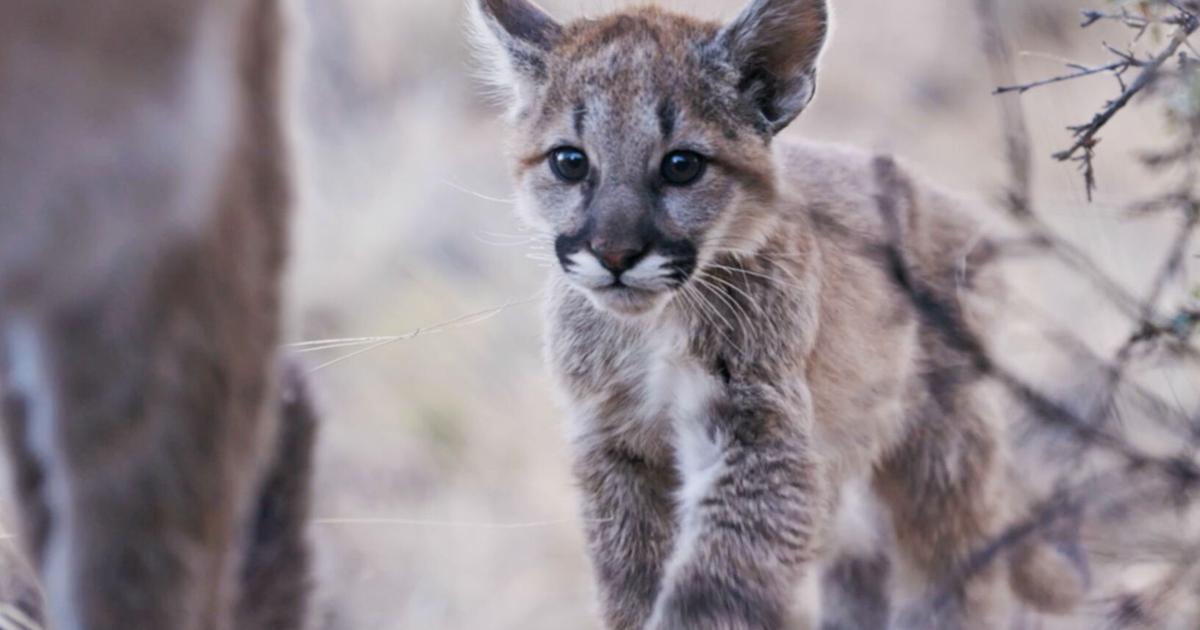
Darkness had fallen over the Gila National Forest and Lia Nydes was lying in a small blind alongside her camera gear within about 40 feet of a female mountain lion that was feasting on a coyote it had killed.
On a solo stakeout while filming one of the Southwest’s apex predators for an upcoming wildlife documentary called American Lion, Nydes had not been able to haul lights to the site with the rest of her equipment. So when the last embers of the day had died out and there was nothing more to film, Nydes could no longer see the big cat. But she could definitely still hear it.
“I slept in that blind through the night and just fell asleep to her crunching and eating,” Nydes said. “It gets a little spooky because they’ll eat and then they’ll take a break, then they’ll go lie down. I was like, ‘Oh my god, she could be lying down like 10 feet from me.’ ”
The next morning Nydes awoke to a light rain. The mountain lion was still there, still eating.
For another hour, Nydes was able to film her stealthy subject before it wandered off from the kill site.
“She didn’t go back to it because there wasn’t anything left,” Nydes said.
Immersing herself in the rugged spaces where the wild things are, Nydes uses hours of planning, preparation and patience to spend quality time with creatures most people may only catch a brief glimpse of or never see at all.

Wildlife cinematographer Lia Nydes, a 2010 Santa Fe Preporatory School graduate, has shot footage for National Geographic, PBS, the National Park Service and numerous independent production companies.
Courtesy Lia Nydes
The 34-year-old Santa Fe native has found her calling and footing as a wildlife cinematographer, doing work for National Geographic, PBS, the National Park Service and numerous independent production companies.
Filming everything from bears to orchid bees, Nydes said she appreciates the opportunity to dive into the lives of diverse species, to spend weeks or months observing their behaviors and to get to know some of them as individual animals.
“I just feel very fortunate when you kind of get let into their world, especially with predators,” Nydes said during an interview in late June while taking a break from filming burrowing owls and prairie dogs near Raton.
A 2010 graduate of Santa Fe Preparatory School, where she developed an interest in film photography, Nydes said she always had a love of nature and possessed an early desire to be involved in wildlife conservation.
Nydes went on to Eckerd College in Florida, where she majored in environmental studies and visual arts and minored in biology.
After college, Nydes got an internship in Alaska through AmeriCorps and the Student Conservation Association. She spent a year and a half working as a backcountry ranger and filmmaker in Bering Land Bridge National Preserve and Gates of the Arctic National Park and Preserve, the most isolated and least-visited national park in the United States.
“I just had this thirst for adventure and wanting to get as remote in the backcountry as possible,” Nydes said. “I wanted to get out there and push the boundaries of what I’d done.”
There are no roads or trails into Gates of the Arctic. Most visitors access it by chartering small aircraft that are equipped with floats or tundra tires.
When working at the park, Nydes lived in nearby Bettles, a tiny fly-in community with a dirt runway, a bush plane service, a ranger station and a lodge.
With no cellphone service or internet at her house, Nydes said she felt like she had stepped back in time. And it suited her.
On backcountry patrols, she and another ranger would get dropped off by float plane on lakes and paddle around for several days at a time. The wildlife she encountered in the grand settings was like nothing she had ever seen.
Salmon would run up the Noatak River, where Nydes said she saw around 30 grizzly bears trying to catch their fill.
A great egret catches a fish in a still image of footage captured by cinematographer Lia Nydes.
Courtesy Lia Nydes
On a trip she was on with one other person, the Brooks Range got socked with snow and the pair had to wait three extra days to get picked up. The delay ended up being a blessing.
The Western Arctic caribou herd, with a population estimated at about 150,000, migrated right past them. They watched for hours as the deluge of caribou flowed across the epic northern landscape.
The videos Nydes was producing for the Park Service were short films, mostly for social media. She learned the agency contracted production companies for its higher-end films, and that knowledge planted the seed for what she wanted to do next.
Nydes went from America’s caribou capital to its actual capital and enrolled in an environmental and wildlife filmmaking program at American University in Washington, D.C., where she earned a master’s degree.
In 2022, Nydes got a big break when she was hired on to a California production and worked as a camera assistant on the National Geographic/Disney+ series Biggest Little Farm, which has not yet been released.
“They had all this top-of-the-line camera equipment and I got to learn so much from some really amazing cinematographers and I just filmed all types of animals,” Nydes said. “We were basically filming an entire ecosystem on this farm, so we’d film anything from coyotes to little spiders, bobcats and badgers, hummingbirds. That was a really amazing experience.”
The opportunity allowed Nydes to expand and sharpen her skills.
A versatile cinematographer, she’s comfortable shooting on cinema cameras, full-frame mirrorless cameras and drone cameras.
One of her specialties, though, has become camera traps.
Lia Nydes sets up a camera trap to film Mexican gray wolves in the Gila National Forest in southwest New Mexico earlier this year. The footage is for an upcoming PBS series called Wild Summons that is scheduled to premiere in November 2027.
Photo by Russell Kaye/PBS
She’ll carry three to seven remote cameras into the field, placing them around a kill site or a den area to capture footage that helps build out a sequence of an animal’s actions.
No matter what cameras she’s using, the work can be grueling and exhausting.
Nydes sometimes goes out on shoots with others but is frequently alone. She said she’ll commonly carry 60 to 70 pounds of gear to a site. And the sites aren’t on the side of a road or along trails. They’re often in treacherous terrain and sometimes require scaling steep mountainsides.
While some of her friends in the industry have suffered injuries like broken ankles, Nydes said she’s avoided anything serious.
The worst incident she had was accidentally spraying herself with bear spray when she was getting up to leave after a six-hour setup of camera traps on a mountain lion kill site. With the burning spray all over her back, she had to drive two hours to her short-term rental to try to clean up. But she still got the shots.
Now based in Taos, Nydes mostly works regionally in Texas and the Four Corners states, though she said she has her first international shoot coming up this fall when she will head to Brazil to film jaguars.
Nydes has been part of multiple projects for Fin & Fur Films, including 2025’s The American Southwest and the upcoming films American Lion and Deep In The Heart II: A Texas River Story.
A long-eared owl chick looks down from a tree in Santa Fe. Wildlife cinematographer Lia Nydes shot footage of the owl for an upcoming PBS Nature special.
Courtesy Lia Nydes
She has also been working on multiple PBS projects this year. She filmed Mexican gray wolves in the Gila for an upcoming series called Wild Summons, and she was in Santa Fe recently to shoot footage of long-eared owls for a PBS Nature special.
As with the Hollywood film industry, Nydes said the wildlife film industry is a male-dominated world with a “huge imbalance” both in terms of the percentage of women hired for camera jobs and the pay they receive relative to men.
There’s a long way to go, but Nydes said there’s energy behind closing the gap. She’s part of a group called the Wildlife Camerawomen Community where members offer each other support and are open to talk about anything, including advocating for fair pay.
Nydes said she enjoys connecting with and mentoring aspiring cinematographers, and encourages them to reach out through her website at lianydes.com.
A wild dog yawns while lying in the tall grass in Botswana in a still image taken from footage by wildlife cinematographer Lia Nydes.
Courtesy Lia Nydes
Considering herself fortunate to have worked with producers and directors who bridge the gap between polarizing views, Nydes said she wants to play a part in fostering greater empathy toward the animals we share the planet with and inspiring positive change.
She said she’s recently done film work for the New Mexico chapter of the Backcountry Hunters and Anglers, who have been removing and modifying fences in the state to restore migration corridors for pronghorn, elk and other animals.
Through the significant time she’s spent immersed in nature, Nydes has seen the narrow margins that sustain life or result in death.
When she first started tracking one mountain lion mother with kittens, Nydes came upon the big cat’s kill site under a juniper tree that included a mule deer, a coyote and a badger.
“I was like, ‘Wow, she’s quite a powerful creature,’ ” Nydes said.
She followed the mountain lions for six months, starting when the kittens were about 6 weeks old. Unfortunately, none of the kittens survived beyond that time.
A Mexican gray wolf is shown in a still image pulled from footage shot by wildlife cinematographer Lia Nydes for the upcoming PBS series Wild Summons, scheduled to premiere in November 2027.
Courtesy Lia Nydes
Facing human and natural threats, the story of survival plays on before Nydes’ lens.
The more she films animals, she said, the more they surprise her, and the deeper she feels connected to them.
“Just by observing wildlife and all these little species, sometimes big species, everything is very vulnerable and delicate,” Nydes said. “I feel like right now there’s just so much pressure on wildlife from all corners. I feel so privileged to take the time and observe them like this and it’s something that I wish a lot more people could get to experience.”