

The clean energy incentives under the Inflation Reduction Act (IRA) of 2022 sent the solar and other clean energy industries on an upward trajectory. Three years later, changes in the One Big Beautiful Bill Act (OBBBA) are creating ongoing economic fallout; the focus of the recent E2 report One year since the One Big Beautiful Bill: An economic impact analysis of America’s clean energy economy.
The E2 report is based on analysis completed by BW Research, modeling the economic impact of 216 large-scale clean energy and clean vehicle manufacturing and electricity generation projects that have been cancelled, closed or downsized as a result of the changes to tax law.
“The numbers tell the story. Making it harder to build clean energy projects means lost jobs, lost investments, lost electricity supplies and lost local tax revenues,” said E2 Executive Director Bob Keefe. “Add it all up and it’s clear that federal actions to stop clean energy are costing all of us – consumers, businesses and our national economy – big time.”
The analysis found that, as a result of the rollbacks,468,000 jobs are no longer supported, including 124,500 construction jobs annually for five years and 343,500 permanent jobs. The job and gross domestic product (GDP) losses extend far beyond those workers directly employed at the cancelled or downsized projects, but also businesses that supplied product as well as local businesses that would have been supported by the workers.
By energy sector, solar has lost 32,627 jobs (annual jobs for five years); battery storage has lost 42,365; electric vehicle industry has lost 27,810.
To estimate the economic impacts associated with the cancelled, closed or downsized clean energy projects, BW Research used modeling software to estimate the economic activity that would have been supported by these projects based on publicly available project announcements. BW then generated economic impact models of each sector, generating output at the national level, including earnings, tax revenue, employment, and GDP.
The chart below shows the combined jobs, wage, tax and GDP reductions from major clean energy project cancellations, downsizes and closures since 2025.
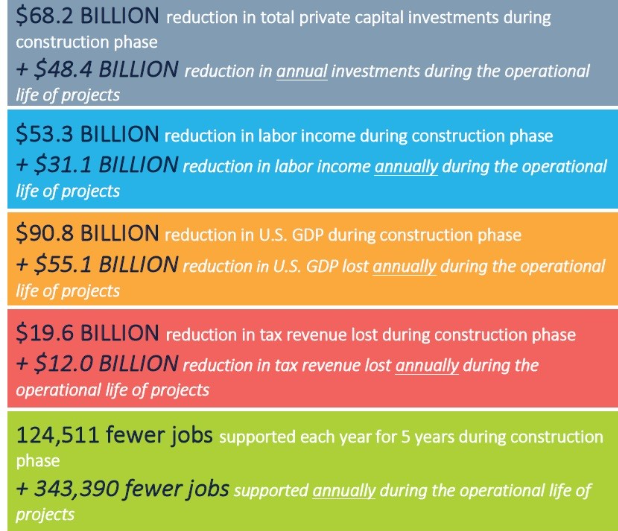
The total lost capital investment in solar is estimated at $16.71 billion; battery storage $24.15 billion, electric vehicle $16.11 billion. Across all six sectors modeled, which also included wind, electric transmission and distribution and clean fuels, total lost capital investment is estimated at $68.18 billion. Annual lost operational investment is $48.36.
The report points out that, assuming private-sector capital investment cancellations would have been evenly invested over the next five years, the $68 billion reduction translates to a reduction of about $13.6 billion annually over those five years.
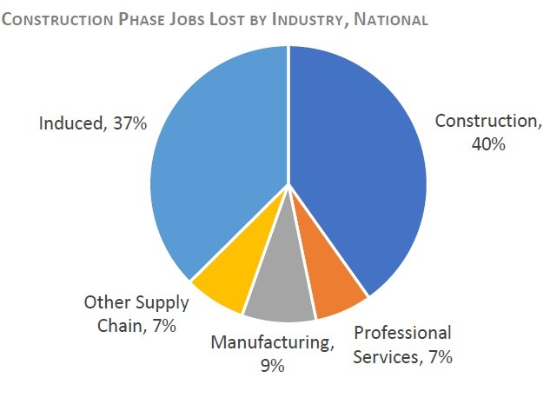
In that five-year period, the $13.6 billion annual investment would have supported about 124,500 jobs throughout the economy in each of those five years. The report notes that construction phase jobs include more than just putting steel in the ground, but also includes professional services, manufacturing, other supply chain and induced jobs.
Induced jobs no longer supported by the cancelled or reduced clean energy projects include healthcare, retail, finance, insurance, real estate, hospitality and professional business services. All of these sectors suffer with a reduction in workforce.
Further losses can be seen in the construction phase, assuming private-sector capital investment cancellations would also have been evenly invested across the next five years. Had they not been cancelled, the report estimates that the value added generated from the projects would have represented a 134% return on the original $68 billion capital investment over five years. Additional impacts would include $10.7 billion in annual labor income and $2.5 billion in annual local, state and federal tax revenue.
Overall, the report finds that, in addition to the economic setback, the cancellations come at a time when demand for electricity is at an all-time high. Cancelled, closed or downsized projects amount to an estimated 10 GW of solar capacity, 3.75 GW of wind capacity and 9 GW of battery storage, or enough electricity to power about 3 million homes, the report finds.
“These cancellations are hitting exactly the kinds of projects America needs most: domestic manufacturing, battery storage, solar, wind, and electric vehicles,” said Michael Timberlake, E2 Director of Research and Publications. “The losses go far beyond the direct jobs announced by companies. Every cancelled factory or power project means fewer construction workers on site, fewer suppliers filling orders, fewer dollars flowing through local economies, and fewer tax revenues for schools, fire departments, roads, and public services.”