
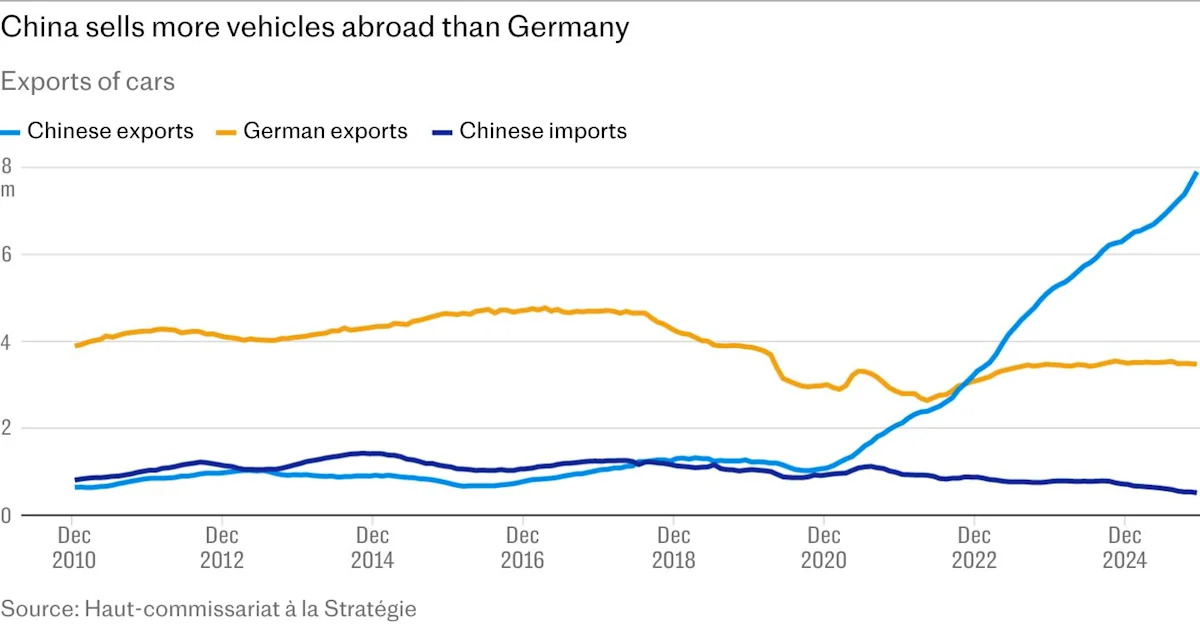
China has exported more than one million cars in a single month for the first time, putting further pressure on Europe’s beleaguered automotive industry.
Chinese car shipments surged to 1.1 million in June, up 71pc from a year earlier, as the Iran war drove up fuel prices and turbocharged demand for electric vehicles (EVs) in Asia and Europe.
Wang Jun, the deputy director of China’s general administration of customs, hailed the figures as confirmation that the country’s “green product offerings” were suited to “the global shift toward green and low-carbon development”.
But the figures will trigger fresh alarm in Europe, where tariffs on cut-price Chinese EVs have failed to stop the likes of BYD, Geely, Chery and Leapmotor eating into the market share of the bloc’s traditional car giants.
“The EU’s trade imbalance with China isn’t going to disappear of its own accord,” said Brad Setser, of the Council on Foreign Relations, on X. “Policy will have to change in either China or the EU if there is going to be a shift in the trend.”
The EU has imposed tariffs of up to 35pc on Chinese EV imports. However, Chinese carmakers are either absorbing the tax cost rather than raising prices, or switching to selling hybrid vehicles, which are not covered by the levies.
Chinese cars still account for under 10pc of those sold in Europe, but their market share has almost doubled in a year, according to Schmidt Automotive Research.
Heavy state subsidies encourage China’s big industries to produce far more than the domestic market can absorb. The surplus is sold overseas at knock-down prices, undercutting European producers.
Meanwhile, cost-conscious local consumers are also buying imported goods from Europe, including cars.
China overtook Japan as the world’s biggest car exporter in 2023, having outgrown Germany a year earlier.

The European Commission imposed a tariff on Chinese-made tyres on Tuesday and officials are reportedly considering extending its tariff regime to hybrid cars.
The bloc’s looming “Made in Europe” regime, which mandates that vehicles sold on the Continent be built with 70pc EU parts, may push Chinese carmakers to build more factories in Europe.
China’s total exports jumped 27pc in June to a record high, fuelled by shipments of EVs, semiconductors, computer equipment, ships, batteries and wind turbines.
Exports to the EU climbed by 17pc from the first half of 2025, and to Britain by 13pc. Exports to the US were almost flat.
China’s overall trade surplus with the rest of the world shrank slightly, amid a 36pc rise in imports. But Chinese purchases of European-made goods rose just 9pc, widening China’s surplus with the EU by 27pc, to $33bn (£25bn).