
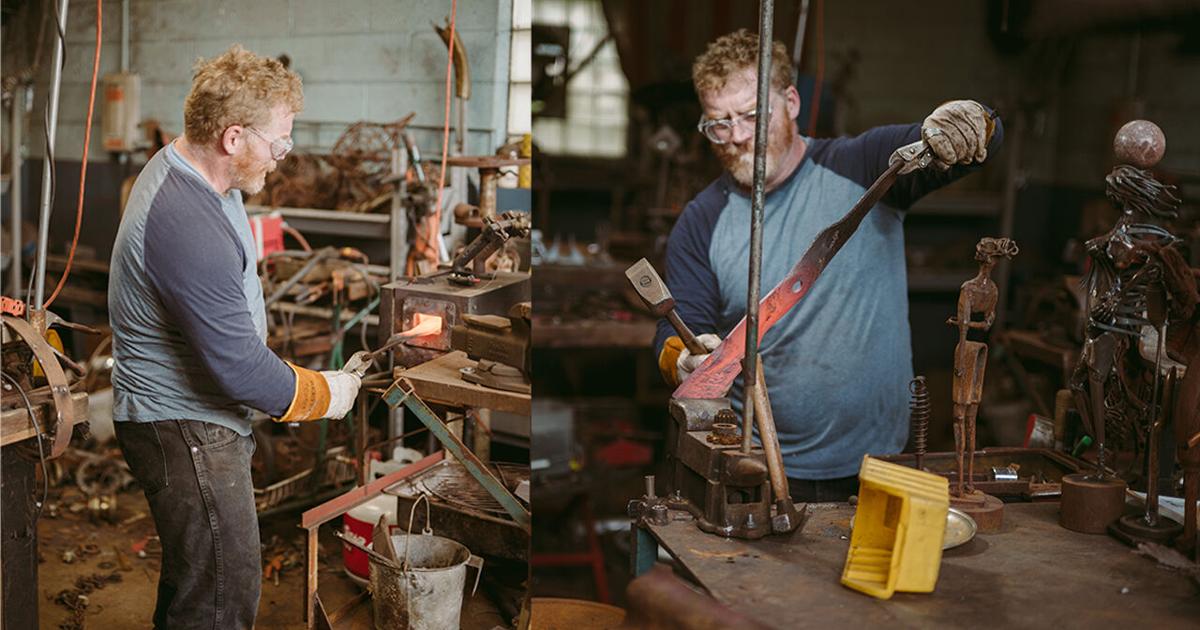
Metalworking and art are a kind of creative inheritance for John Pahlas.
The steel sculptor grew up in Ripon, receiving a rich, hands-on education in blacksmithing, forging and welding through his parents’ business, Metalworks, which built custom, traditionally made metal furnishings and sculptures for customers across the country. He remembers helping with monotonous tasks like flattening, cleaning or cutting pieces of metal.
“I was doing really remedial, boring labor,” says Pahlas, “but after I did a certain amount of work, I could play.”
He learned to weld at 12 and continued to hone his skills before earning a BFA from the University of Wisconsin–Oshkosh. Today, he works at Center Ground Studios in Mount Horeb, which he co-owns with his partner, Heidi Clayton, who is a potter.
Since moving to the Madison area in 2013, he’s accomplished a lot. He created a sculpture for the lobby of the Duluth Trading Co. headquarters in Mount Horeb, has multiple pieces displayed on Epic Systems’ campus in Verona and regularly works with the Madison Children’s Museum. But he’s most proud of finding his way back to the sense of creative freedom he felt while experimenting with metal in his parents’ shop.
“[As a child], there’s that sense of play that’s generated strictly by wonder. … It’s not muddled by adult-ism,” he says, referring to the anxieties and pressures he’s struggled with as an adult. “How can I disengage with all of the boundaries that my adult mind has built up?”
This year, he feels like he’s finally found a way to answer that question — but this time, he has decades of skill and experience to draw from, too.
In other words, after a lot of work, it’s time to play.
Close
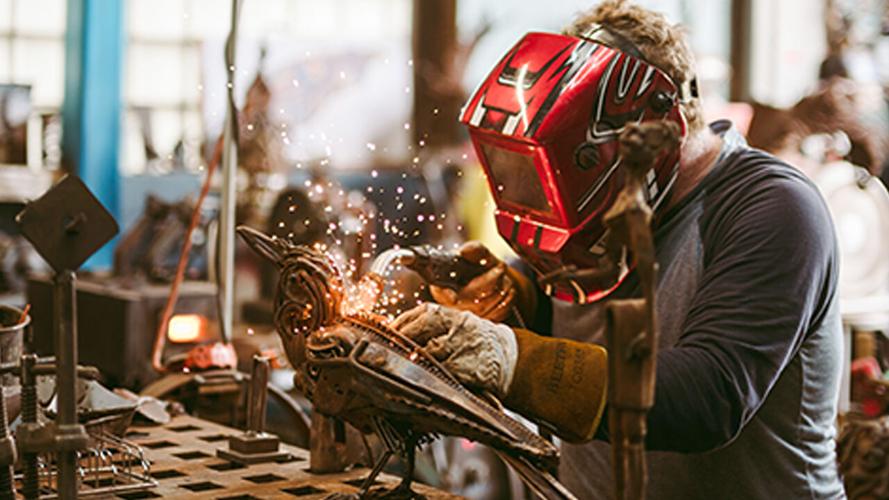

Pahlas’ main tools are his welder and his angle grinder. “I use the welder to add and the grinder to subtract,” he says.
Photos by Christine Dopp
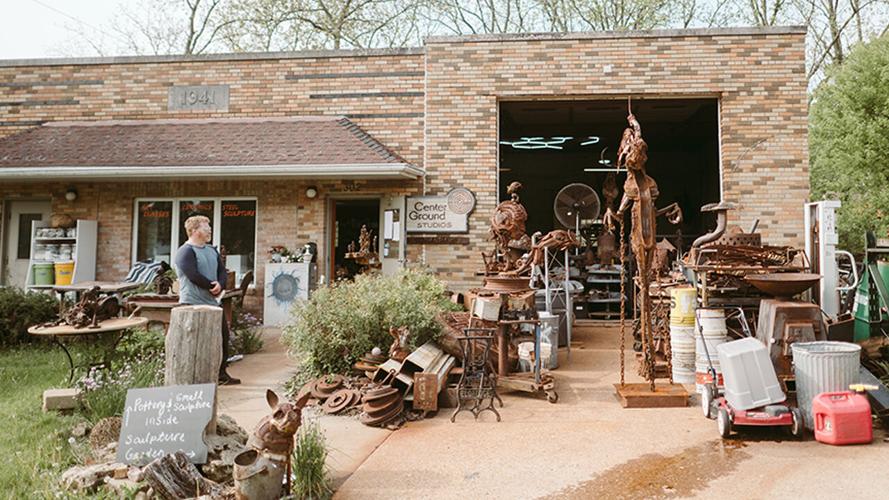
The front lawn of Center Ground Studios is something between a sculpture garden and a scrapyard. Early in his career, Pahlas raided machine shop dumpsters and scrapyards to find metal — now scrap metal appears, almost magically, at his doorstep, thanks to Mount Horeb’s arts-friendly community. “I’ve got my scrap fairies,” he says. “It takes a little village.”
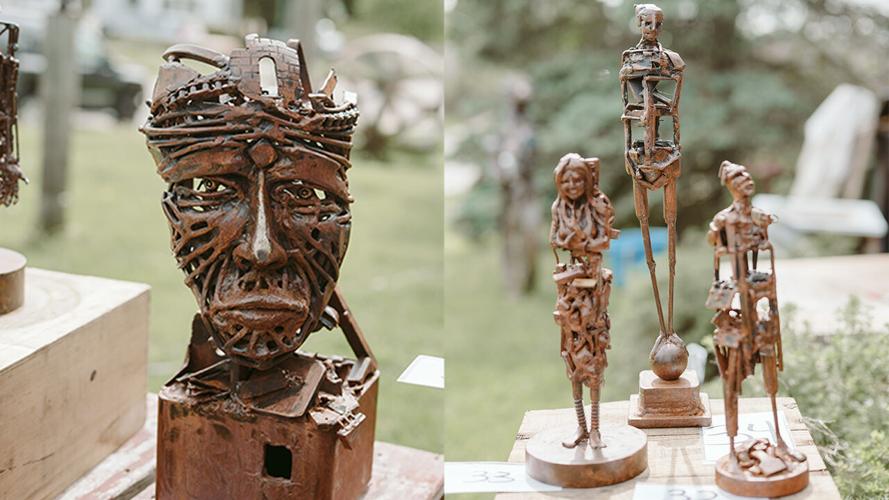
Recently, Pahlas has been creating a series of figures resembling bombed buildings. It’s his way of responding to the barrage of violent and devastating imagery shared online. He describes the sculptures as votives — objects that act as offerings or memorials. “We’re living in a time of constant conflict,” he says. “I can do the artist’s timeless civic duty of trying to help people through this mess the only way I know how.”
Pahlas’ main tools are his welder and his angle grinder. “I use the welder to add and the grinder to subtract,” he says.
Photos by Christine Dopp
The front lawn of Center Ground Studios is something between a sculpture garden and a scrapyard. Early in his career, Pahlas raided machine shop dumpsters and scrapyards to find metal — now scrap metal appears, almost magically, at his doorstep, thanks to Mount Horeb’s arts-friendly community. “I’ve got my scrap fairies,” he says. “It takes a little village.”
Recently, Pahlas has been creating a series of figures resembling bombed buildings. It’s his way of responding to the barrage of violent and devastating imagery shared online. He describes the sculptures as votives — objects that act as offerings or memorials. “We’re living in a time of constant conflict,” he says. “I can do the artist’s timeless civic duty of trying to help people through this mess the only way I know how.”
From the Artist: John Pahlas
Early Memories
Our dinner table was more of a drafting table. It was blueprints instead of a tablecloth. My mom would be working on a clay bust in the corner, and then she’d have a draft of a railing out on the table, and we’d be eating hot dogs on top of it.
First Inspiration
I like H.R. Giger, the Swiss artist who designed the concept for the “Alien” movie with Ridley Scott. … I started to see the piles of metal in my dad’s shop as these gnarly, surreal, biomechanical things. It was [my] origin of falling in love with art that was part of a dark, sci-fi fantasy world.
Push and Pull
The tug-of-war I’m working with right now … [is that] I have to build this thing that is for me — [it’s] not only cathartic, but [it’s] like my identity — and then I have to immediately put a price tag on it and then haggle with someone in a tent all summer.
Long Journey
For a long time, my work has been shadowed by these negative emotions and anxieties that I’ve had to come to terms with. … It takes a lot to get to a playful place, where I can come in here and make something that’s fun.
John Pahlas | @centerground.studios | centergroundstudios.com
Anna Kottakis is a contributing editor to Madison Magazine
COPYRIGHT 2026 BY MADISON MAGAZINE. ALL RIGHTS RESERVED. THIS MATERIAL MAY NOT BE PUBLISHED, BROADCAST, REWRITTEN OR REDISTRIBUTED.