
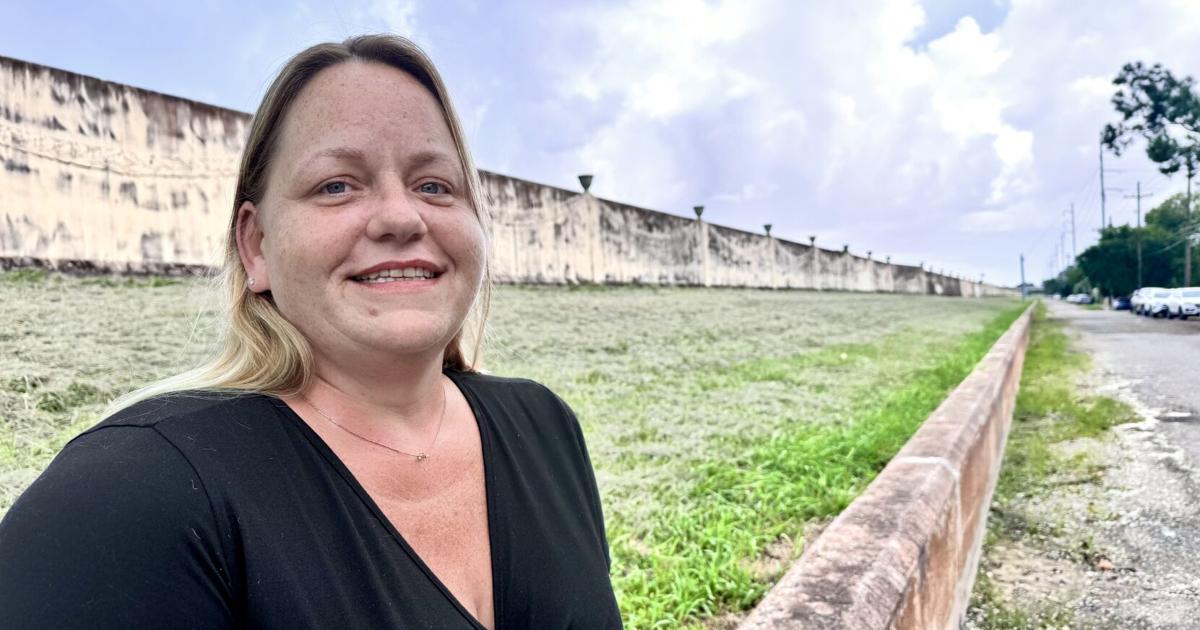
Elizabeth Dixon was puttering in her front yard flower patch one Monday morning in early June when she witnessed an amazing spectacle. It was a duck like no duck she’d ever seen before — a rusty-brown colored bird with a black belly, pink feet and bright orange beak.
The odd duck was trailed by a troop of 10 or so tiny ducklings. Each 4-inches-tall, downy hatchling was black-and-white checkered, like a chessboard. The baby ducks waddled in a line. “That phrase ‘ducks in a row’ is a real thing,” Dixon said.
Trouble was, Dixon immediately realized there was a problem. She lives on a street in Lakeview that runs right near the Orleans Canal, and it seemed to her that the mother duck and her hatchlings probably intended to reach the canal water.
But they weren’t going to make it, because the tall levee wall — decorated with concrete bunting by the late, great New Orleans artist Enrique Alférez — stood in their way. In fact, even the much shorter, knee-high wall along the edge of the street was enough to prevent the ducklings from getting to the water.
The mission to save the wayward duck and hatchlings wasn’t just a momentary pause in her day; Dixon discovered it was one of those small events that serve the soul.
The Harrison Avenue hazard
If they kept heading north toward Harrison Avenue, they would end up in serious danger. Dixon said she didn’t want to drive down Harrison the next day and see what happened when the parade of ducklings tried to cross four lanes of traffic. “Not if I was able to stop it,” she said.
She “kind of sat there for a minute, saying ‘What should I do?’” Dixon recalled.
Dixon, 46, is twice as old as most of her fellow students at LSU New Orleans, formerly known as University of New Orleans. She’s studying to be an accountant.
Dixon has spent the past couple of decades as a stay-at-home mom, homeschooling her four kids. And she must have done a pretty good job, since two of her brood earned scholarships to attend Tulane and Columbia universities. Dixon still has two teenagers at home.
Seeking safety in the strangest of places
After a few seconds of mulling, Dixon made up her mind what to do about the imperiled ducks. She decided to shepherd the feathery family away from Harrison in the opposite direction, toward a geographic juncture where they might reach the water.
It’s a no-man’s-land where a roaring highway overpass, a tar-coated railroad bridge and a brick pumping station join in a grimy jumble of infrastructure, litter and weeds. True, it didn’t sound like a place that would be very hospitable to wildlife, but Dixon knew the levee wall ended at that point, so there was probably a way to reach the water.

Whistling ducks aren’t really ducks at all. They’re a different sort of fowl, common near the river uptown, rarer in Lakeview.
(Photo courtesy Elizabeth Dixon)
Uptown fowl
Dixon became a sheepdog, guarding her flock as they scrambled along the edge of the street, emitting high-pitched peeping as they went. Now, they were heading in the right direction, and that was the important thing.
Sometime in there, Dixon said, she realized there was a second adult duck in the picture. A few yards behind her, she was pursued by what she believed to be the father duck, who spread his wings “real big” in a threatening manner. Despite her good intentions, the father duck was clearly PO’ed at Dixon. She was afraid he might nip her.
Pretty rust-brown ducks like the ones Dixon found herself herding are mostly Uptown fowl. If you live around Audubon Park or the batture, you might see them all the time. But out by the Lake, where Dixon lives, not so much.
Dixon has since learned they’re called whistling ducks. As The Times-Picayune reported in 2024, whistling ducks are a Central and South American species that isn’t really a duck at all. They don’t quack; they, well, whistle. They’re a whole different sort of bird than a duck, though for this story that’s what we’re going to call them.
Dixon doesn’t claim to know much about whistling ducks. Still, she figures the pair flew in and nested in the neighborhood, near the shimmering water of the canal, without realizing that water would be inaccessible to tiny hatchlings.
Waterfowl odyssey
Dixon’s duck parade moved amazingly quickly. The mother duck mostly stays ahead, with the ducklings sprinting to keep pace, their little webbed feet churning beneath them. It was a long haul. Dixon estimated the whole trek was about a half mile. “It was hot,” she said, “but I was committed.”
As she urged the ducks along, she encouraged them, saying things like “you got this” and “teamwork makes the dream work.”
Along the way, one of the ducklings got stuck in the grass somehow and “froze,” Dixon said. She knew she wasn’t supposed to touch wildlife, but she made a “snap decision” to scoop up the straggler and get it back on the path with the others. “I couldn’t believe how soft it was,” she said. “Just a ball of feathers.”
Finally, the duck family reached the embankment leading to the pumping station. The levee wall was gone, but a chain-link fence now stood in their path. Happily, Dixon said, the adult ducks easily flew over the final barricade, and the ducklings squeezed through the fence’s galvanized diamonds near the ground and kept going. They may have faced a considerable leap to the water below, but Dixon didn’t doubt they’d make it.
Living your best life
Through the fence, Dixon said she could see the mother duck take the plunge. At that point, she’d done what she could and turned over further responsibility to Mother Nature.
“I guess it’s happily ever after if a gator didn’t get them,” Dixon said, laughing.
“I thought it was so cute,” she said of the quacking visitors to Lakeview. Seeing them “was the highlight of my day.”
Dixon naturally captured video of the adventure to share with friends, as one is wont to do in this 21st century we live in. The resulting video is adorable.
And that’s all there was to it. It’s a simple little story. But it leaves us all with an internal question. Would we have interrupted our day to walk half a mile in the June heat to save some ducks, or let natural selection do its work? We all wish we’d intercede like Dixon did, right?
Asked why she did so, Dixon said she “just wanted them to be in a happy home and live their best little duck lives.”
As simple as that.