
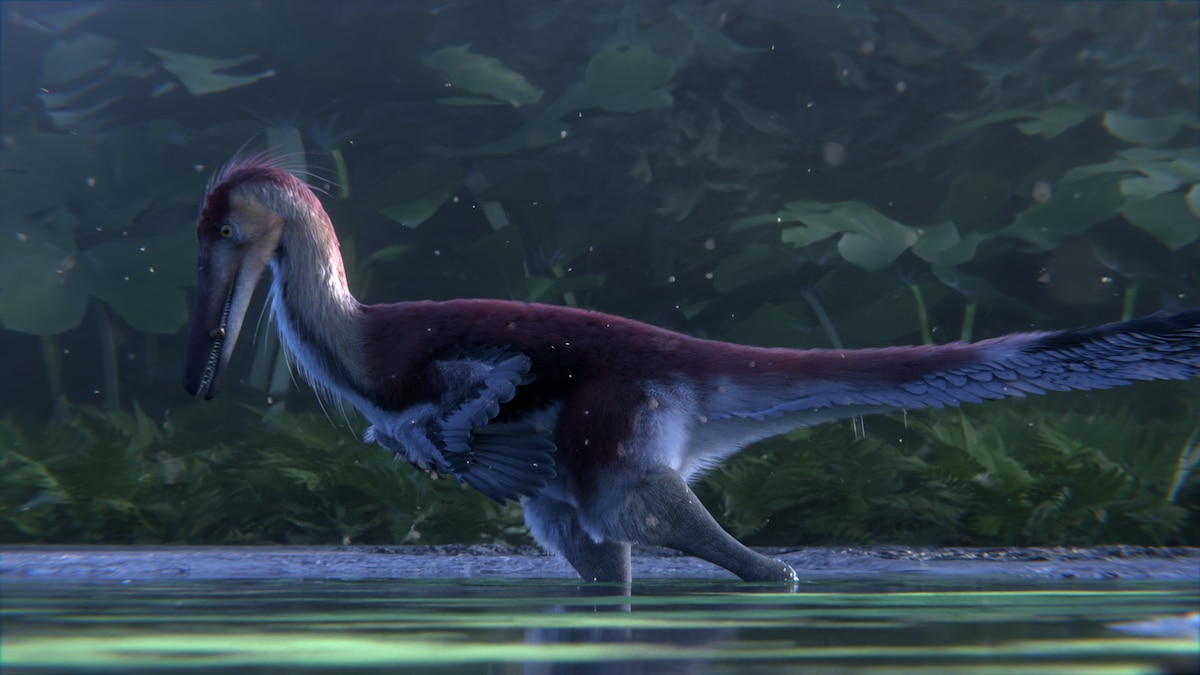
During a recent visit to National Geographic headquarters, Pol told me that back in 2019, his team had found a fossil that screamed raptor because it was a fragment of the iconic kill claw on the second toe. They spent years searching for more specimens, ultimately turning up additional foot bones, a vertebra, and several curved teeth.
But the crucial fossil find came in 2024. As Pol’s colleagues crawled on their stomachs across the freezing Patagonian mountain tops, sifting through rocks and dirt by hand, a technician named Gonzalo Muñoz came across what appeared to be a minuscule neck bone. He showed it to National Geographic Explorer Matías Motta, then a newly minted Ph.D. who did his doctoral work on southern raptors.
“When I saw the vertebra, I recognized immediately that it was a raptor,” Motta says. “I said, That is a raptor vertebra! We found the fossil that we need to name this animal!”
Motta and the team celebrated back at the tents with wine and a big meal, eager to find more the next day. But the jubilation was short-lived: When they awoke the next morning, the entire mountain was blanketed in several feet of snow.
“It’s the worst situation because the snow covered the floor and we couldn’t see the fossils,” Motta says. Even worse, the snow made it treacherous for their trucks to descend the mountain.