
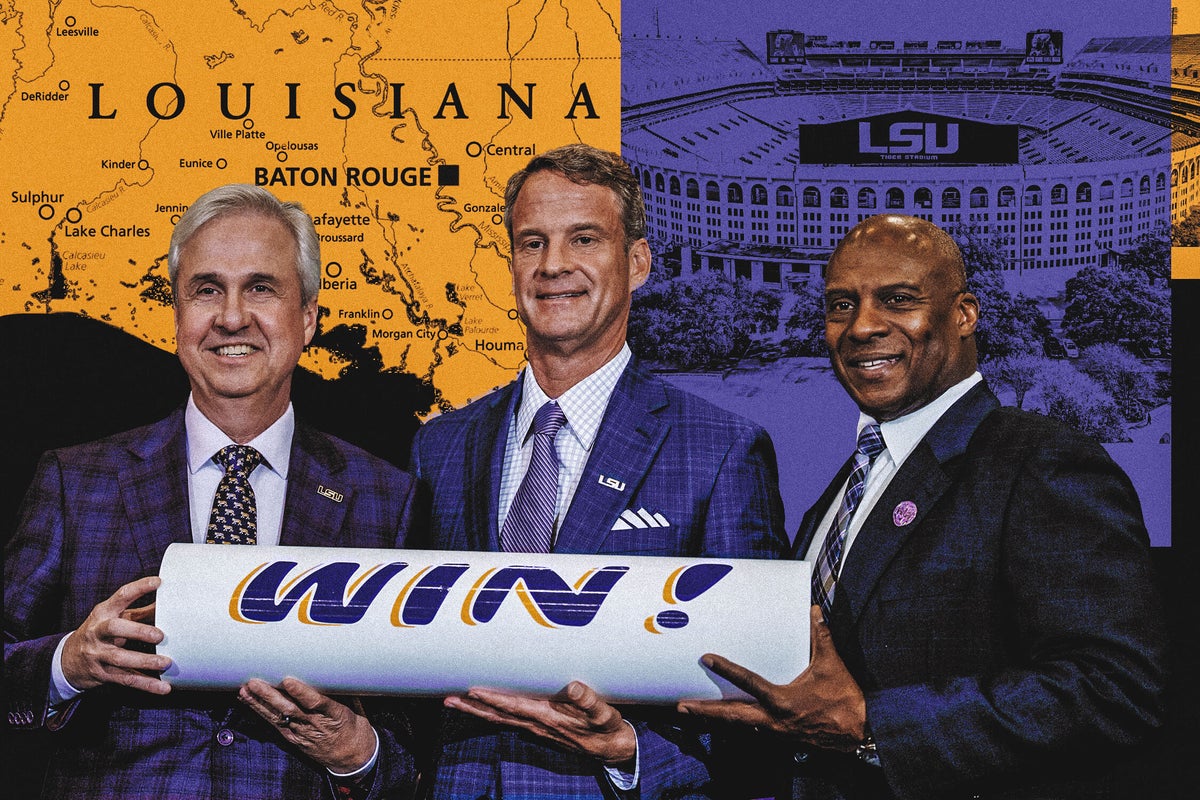
BATON ROUGE, La. — You won’t find a better spot to understand the most interesting place in college football than the intersection of Lane Kiffin’s past and present.
Oxford Ave. and LSU Ave.
At first glance, the oak-canopied corner in the College Town neighborhood seems generic enough to fit in Gainesville, Fla., Auburn, Ala., Oxford, Miss. or any other place Kiffin could have been coaching this fall. But look around, and you’ll see signs that it is, to use the phrase Kiffin has repeated countless times since leaving Playoff-bound Ole Miss for LSU late last year, just different.
A pair of tiger statues stand guard a few houses down. The park around the corner lists one of its benefactors as Todd Graves, the LSU donor and CEO of the Raising Cane’s chicken fingers empire. The for-sale sign on the vacant lot across the street beckons with the promise that “gameday could start here,” 1.1 miles from Tiger Stadium.
Football at LSU is ‘just different.’ Here’s why
Matt Baker
Is all that enough to explain why Nick Saban reportedly advised Kiffin that his old job here is the best in the country? Of course not. The Tigers rank no worse than 12th nationally in (deep breath): athletic expenses, athletic revenue, stadium capacity, stadium atmosphere, facilities, all-time victories, top-10 finishes and Heisman Trophy winners, plus modern-era NFL Draft picks, recruiting rankings and national titles. Those metrics collectively put LSU in the same top tier as Texas, Ohio State, Michigan and Alabama, with only the Crimson Tide winning more national championships this century.
Yet if LSU really is just different — as Kiffin and others at LSU say it is — there has to be more. Something that separates the Tigers from every other powerhouse program and explains why three coaches have led them to a national championship since 2003 and why Kiffin would leave a College Football Playoff team for the chance to become No. 4.
But what?
“How do you explain God to somebody?” asked Dixon McMakin, Tiger Stadium’s public address announcer and a state politician. “It’s the ultimate intangible aspect of this place, yet there are tiny moments of tangibleness that happen all the time.”
By an aptly named intersection in College Town. At a sushi joint on the eve of national signing day. And, because this is Louisiana, in the backroom of a seafood restaurant.
The night the Playoff began, Kiffin could have been back in Oxford making 11th-hour preparations for Ole Miss’ first-round game against Tulane. Instead, he was posting photos of oysters on social media.
Real seafood!! #ItsJustDifferent 👢 pic.twitter.com/aRc8yxamQo
— Lane Kiffin (@Lane_Kiffin) December 20, 2025
It’s not a stretch to connect the two through the organic asset that has nothing to do with historical success or first-round picks.
“We don’t have an Ole Miss and a Miss State, an Auburn and an Alabama,” said Jay Dardenne, an LSU alumnus who served as Louisiana’s lieutenant governor from 2010-16. “LSU has always been the institution in Louisiana.”
That one-of-one institutional power translates most clearly in recruiting. Despite an average population, Louisiana produced the sixth-most NFL players on Week 1 rosters last season (59). The top five states — Texas, Florida, California, Georgia and North Carolina — have 21 in-state power programs fighting for local recruits. Louisiana has … LSU. That alone has given the Tigers the inside track for in-state talent like Ja’Marr Chase, Leonard Fournette, Tyrann Mathieu and College Football Hall of Famers Kevin Faulk and Glenn Dorsey.
In that respect, the Tigers are similar to Ohio State (no offense, Cincinnati), except the Buckeyes recruit more nationally. Of the 22 starters in the January 2025 national championship, only six were Ohio natives. When LSU won it all five years earlier, 13 of its starters were homegrown, and three more were from nearby Houston.
There’s also something different about Louisiana players. According to data from the recruiting service Scorability, 7.3 percent of Louisiana’s prospects across all sports only want to play collegiately in the state. That doesn’t sound like much, but it’s twice as high as Georgia and above most other top football states, including Florida, California, North Carolina and, yes, Ohio.
Translation: LSU is the lone local hunter in a talent-rich state where recruits are more reluctant to leave. Location alone isn’t enough to win every recruiting battle in the revenue-sharing era, but it’s a great start.
“You turn the TV on and you’re watching the games, they’re showing LSU,” said ESPN analyst Booger McFarland, a Louisiana native and 1998 All-American defensive lineman at LSU. “When you’re driving around town, you’re seeing LSU. Those kids still grow up with those three letters and those two colors, purple and gold.”
Those two colors are everywhere — the logo of one local A/C company is a purple hat on a golden retriever — including the memorabilia lining the walls of the place Kiffin posted about in December: Phil’s Oyster Bar & Seafood Restaurant.
Phil’s sits 4 miles from Tiger Stadium and 4 1/2 from the governor’s mansion, making it the unofficial midpoint between two of the state’s biggest forces — LSU and politics. The joke is that so much business gets done over gumbo and po’boys in its backrooms (plural) that it’s the unofficial state capitol. First-year LSU men’s basketball coach Will Wade was making calls in one of them during lunch last month.
Politicians everywhere tie themselves to their local teams, but few have done so like Louisiana’s Huey Long did until his assassination in 1935. The larger-than-life governor/senator didn’t just hire and fire coaches, said former LSU professor Robert Mann, a Louisiana Political Hall of Fame inductee and author of “Kingfish U: Huey Long and LSU.” Long drew up plays, wrote marching band songs, coupled new student housing with stadium expansion, tried to fill a state senate seat with the star tailback (who wasn’t eligible for the role) and moved injured players into the governor’s mansion to personally nurse them back to health.
It’s not hard to draw a line from Long trying to barge into a locker room to deliver a halftime pep talk (running off Hall of Fame coach Biff Jones in the process) to current Gov. Jeff Landry importing a Florida tiger to bring onto the field for an Alabama game or declaring who would (and wouldn’t) hire Brian Kelly’s replacement last year.
“Maybe not a straight line,” Mann said, “but it’s not very crooked.”
The actions might not work in Mississippi or Florida, where supporting the Rebels or Gators means alienating Bulldogs or Seminoles. But in Louisiana, it’s a red-meat issue. McMakin — who represents East Baton Rouge in the statehouse — said politicians feel an “obligation” to help the Tigers, whether it’s a governor intervening in a coaching search or McMakin filing a bill to exempt players’ NIL earnings from state income taxes to help LSU recruiting.
“Because when LSU wins,” McMakin said, “the state just feels better.”
The night before February’s traditional signing day, Duy Nguyen couldn’t immediately place the familiar-looking man walking into his six-month-old sushi restaurant, Homakase, just before closing.
“Sure enough, all of my other workers are like, ‘Oh my God, it’s Lane Kiffin,’” Nguyen said. “I was like, ‘Oh s—.’”
Kiffin posted a photo of the menu and posed for a picture with Nguyen. The lunch crowd swelled the next day. Months later, Nguyen still gets asked about his interaction with Homakase’s most famous patron.
Louisiana doesn’t have a major corporate base. It’s not home to Fortune 100 giants like the ones in Arkansas (Walmart, Tyson Foods) or Georgia (Delta Air Lines, Coca-Cola). But it does have LSU. Its statewide system is one of Louisiana’s largest employers. The brand resonates so strongly that the University of New Orleans recently rebranded as LSU New Orleans (complete with adopting the purple and gold color scheme).
University of New Orleans ➡️ LSU New Orleans
Same City, New Name. The LSU New Orleans Privateers are now official as of today.🟣🟡⚔️ pic.twitter.com/ieZ8u3atgC
— Southland Conference (@SouthlandSports) July 1, 2026
Those two colors link every corner of a state that’s just different in another key way: About 77 percent of Louisiana’s 4.6 million residents were born in the state, according to the U.S. Census. That’s the highest percentage in the country (more than double Florida’s). All the Louisiana lifers create a richer, deeper culture with their own food (gumbo and beignets), music (New Orleans is the birthplace of jazz) and festivals (Mardi Gras).
Its town square is Tiger Stadium, voted by The Athletic as the best in college football.
“I think LSU football is as important to Louisiana as the state flag, as the state motto, as the state flower,” said Dan Borné, who spent 38 years as Tiger Stadium’s public address announcer before retiring last year.
Which explains why there’s always money somewhere to support it.
When LSU fired Kelly after a 34-14 record, the school owed him as much as $53 million — the second-largest buyout ever — prompting the governor to vow LSU was “not doing that again.” A month later, LSU did pretty much the same thing by guaranteeing 80 percent of Kiffin’s seven-year, $91 million deal. Kelly’s buyout will decrease if he gets another job; Kiffin’s won’t. Add in the price of firing athletic director Scott Woodward (another $6 million), the roster budget more than doubling since last fall to the $40 million range (believed to be among the most expensive in the country), and the cost of the men’s basketball coaching transition that brought Wade back, and the back-of-the-envelope math already tops $100 million.
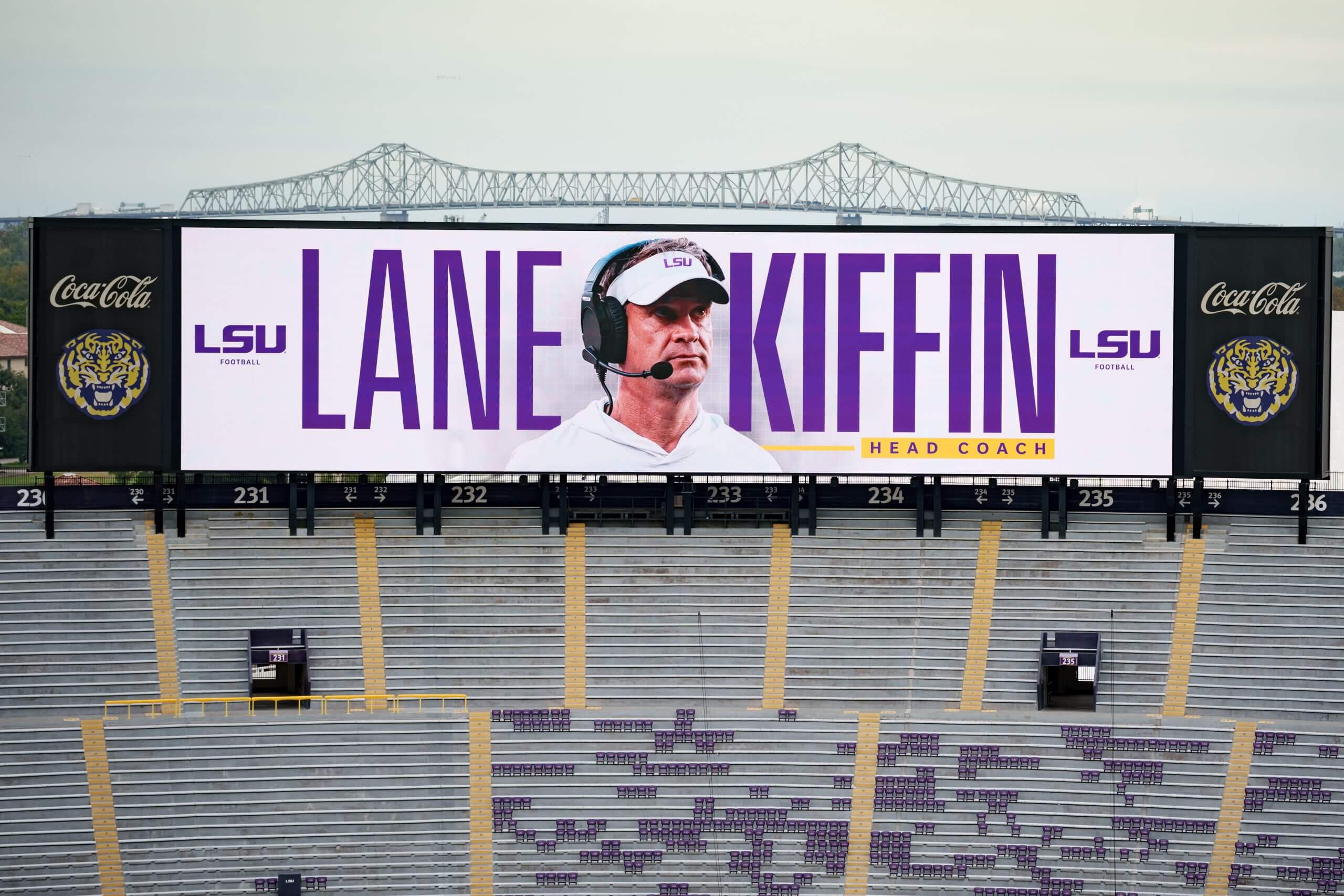
Lane Kiffin is trying to join Nick Saban, Les Miles and Ed Orgeron as national title winners at LSU this century. (Matthew Hinton / Imagn Images)
The sustainability of the fiscal spike remains an open question. In a budget document from last summer, LSU’s interim CFO said the “only area of concern is the continuing negative fund balance” for athletics. A gathering of top donors next month (at the governor’s mansion, of course) on the financial future of LSU sports adds to the intrigue. But the program’s private fundraising arm, the Tiger Athletic Foundation, has found ways to keep the money flowing; only five schools reported more donor contributions last year than LSU ($68.7 million), according to the Knight-Newhouse college sports database.
“They’ve been rattling the tin can around the state for over a decade trying to raise that money for a library because the current one is in deplorable state,” said Mann, the historian and former LSU professor. “But by God, when we want to buy out Brian Kelly and hire Lane Kiffin, the money just falls from the sky.”
The general vibe among current faculty, according to one university official (who spoke on the condition of anonymity because of fear of retribution), is that the athletic department can spend how it pleases, as long as the money doesn’t come from academic budgets. The feeling elsewhere is that buyouts aren’t as expensive as losing.
“Apathy costs money,” said Derek Ponamsky, a Chalmette, La. native who was the Tigers’ special assistant to the head coach under Ed Orgeron.
At Phil’s Oyster Bar, manager Charles Rodrigue reported a “noticeable” dip in business this spring when LSU’s eight-time College World Series champions missed the baseball postseason for the first time in 15 years. If that’s the impact of a subpar season for a secondary sport, the cost of an apathetic November without College Football Playoff dreams would be even more damaging for the sushi joints and clothing shops that rise and fall on football weekends. Through that lens, the buyouts and top-ranked transfer class seem worth every penny.
An offseason of hope for an entire state is priceless.
The vacant lot in College Town looks a little overgrown but more lush than unkempt. You don’t have to squint to picture someone’s gameday starting there on LSU Avenue, just past where Oxford ends. The online listing calls it a place where “lifestyle, location and opportunity come together.”
Whether — and how quickly — all three converge 1.1 miles down the road at Tiger Stadium remains one of the season’s biggest questions. In the six years since Joe Burrow quarterbacked one of this century’s best teams to a national title, LSU is 44-29. That’s not good enough for a program that lured two coaches away from championship hunts (Kelly’s Notre Dame team wasn’t yet eliminated when he left for LSU in 2021).
“Expectations are as high as they can be,” said Patrick Wilkerson, an LSU graduate who co-owns the Bengals & Bandits clothing shop a few steps outside the campus gates. “Everybody’s excited. Everybody’s happy.”
And everybody’s waiting, as Wilkerson said, to see if Kiffin “actually pans out to what he could and should be” after Kelly struggled to fit in from Day 1.
Although Kiffin has stressed that turnarounds don’t happen overnight, many preseason rankings peg his Tigers as a top-10 team. Playoff contention feels like a reasonable expectation. If he could do it at the traditional SEC also-ran in Oxford, he should be able to do it faster and better at LSU, a one-of-one institution that unites governors, chicken finger barons and oyster shuckers in a way that really does feel just different from everywhere else.
“The only thing we demand excellence of in Louisiana,” Mann said, “is Mardi Gras and college football.”