

Marin County and local municipalities can’t address rising seas individually, but now is not the time to form a joint agency to do it, analysts say.
The findings come from two assessments discussed by the Board of Supervisors on Tuesday. One was a two-year study by AECOM, a consulting firm advising the county, that evaluated the feasibility of forming a special district, a joint powers authority or other models.
The other was commissioned by the Marin Community Foundation and conducted by Coastal Quest, a consulting group focused on climate.
“Both studies recognize that Marin’s climate resilience initiatives have thus far been siloed,” said Nadia Seeteram, the county’s chief climate officer.
Seeteram said no single jurisdiction can tackle the scale of the problem, which needs an estimated $17 billion in long-term adaptation efforts.
Nevertheless, Seeteram said, “Neither study recommended that the county move towards a formal governance authority.”
Instead, both studies recommended “prioritizing voluntary collaborations that are focused on establishing trust, demonstrating the power of collaboration and delivering early wins,” she said.
The studies also suggested that the county’s new climate office, created as part of a recent reorganization of the county executive’s office, serve as the countywide backbone organization in the meantime, coordinating agencies and developing funding strategies.
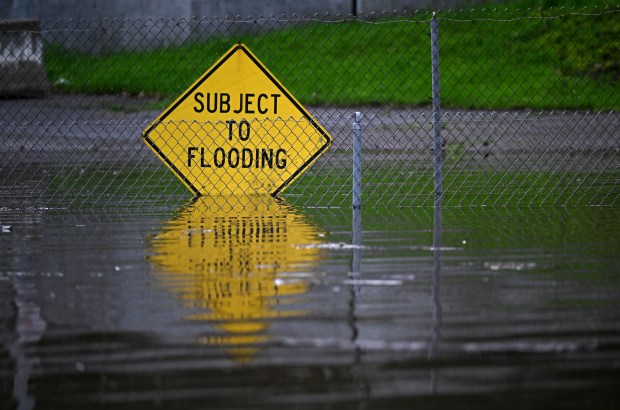 Water inundates the Manzanita park-and-ride lot in Mill Valley, Calif., during a king tide on Friday, Jan. 2, 2026. (Alan Dep/Marin Independent Journal)
Senate Bill 272, approved in 2023, requires all local governments in the coastal zone and along San Francisco Bay shoreline to create formal sea-level rise plans by Jan. 1, 2034. The state has made planning funds available to support this process through Senate Bill 1.
Mill Valley, Sausalito and Tiburon have already applied for and received planning funds, Seeteram said. She added that the county is leading an application for SB 1 funds that will include unincorporated bayside lands as well as San Rafael, Novato, Corte Madera, Larkspur and Belvedere.
However, while the AECOM study recommended against a governance structure now, it also suggested that the county move deliberately in phases toward an agency.
Seeteram said the county and San Rafael are exploring the benefits of formulating a climate resilience district.
“That is a great first step,” said Supervisor Stephanie Moulton-Peters. “I’ve always envisioned a countywide resilience district much like the Marin Wildfire Authority. We have seen that individual cities and towns cannot do this alone.”
The studies also recommend that the county work with other jurisdictions to develop a coordinated funding and financing strategy that matches available grants to emerging opportunities.
Supervisor Brian Colbert expressed some skepticism, given the size of the problem.
“There is not enough grant money for $17 billion,” he said.
Supervisor Eric Lucan said, “Seventeen billion dollars is a massive, massive number.”
“What we don’t want is for every jurisdiction to get a little piece of something,” he said. “That will just water down the limited dollars that will be available.”
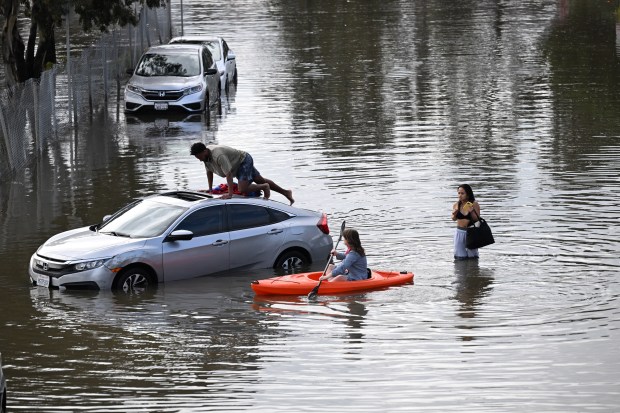 Emily Drake of Corte Madera paddles to help people stranded in a flooded area of Nellen Avenue near Lucky Drive in Corte Madera, Calif., on Friday, Jan. 2, 2026. (Sherry LaVars/Marin Independent Journal)
Many members of the public commented on the reports.
“While SB 272 provided the needed legislative backing to plan for sea-level rise, its deadline for only a plan by 2034 is much too late,” said Isabel Dawson, a policy associate with the Environmental Action Committee of West Marin.
Dawson noted that El Niño conditions continue to strengthen.
“This could mean stronger winter storms and an increased risk of events like the damaging flooding we saw this winter,” Dawson said. “Adaptation action needs to happen now. We support pursuing grant funding for pilot projects within the next year and for implementation of pilot projects within the next one to three years.”
Sachi Itagaki, a member of Corte Madera’s flood control board, said, “We need to emphasize some near-term measures, such as early alerts for high tides.”
Itagaki said her 2007 Honda Civic was submerged by high tides in June and was a total loss.
Ken Strong, a Marin Conservation League board member, said, “We think the county being the backbone is key. No one else can perform that service in this area.”
Strong said the organization also wants the county to create a community advisory committee.
Patti Juachon, a Marin Community Foundation program manager, said the county faces other climate risks in addition to the rising sea. The study by Coastal Quest also addressed hazards such as wildfire and extreme heat.
“If we can initiate a multi-hazard approach now while addressing sea-level rise,” Juachon said, “we can help ensure that our collective efforts deliver broader and more lasting benefits than doing it by piecemeal.”
Bill Carney, a member of Sustainable San Rafael and the Marin Climate Action Network, said, “Where possible we need to find funds that do double duty supporting actions that both prepare for climate impacts and reduce the greenhouse gases that are driving them.”