

Western Washington is about to get hot and smoky, but the sticky weather won’t linger long.
Temperatures nearing the triple digits are expected in Issaquah (97), Auburn (96), and Chehalis (95) for both Tuesday and Wednesday, before storms roll through Wednesday night, bringing more typical temperatures through the weekend. Temperatures are expected to hit 91 in Seattle Wednesday and 90 in Tacoma.
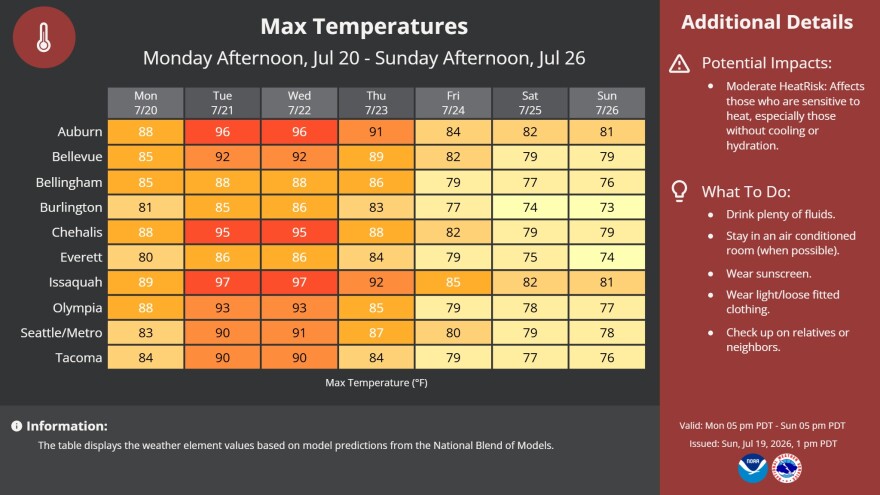
National Weather Service Seattle
Matthew Cullen, a meteorologist at the National Weather Service in Seattle, urged Washingtonians to limit stressful activity outside during the hottest periods of the day, if possible. He also said it was important to remain hydrated, wear light-colored clothing, and seek air conditioning to give your body relief from the heat, even if only for a brief period during the day.
“Heat is very dangerous, especially when it becomes a multi-day event,” Cullen said.
Cooling centers across the region are opening starting Monday. Call 211 or check the King County severe weather shelter website to find a cooling center near you.
Cullen said high temperatures during the day also mean less of a cool down at night.
“Especially if you’re closer to the city center in more of the built-up urban areas, where our overnight lows may only get down to about 65 overnight,” he said.
The National Weather Service has issued a heat advisory from 10 a.m. Tuesday to 11 p.m. Wednesday for much of Western Washington. The advisory warns that temps at or near the 90s will “pose a moderate to major risk of heat-related illness.”
The two-day hot flash will be accompanied by wildfire smoke, especially to the north of Seattle in Skagit and Whatcom counties, where the Northwest Clean Air Agency has issued an air quality alert through 9 a.m. Wednesday.
But the air quality will not be as extreme as what much of the Midwest and East Coast have been experiencing from wildfires in Canada and Minnesota over the last week, said Seth Preston, communications program manager for Northwest Clean Air Agency.
“We don’t expect it to be super bad,” Preston said.
The people most at risk are those sensitive to smoke, such as people with lung and heart issues, the elderly, and small children. Check the agency’s Air Quality Center for more details as the week progresses.
“Everybody’s a little smoke shy because we’ve had some pretty bad years in the recent past,” Preston said.
Preston said the air should clear Wednesday morning.
“At least, that’s what we’re forecasting right now,” he said.