
STEADY AND STABLE:
The credit ratings agency listed some of the factors propelling Taiwan’s growth, as well as pointing out some possible future headwinds
By Crystal Hsu /
Staff reporter
Taiwan’s economy should expand 9.4 percent this year, fueled by a technology-led growth surge, while strong external finances continue to underpin the nation’s sovereign credit strength, Fitch Ratings said yesterday.
The economy’s outlook remains supported by surging semiconductor exports, driven by global demand for artificial intelligence (AI) applications, as well as resilient private consumption, Fitch Ratings director for Asia-Pacific sovereign ratings Sagarika Chandra said at a news conference in Taipei.
Taiwan’s advanced manufacturing capabilities and highly specialized semiconductor ecosystem give the economy a competitive edge, allowing it to benefit from the global AI investment boom, Chandra said.
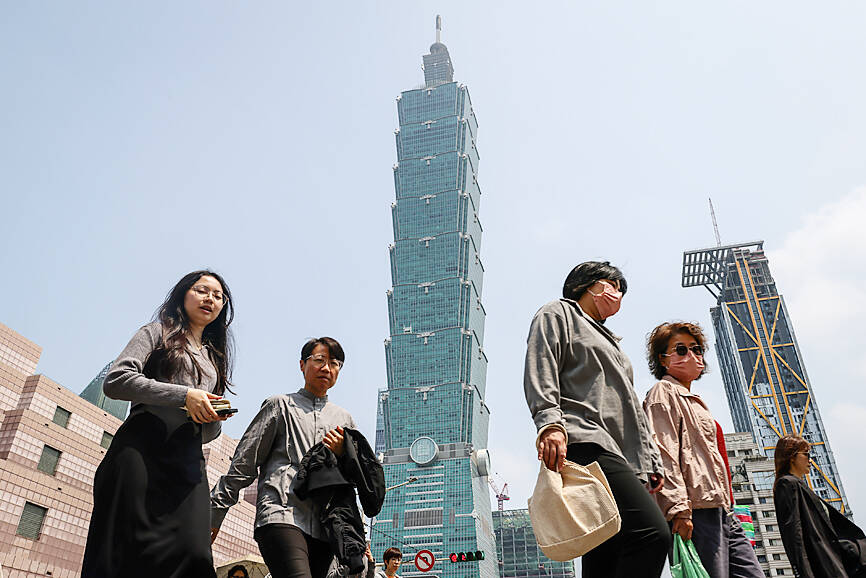
Photo: EPA
Growth is expected to slow to 4.8 percent next year and 4.5 percent in 2028 as the AI-driven upcycle gradually loses momentum following rapid expansion last year and this year, Fitch said.
Exports to Taiwan’s two largest trading partners, the US and China, remained strong in the first half of this year, rising 69 percent and 22 percent from a year earlier respectively, reflecting sustained demand for technology products, the agency said.
The export strength has helped Taiwan maintain large and persistent current-account surpluses, which Fitch views as a key economic strength. Taiwan’s net external creditor position is estimated to reach about 208 percent of GDP by the end of this year, much higher than the median level for economies with similar ratings, the agency said.
Taiwan’s public finances compare favorably with many peers, supported by relatively low fiscal deficits and steady economic growth, Fitch said.
Government debt is expected to remain well contained in the coming years, with authorities likely to tap accumulated fiscal reserves to fund part of additional spending needs, it said.
Chandra said Taiwan’s “AA” credit rating with a stable outlook reflects its strong external finances, prudent fiscal management and competitive business environment.
However, the economy’s heavy dependence on exports leaves it exposed to shifts in global demand, while cross-strait tensions remain a long-term risk, she said.
Fitch identified several possible headwinds, including a sharper-than-expected slowdown among major trading partners, weaker global demand for AI-related products and escalating geopolitical tensions.
The agency expects tensions across the Taiwan Strait to remain elevated amid complex political dynamics and recurring incidents, although they are unlikely to undermine Taiwan’s economic or political stability.
Fitch warned that domestic policymaking could become more difficult as the ruling Democratic Progressive Party lacks a majority in the legislature, potentially complicating the passage of key policies.
Despite these challenges, Taiwan’s leadership in advanced technology manufacturing, strong external buffers and sound fiscal position should continue to provide resilience against external shocks, the agency said.