
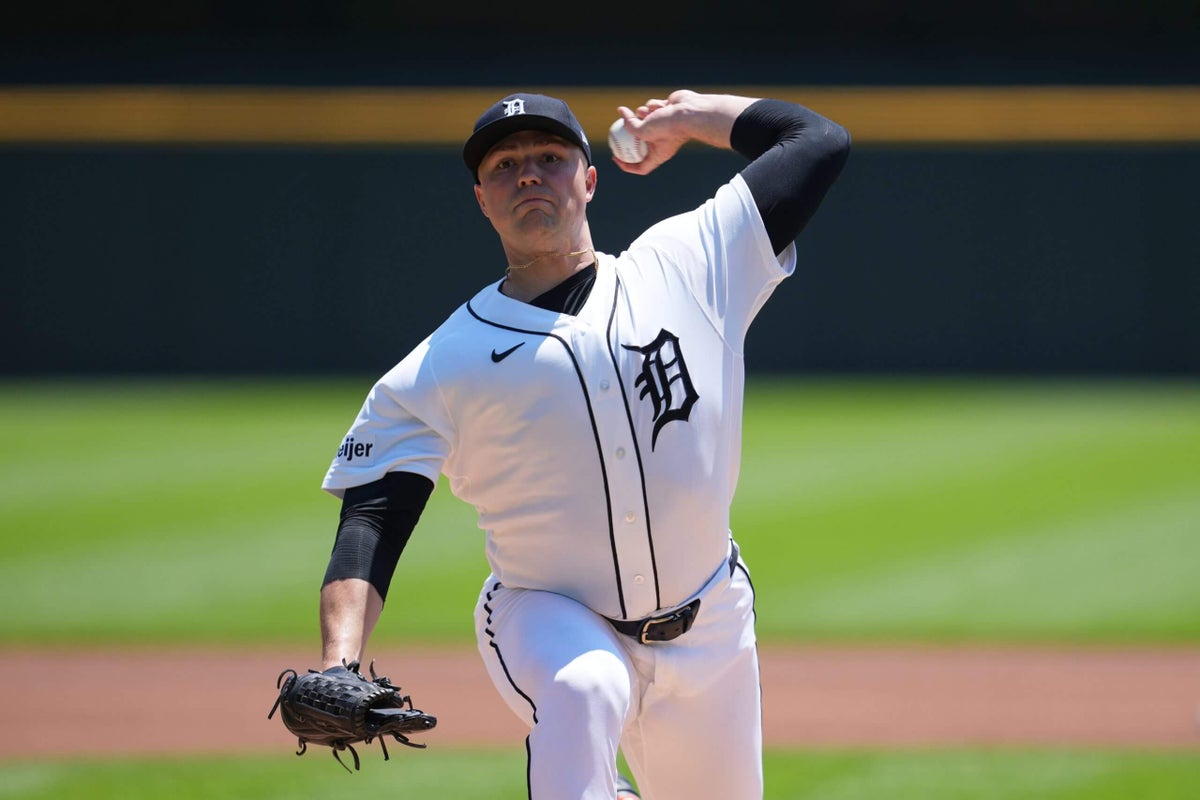
The Detroit Tigers probably cannot trade Tarik Skubal without dramatically compromising their chances of winning the World Series. But the Tigers are at least mulling the possibility of securing a package for Skubal that potentially would keep them strong in the present while making them stronger for the future.
The way they would do it, according to two rival executives briefed on the Tigers’ thinking, is by trading Skubal for a controllable starting pitcher plus quality prospects. The starter would replace Skubal in the rotation, backfilling his innings but almost certainly providing lesser performance.
Among the pitchers who might fit in such a trade:
Emmet Sheehan, Los Angeles Dodgers
Logan Henderson, Milwaukee Brewers
Ian Seymour, Tampa Bay Rays
Andrew Painter, Philadelphia Phillies
JR Ritchie or AJ Smith-Shawver, Atlanta Braves
Will Warren or Ryan Weathers, New York Yankees
With the exception of Henderson, who recently missed 6 1/2 weeks with a lower back strain, none of those pitchers has been a world beater this season. Certainly none has been close to the level of Skubal, who has a 2.97 ERA in seven starts since returning from his innovative NanoNeedle surgery to remove loose bodies in his left elbow.
All, however, have shown varying degrees of promise. And all would be with the Tigers for longer than two-plus months, the amount of time Skubal has left with the Tigers before he becomes a free agent. So, of course, would any prospects Detroit landed in the trade.
2026 Aces Project update: MLB insiders rank starting pitchers
Andy McCullough
The problem with such a scenario is that the Tigers’ playoff odds would take a hit, their odds of winning the World Series a major hit. Those odds, as of Tuesday, are relatively steep — 32.9 percent to reach the postseason, 2.5 percent to win the Series. And that’s with Skubal on the roster.
“Threading the needle”— the term baseball executives use to describe a strategy in which they both buy and sell, the way the Tigers could with Skubal — can be both difficult and disruptive.
Remember the uproar when the Milwaukee Brewers made the infamous Josh Hader trade at the 2022 deadline, sending the closer to the San Diego Padres for left-hander Taylor Rogers, righty Dinelson Lamet, outfielder Esteury Ruiz and pitching prospect Robert Gasser.
The Brewers figured Rogers could help replace Hader, who was coming off a July in which he had a 12.54 ERA in 9 1/3 innings. Their short-term plan did not work. Trading Hader sucked the life out of them, the way trading Skubal could for the Tigers.
Milwaukee went 19-21 the rest of the way, losing its three-game lead in the NL Central at the deadline and missing the playoffs.
Long-term? The Brewers came out of it just fine.
That offseason, they flipped Ruiz in a three-team trade that landed them catcher William Contreras, who became a three-time All-Star. Gasser, after recovering from Tommy John surgery, is now part of their rotation mix.
The difference with the Tigers is that Skubal gives them a chance of reaching the World Series in a particularly down year for the American League. With the current CBA in effect until Dec. 1, they still would receive a draft pick after the first round as compensation if they made him a qualifying offer and he left as a free agent.
Such picks can be valuable: The Tigers landed All-Star infielder Kevin McGonigle with the 37th overall choice in 2023. That pick was a competitive-balance selection. The one the Tigers gained for Skubal would come before that round.
The deadline is 12 days away. The Tigers need not make any decisions yet. They can keep playing this out, pondering every scenario and hypothetical. Trading Skubal for a package that includes a lesser starting pitcher under greater club control is just one possibility.
Dombrowski: Phillies’ system good enough
The Philadelphia Phillies’ farm system, ranked 15th by The Athletic’s Keith Law, is not exactly the envy of the sport. But Dave Dombrowski, the team’s president of baseball operations, believes the Phillies have enough young talent to address each of their three principal needs — a No. 5 starter, high-leverage reliever and right-handed hitting outfielder.
“There is plenty of interest in players in our system,” Dombrowski said Tuesday. “That’s not a concern at all.”
Like most clubs, the Phillies are deep in prospects they can trade for marginal additions. But Law based his modest ranking of their system on three prospects he ranked in his preseason top 50 — shortstop Aidan Miller (No. 6), right-hander Painter (No. 22) and outfielder Justin Crawford (No. 48).
Miller underwent a procedure in early June to address a back problem that has sidelined him all season. Painter had a 7.06 ERA in 65 innings, mostly as a starter, before getting demoted to Triple A. Crawford entered Tuesday 26 percent below league average in adjusted OPS, and 34th among 40 center fielders in Outs Above Average.
The Phillies as a team were 17th in runs per game with the league’s seventh-highest strikeout rate. And their defensive rankings — 23rd in Outs Above Average, 29th in Defensive Efficiency and 30th in Defensive Runs Saved — were far from championship-caliber.
Dombrowski is almost always aggressive at the deadline. The Phillies need left-handed relief help, and after the loss of righty Brad Keller to a UCL tear, they could use a righty, too. Perhaps Painter can reemerge as the fifth starter. Surely Dombrowski can find a bat.
Still, with so few sellers at this moment, what kind of impact might Dombrowski acquire? The Phillies have cut their NL East deficit from 10 1/2 games to three since interim manager Don Mattingly took over for Rob Thomson on April 28. But serious questions remain.
Rays on the prowl
The Tampa Bay Rays, sitting on the best record in the AL even after losing four straight to the Boston Red Sox out of the break, give every indication that they will be aggressive at the deadline.
“I think the big surprise will be Tampa buying big,” one rival executive said. “They’re everywhere scouting.”
Another official listed the Rays, Phillies, New York Yankees and San Diego Padres as the teams with the most prominent scouting presence in major-league parks. That measure, though, is not as meaningful as it once was. Some teams prefer to rely on data and video more than scouts in the field.
In any case, the Rays want to add pitching, as well as an impact hitter to complement Junior Caminero, Yandy Díaz and Jonathan Aranda. That hitter could play any number of positions — catcher, second base, outfield. And the Rays will not necessarily add just one.
Nationals’ Griffin a goner?
Some rival executives believe a Foster Griffin trade is inevitable. The Washington Nationals, however, are still assessing whether to deal, extend or keep the starting pitcher through the end of the season, according to people familiar with the club’s thinking who were granted anonymity to speak freely.
If the Nationals end up engaging with other teams on Griffin, the expectation is that there would be strong interest in the right-hander.
Either way, the small bet Washington made on Griffin, giving him a one-year deal worth $5 million over the winter, is paying off. In his first full season in the major leagues and after spending the prior three years pitching in Japan, Griffin made the All-Star team.
Griffin, 30, holds a 2.68 ERA/3.96 FIP over 117 1/3 innings and 20 starts. He has 111 strikeouts and his 5.7 percent walk rate, per Baseball Savant, ranks in the top 10 percent of the league.
There are not many attractive rental starters on the market. The obvious candidates are the New York Mets’ Freddy Peralta and the San Francisco Giants’ Robbie Ray. Griffin’s numbers are better than both of those more accomplished veterans.
The main concern some scouts harbor regarding Griffin is possible regression, attributing some success to his newness to the league. Griffin’s supporters, however, would point to his ERA since June: 1.25.
Marlins in holding pattern
In the middle of the wild-card picture yet losers of eight straight, the Miami Marlins are firmly a bubble team. They may not sell in a major way, as The Athletic recently reported when times were better for them all of two weeks ago. But they may not do much adding, either.
Indeed, according to people familiar with the situation who were granted anonymity in exchange for their candor, the Marlins are going to let things further play out before making any firm decisions on their trade deadline plans. Their placing of All-Star right-hander Max Meyer on the injured list with a neck strain Monday further complicated matters.
The Marlins know as well as any team how much can change over such a relatively short period. On July 9, the Marlins reached a high-water mark of 10 games above .500 after winning 16 of their past 20 games, matching the best single-season span in their 34-year history. Since then, they have not won a game.
From a trading perspective, the Marlins may see the value in mostly standing pat, particularly after their rough stretch. In terms of difficulty, their remaining schedule is second only to the Brewers’, per FanGraphs.
Miami’s farm system is strong. Their payroll contains no large guarantees beyond the season (they hold a $21 million club option on Sandy Alcantara). Even if Marlins officials see their present as encouraging, they view their near future as much brighter.
Diamondbacks trying to figure it out
Arizona Diamondbacks general manager Mike Hazen repeatedly has said he plans on buying. The problem for Hazen, according to a person briefed on his thinking, will be determining how to direct the team’s limited resources.
The Diamondbacks, who have played better of late, winning seven of their past nine games, might not have the payroll flexibility and prospect capital to address all of their concerns.
For most of the season, the D-Backs’ biggest need appeared to be a left-handed hitting first baseman/DH type — the team entered Tuesday ranked last in OPS at first base by nearly 50 points, and 27th at DH. But the latest wave of pitching injuries, to right-handed starters Ryne Nelson, Mike Soroka and Zac Gallen, might force Hazen to reassess.
All three pitchers are expected back, as are staff ace Corbin Burnes and closer Justin Martinez. But the Diamondbacks do not know when they will return, or how effective they will be. And Nelson and Burnes likely will not have enough time to build up to typical starters’ workloads.
If the Diamondbacks are confident in Martinez making an impact, they might be deep enough in their bullpen to trade a reliever. But as they have learned so often this season, banking on pitching health is risky, to say the least.
Rockies ready to roll
The Colorado Rockies are fielding interest in starting pitchers on expiring contracts (Kyle Freeland, Michael Lorenzen, Tomoyuki Sugano) and position players under control beyond this season (Mickey Moniak, Jake McCarthy, Willi Castro), according to a person briefed on their discussions.
The biggest focus for rival clubs, however, is on the Rockies’ bullpen, most notably righty Antonio Senzatela, whose $14 million club option for next season likely will make him a rental as well.
A number of other Colorado relievers drawing interest are under long-term control. The Rockies traded such a pitcher, right-hander Seth Halvorsen, to the Dodgers on Monday, acquiring minor-league righty Nick Frasso and outfielder Landyn Vidourek in return.
Halvorsen has only one-plus years of service. Frasso has yet to reach the majors but has only one minor-league option remaining while Halvorsen has three. Vidourek, the Dodgers’ third-round pick in 2025, helped balance out the trade.
Yes, teams still want him
Mets center fielder Luis Robert Jr., who just returned from the injured list Monday after missing more than two months with a spine issue, is generating preliminary interest from multiple teams, according to a person briefed on the situation.
After Aug. 3, Robert, 28, is owed $5.9 million (plus a $2 million buyout on a $20 million club option for 2027). It’s unclear yet if the Mets hold any interest in paying down any of Robert’s remaining salary. The answer could, at least somewhat, depend on Robert’s performance.
A handful of teams, including the Phillies, are looking for right-handed hitting outfield help, especially in center field.
Before landing on the injured list, Robert was slashing .224/.327/.329 with two home runs and two stolen bases. On Tuesday, he went 1-for-4 with a home run.
Mets interim manager Andy Green said the plan for Robert includes him playing two out of every three days and in center field. The Mets’ DH picture is crowded, with Jorge Polanco soaking up time at the position. On the days Robert plays, his presence moves rookie center fielder A.J. Ewing to a corner spot or rest day. On Monday, Ewing played right field while rookie Carson Benge had a rare rest day.
Around the horn
• While the possibility remains that the New York Mets and Clay Holmes agree to an extension, there’s a significantly greater likelihood of a trade, said people familiar with the situation who were granted anonymity in exchange for their candor.
Holmes, out since mid-May because of a fibula fracture, is set to make a rehab start this week. He holds a player option for 2027 worth $12 million.
• An all-in approach for the Chicago White Sox features adding a top-of-the-rotation starter and closer, with adding a right-handed batting center fielder as a lesser possibility.
A more realistic approach includes adding a mid-rotation starter and high-leverage reliever.
• Best line from a rival executive on San Diego Padres president of baseball operations A.J. Preller, who is mulling whether to buy or sell (and could do both):
“He’s push in with a pair of twos — and I say that with tremendous respect for the guy.”
Indeed, many in the industry sense Preller is itching to buy, even with playoff odds that as of Tuesday were only 9.1 percent.
• The rival executive, by the way, believes Preller would be foolish not to trade closer Mason Miller (and no, the exec likely would not be involved in any Miller sweepstakes).
Relievers hold their greatest value at the deadline. Free-agent options are in abundant supply during the offseason, giving teams numerous alternatives.
A team trading for Miller would acquire him for four pennant races. One executive who has spoken with Preller surmised that if he shops Miller, his initial ask would be at least two top-100 prospects. He would be by far the best reliever available now that Aroldis Chapman is likely to stay in Boston.