
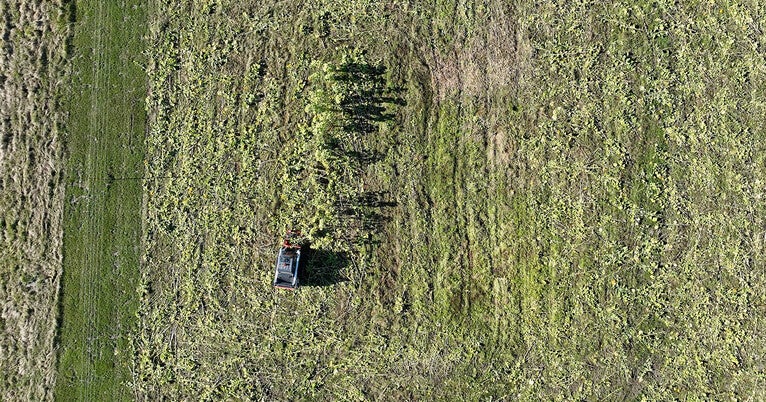
The system’s first step involves spreading a thin layer of crushed, alkaline rock to the area. This raises the soil’s pH level, which, in turn, accelerates the removal of PFOS from the soil via plants growing there.
The next step is to create “biochar” — a specialized form of charcoal — from the harvested plants, which destroys both PFOS and PFOA chemicals. This is done by heating the plants with either a large, stationary machine or a smaller, mobile unit.
Researchers estimate that remediation using this new model costs $1,460 per hectare. Since the process would be repeated each year for up to 20 years, the total cost would be just over $29,000 per hectare — which includes compensation for the farmer’s lost income during treatment.
The system also has the added benefit of removing carbon dioxide — a greenhouse gas and main contributor to climate change — via enhanced weathering of the crushed rock applied to the soil and biochar generated from biomass. At a national scale, the system could remove 10.5 million metric tons of carbon dioxide per year, the researchers estimate.
“This is a real pathway to actually give farmers in this situation some agency over their land and leave the soil in better condition than it was before,” Thompson said.
The research project recently received a Yale Planetary Solutions Impact Accelerator (PSIA) grant. The grants, recently introduced by Yale Planetary Solutions and Yale Ventures, provide mentorship and commercialization guidance to transformative projects that aim to address the root causes of environmental challenges.
The research is also supported by the Schmidt Family Foundation and the UK-based Natural Environment Research Council.
Co-authors of the study are Tim Jesper Suhrhoff, Chloe Kent, and Ella Milliken of Yale, Millie Dobson and Rachel James of the University of Southampton in the UK, Yoshiki Kanzaki and Christopher Reinhard of the Georgia Institute of Technology, and Lucinda Bryce of Brown University.