
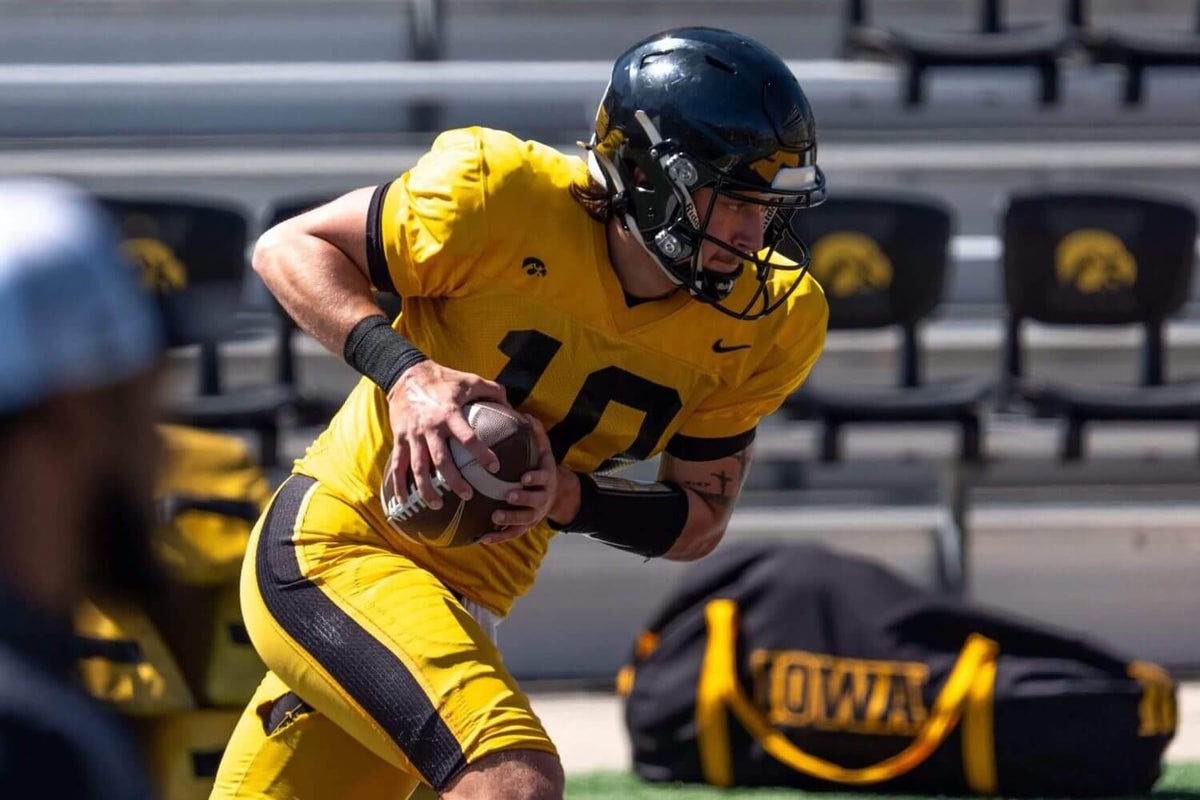
IOWA CITY, Iowa — Of the nation’s 68 power-conference football programs, only two entered the preseason with an open quarterback competition between two returning backups: Alabama and Iowa.
College football’s reliance on the transfer portal — especially at quarterback — makes homegrown competitions rare and too risky for most coaches. For the Crimson Tide, the battle comes down to former five-star redshirt freshman Keelon Russell and former four-star junior Austin Mack, two blue-chip prospects who fit Kalen DeBoer’s proven offensive system. At Iowa, the situation is different. The Hawkeyes are standing firm with Hank Brown, a junior, and redshirt sophomore Jeremy Hecklinski — both three-star high school prospects who transferred in before the 2025 season with little on-field college experience.
External expectations for whoever wins the job are low, as evidenced by Hecklinski’s spot at No. 106 on The Athletic’s recent ranking of all 138 projected Football Bowl Subdivision starters. But one year after paying up to bring in FCS star Mark Gronowski, the staff chose to stick with Brown and Hecklinski rather than explore an experienced upgrade.
“They’re both good, they’re both doing a good job, and they both have ability,” said offensive coordinator Tim Lester, who called the decision not to target a portal quarterback “a program- and system-based decision.”
“Unless your eyes are telling you we don’t have a guy that can run it, then you have to go get one, which we had to do a year ago,” Lester said.
College QB Tiers: Which quarterback has the highest ceiling?
Antonio Morales and Sam Khan Jr.
Part of coach Kirk Ferentz’s rationale comes from a desire to get off the quarterback carousel and build stability. Every freshman quarterback the Hawkeyes signed from 2017 through 2024 left the program with eligibility remaining. Since 2021, 11 Iowa quarterbacks have transferred to other schools. The Hawkeyes have tried to spackle over their recruiting whiffs with portal additions, bringing in seven different quarterbacks since 2023, including five that have started at least one game in Iowa City. Hecklinski or Brown will bring the total to at least six this fall.
There’s also a roster budget component, but that’s not the primary driver. It’s expensive to shop for free-agent quarterbacks, which the Hawkeyes found out following the 2024 season when they signed Gronowski along with Brown and Hecklinski.
“You’re better off from a financial standpoint if you can get a younger guy to emerge,” Ferentz said. “We’re going to pay them and reward them appropriately. But my preference has always been, especially at quarterback, I’d rather have a guy for two years or three years, and I still think it’s possible.”
Lester, who took over the offense in 2024, implemented a scheme mastered by NFL coaches Kyle Shanahan and Sean McVay to turn around what had been the Power 4’s lowest-scoring unit the prior year. Lester ran it as head coach at Western Michigan (2017-22) but dove into its intricacies as a senior analyst in Green Bay in 2023, working under former college teammate Matt LaFleur. Their bond remains so strong that LaFleur provided Iowa with a recruiting assist last fall.
When Lester was at dinner with four-star Tradon Bessinger during his official visit after a win against Minnesota, LaFleur popped on FaceTime and told the quarterback to pick Iowa “if you want to get to the league,” Lester told The Athletic. Bessinger committed two weeks later.
Lester places a premium on explosive plays, which often require long throws to the field and one-on-one deep shots. But his offense places mental pressure on quarterbacks, from its extensive pre-snap verbiage to its route construction. Hecklinski arrived at Iowa last summer and said he didn’t become comfortable with the offense until March. The curve was similar for Brown.
When the Shanahan-McVay scheme is operational — as the NFL has seen with the 49ers, Rams, Vikings and Packers for a decade — the results can change a football team’s fortunes. Iowa saw improvement, too, once Gronowski grasped the nuance of the offense around the midpoint of the season. Iowa’s 29.3 points per game were its fifth-most in the last 20 years. The Hawkeyes averaged 5.5 yards per attempt through the first seven games, then 8 yards per attempt over the final six.
Lester, in particular, saw enough growth from Brown and Hecklinski as Gronowski’s understudies to prefer their full-scale competition over grabbing an experienced quarterback but dialing down the offense.
“I might eat my words here, but I would always choose a guy that’s been in the system,” Lester said. “You’re going to see people at other places go with a guy that just got there, and they’re going to run a simpler deal, and that’s good for them. That’s great if they want to buy a quarterback every year. But I would change what we were doing if we’re going to buy a quarterback every single year. And if I’m not running this, then I’m going to go back to the NFL. I love it.”
Iowa enjoyed quarterback stability from 2008 through 2019, with four of its five starters becoming NFL Draft picks and only one missed start from 2010 to 2021. But its pass production has bottomed out for most of this decade despite winning Big Ten West Division titles in 2021 and 2023.
Lester jolted Iowa’s running game in 2024 by introducing a mid-zone run, which unleashed first-team All-American Kaleb Johnson. But injuries at quarterback forced the Hawkeyes to eventually start a fifth-team walk-on at the end of an eight-win campaign.
“We didn’t have that guy that could run it,” Lester said. “That’s why we refilled it last year with a guy that had four years left (Hecklinski), a guy that had three years left (Brown), and a guy that had one (Gronowski), knowing that we’d end up here.”
As portal season approached this year, Iowa considered all options and liked the progress of its younger prospects. It chose to reinforce other areas of need like receiver and defensive line and pay its holdovers at other positions. With only eight portal entries, Iowa had the lowest attrition among Power 4 schools.
“If I didn’t think Hank and Heck were good enough…” Lester said, referring to the portal. “I could get someone else and have them run this offense at a very mediocre level.”
“We never got to the point where we had to ask that (money) question,” Ferentz said.
Both quarterbacks welcomed the news during the offseason.
“Obviously, that fired me up,” said Brown, who started two games for Auburn in 2024 and has thrown for 642 yards, seven touchdowns and four interceptions during his career. “There’s no better opportunity than to go out here and compete and have a chance to be a Big Ten starter.”
“I was excited,” said Hecklinski, who transferred from Wake Forest last summer. “I felt like I had paid my dues early on when I got here in June, but for that to come to fruition and just kind of see my hard work pay off was really nice.”
Lester has structured the entire offseason around the competition, charting every pass thrown in spring football with an emphasis on timing and decision-making. He tossed out drops or quality throwaways and watched closely to see if either quarterback tried to “cheat the system” by taking sacks to avoid bad numbers.
At 6 foot 4, Brown looks the part, but Lester wants him to become more aggressive. Brown backed up Gronowski for the first five weeks, then replaced an injured Gronowski in the fourth quarter against eventual national champion Indiana but struggled in a last-minute loss.
Hecklinski moved past Brown on the depth chart at midseason and completed both of his pass attempts while rushing for a score. Lester said Hecklinski, who stands 5-10, has a “gunslinger-type mentality that you see with (Matthew) Stafford.” Hecklinski threw more interceptions in the spring, but the statistics were so close that neither Lester nor Ferentz predicted which one could win the job.
“I would not be shocked if it goes through the first three games,” Lester said. “We have some things you can do in camp that I’ve told Coach (Ferentz) about that can help me make that decision, but I think it’s gonna go into the season.”
“We’re not sure who the guy’s going to be, and we’ll find out by October, end of September, whenever it might be,” Ferentz said. “It may take game competition to sort it out, but all you can do is be fair.”
It likely won’t happen, but “just to put it in their brain,” Lester said he was considering letting both players get hit during scrimmages to see how they respond to the punishment from the program’s notoriously tough defense.
“The major difference between who should be the starter and who should be the backup,” Lester says, “is probably going to be who can handle 70,000 people in Kinnick (Stadium) and who can take a hit and get back up and keep playing without getting rattled.”
There’s a reason why three games is where Lester and Ferentz draw the line. The Hawkeyes open with three straight at home as heavy favorites against Northern Illinois, Iowa State and Northern Iowa. Then they travel to Michigan, host Ohio State and fly to Washington in a season-defining 13-day period.
Should either quarterback perform well, it could show other coaches that development is an option worth examining in future years. If either Hecklinski or Brown struggles, Iowa’s 2026 team might look similar to past versions that were competitive but fell short of College Football Playoff contention without an upper-level quarterback. It’s risky, but Ferentz is willing to stay patient, even in the face of “Same Old Iowa” rhetoric.
“It’s really complex,” said Ferentz, who enters his 28th season at Iowa. “The No. 1 priority in any decision you make is you have to do what is best for the team. That’s always going to be the guiding principle.”