
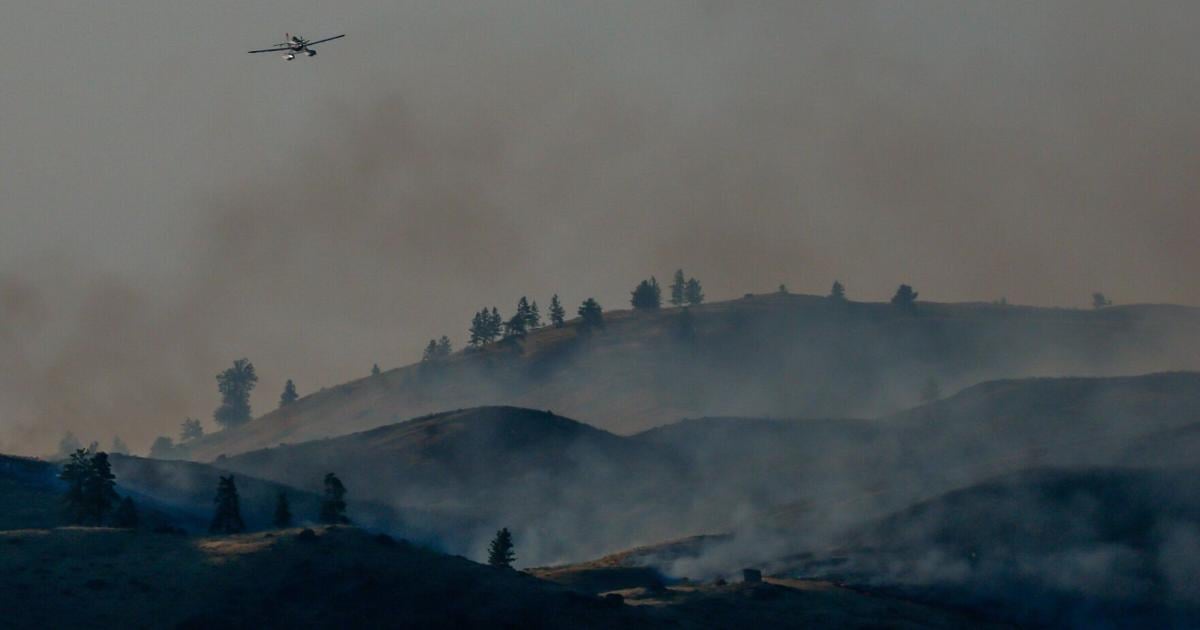
As the Kaiser Canyon fire continued to rage on the Colville Reservation on Thursday, burning nearly 86,000 acres by midday, a short video of a candidate running to represent the area in Congress drew outrage on social media.
In the clip from a 4th Congressional District candidate forum Tuesday, Republican Jerrod Sessler tells the audience in Moses Lake funds from the Federal Emergency Management Agency give the Confederated Tribes of the Colville Reservation an “incentive” to have “more fires, because we get free money.”
“What’s happening up in Colville right now, if you guys remember, a couple years ago, there was another fire up there, which they don’t pay taxes to support,” Sessler said at the Columbia Basin Technical Skills Center. “They don’t pay taxes for anything, but yet we fight those fires to the tune of millions of dollars, and they got a check from FEMA for $30 million for the fire.”

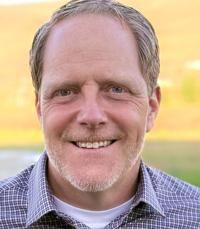
Jerrod Sessler
Cody Desautel, executive director of the Confederated Tribes of the Colville Reservation, called Sessler’s claims “complete nonsense.”
The false trope that tribes and tribal members pay no taxes is widespread enough that the Colville Tribes have a webpage dedicated to debunking to the claim with specific examples of taxes the tribal government and enrolled tribal members pay, such as sales tax, federal income tax and county property tax.
“Our land is not taxed through the county assessors, and that’s because technically it’s federal land owned by the U.S. government and held in trust for the tribes’ benefit,” Desautel told The Spokesman-Review. “I pay income tax, and sales tax unless I have goods delivered to the reservation. We also have some tax compacts with the state of Washington.”
Sessler is one of 11 candidates vying to replace retiring Rep. Dan Newhouse, a Republican from Sunnyside, Washington, in the Aug. 4 primary. The district stretches in Washington from the Canadian border to the Oregon border and includes the western half of the Colville Reservation, as well as the entire Yakama Reservation, along with the Tri-Cities, Yakima and Moses Lake.
Reached by phone Thursday, Sessler said he wasn’t alleging arson by the tribal government or any tribal member, but he maintained that FEMA creates an incentive to intentionally start wildfires.
“I’m not accusing them of that, but I’m definitely saying they’re incentivized to do it,” he said. “The tribes get all the benefits of being citizens with very little, if any, of the costs. And that is both individually and as an entity. And I just think we ought to look at that. I mean, I think the best thing for the tribal members over time is going to be integration, rather than continued separation.”
After the U.S. government forced Native Americans onto reservations for more than a century, Congress passed the Dawes Act in 1887, breaking up reservations into individual “allotments” and beginning a systematic policy of assimilation that included separating Indigenous children from their families at government-funded boarding schools, including six in Idaho and 15 in Washington. A 2024 report from the Bureau of Indian Affairs found that nearly 1,000 Indigenous children died at those boarding schools.
Sessler said he spent more than two months in 2025 proposing reforms to FEMA and the Stafford Act, a 1988 law that governs how the federal government responds to disasters. In an April 2025 video summarizing a report he published that month, Sessler described FEMA as a “socialist disaster” and proposed decentralizing the agency, leaving states to prepare and pay for disaster response.
In a post on Facebook later on Thursday, Sessler responded to the anger over his statements by saying, “People are blowing up because I have the guts to speak the truth.”
“These comments that I’ve made multiple times is about dumb ‘incentives,'” he wrote. “This was not an ‘accusation.’ But, it certainly makes sense to study the facts and find out if someone tied to the tribes started the fire.”
The Kaiser Canyon fire was sparked by lightning, according to the National Interagency Fire Center. It’s believed to have burned around 20 structures, most of which are primary homes, and displaced about 1,000 people, most of them tribal members.
“We are not just letting fires burn because we want money,” Desautel said. “That’s a ridiculous thing to say.”
Many on the Colville Reservation belong to a tribal religion known as Seven Drums. The religion, also known as Washat, holds that Mother Earth is sacred. Humans must honor the link between Mother Earth and their species by singing, drumming, dancing and taking part in rituals. Foods like salmon and huckleberries, even water, are viewed as sacraments. The sacraments themselves are also sacred to tribal members.
Fire after fire has taken or altered some of those sacraments, however.
“Over a million acres (of the reservation) since 2015 has burned. It gets difficult,” Desautel said. “Huckleberries don’t look as good as they do. The places people used to gather those foods don’t exist anymore because of fire. It’s tough to maintain what has been important culturally, because those things don’t exist (anymore).”
Under FEMA regulations, the tribes are reimbursed 75% of the cost of damages but still on the hook for the rest, Desautel said. He doesn’t remember ever getting an exception for extra reimbursement funding approved, even during the 2021 Chuweah Creek fire that burned 36,752 acres on the reservation.
The tribes have trained firefighters and can manage the fire through initial attack, or the first two days of the fire. If fire behavior is too excessive, winds are too strong and the weather is too hot, the tribes will call in additional resources, like state and federal firefighters, to help manage it.
This is not specific to the tribes — local county fire districts will also call in state and federal resources if they cannot contain a fire during the initial attack phase.
“We catch about 97% of fires,” Desautel said, adding that the remaining fires occur during high winds and high temperatures. “Historically, tribes used fire all the time, but we did it under our control. Burn history was driven by tribal use of fire for resource management. But with settlement and removal and federal policy, they restricted us. We have seen our landscape change. It’s so detrimental to maintaining our culture and preservation if we don’t have the resources we need to do that.”
Sessler claims “part of this is driven by what’s happening with the King Ranch situation,” referring to an ongoing legal dispute that began in 2023 when the Washington state Department of Ecology fined ranchers for excavating what the state says are protected wetlands near Coulee City, after a member of the Colville Tribes reportedly spotted equipment on federal land and alerted the state. The ranchers, Wade and Teresa King, filed a lawsuit in March seeking a jury trial, after their case gained national attention when Agriculture Secretary Brooke Rollins stated her support for the Kings in November.