
Seventy million years ago, titanosaur carcasses lay exposed in what is now central Spain, long enough for specialized beetles to bore into their bones and armor plating.
A new study has identified the telltale perforations those beetles left behind. The discovery rewrites what scientists thought they knew about one of Europe’s most significant Late Cretaceous fossil sites.

The dinosaurs weren’t buried quickly, as scientists had assumed. They sat on the surface long enough for a whole community of scavenging insects to move in.
The research was led by Professor Zain Belaústegui from the University of Barcelona, alongside experts from the National University of Distance Education and forensic entomologists from the University of Alcalá.
The site at the center of the study is Lo Hueco, near Cuenca, Spain. This is one of the most important Late Cretaceous fossil sites in Europe, home to relatively complete skeletons of large titanosaur sauropods as well as isolated bone remains.
Beetles left bone clues
The team identified perforations known as bioerosion structures, marks that organisms leave in bone after an animal dies.
These marks have been documented on dinosaur bones before. This study found them not only in the bones of the Lo Hueco titanosaurs but also, for the first time, in pieces of their dermal armor, known as osteoderms.
Titanosaur armor was dense, minerally complex tissue. Finding insect borings in it adds a new dimension to what these fossils can reveal.
The specific perforations, hemispherical or pouch-shaped boreholes, belong to a category called the ichnogenus Cubiculum.
Comparisons with modern analogues point clearly to dermestid beetles as the culprit. These scavenging beetles feed on decaying animal tissue and are capable of boring into bone.
When the beetles arrived
Experiments with larvae of the modern beetle Dermestes frischii, which produces structurally similar borings, show these marks can form after at least 240 hours. Under natural conditions, the process likely takes considerably longer.
That timing offers an important clue about what happened after the titanosaurs died.
According to the researchers, insect damage preserved in different types of fossilized bone offers valuable clues about how an animal’s remains broke down and were preserved after death.
“In any case, this suggests that these remains were exposed for long enough for these scavenging organisms to bore into these skeletal structures,” Belaústegui said.
 Ichnogenus Cubiculum on two fused vertebrae (HUE-02786). A) Overall view of HUE-02786. B–D) Details of the silicone cast HUE-02786A (B, upper view; C, lateral view; D, front view). E) Detail of the silicone cast HUE-02786B. Scale bars: 10 mm. Credit: Earth-Science Reviews. Click image to enlarge.After the dinosaurs died
Researchers previously concluded that the Lo Hueco titanosaur carcasses were buried rapidly. They believed sediment covered the remains quickly enough to protect them from significant surface disturbance.
That’s an appealing explanation for a site with such well-preserved, relatively complete skeletons. Rapid burial often leads to better preservation.
The insect borings tell a different story. You can’t bore into a carcass if it’s already underground.
The abundance of bioerosion structures across both bone and osteoderm material suggests the carcasses remained exposed at the surface for an extended period. That gave dermestid beetles enough time to find them, colonize them, and leave their marks throughout the skeletons.
“The abundance of insect borings suggests that the carcasses were exposed for a longer period of time,” Belaústegui said.
“This would indicate a longer biostratigraphic stage for the two main fossil-bearing levels at Lo Hueco, ruling out the rapid burial of the titanosaur carcasses that had previously been inferred,” Belaústegui said.
The site’s scavenger community had enough time to work through the enormous carcasses before sediment buried them.
Necrophages fed on fresh tissue, while saprophages processed what remained. The fossilized traces of that beetle activity remain preserved in the bones, waiting to be read.
Dead bodies as ecosystems
Since titanosaurs were very large animals, their carcasses represented a substantial resource for the organisms that could exploit them.
“The question arises as to whether the carcass of a large vertebrate could sustain an entire community of scavengers, necrophages and saprophages for a relatively long period,” Belaústegui said.
“If the skeletal remains are fossilized with traces of bioerosion, they may be highly indicative of a specific palaeoenvironmental condition.”
In other words, the presence or absence of insect borings in a fossil assemblage isn’t just a curiosity, but a diagnostic tool.
Carcasses buried quickly leave different traces than those left exposed. By reading those traces carefully, palaeontologists can reconstruct ancient environments in ways no other evidence allows.
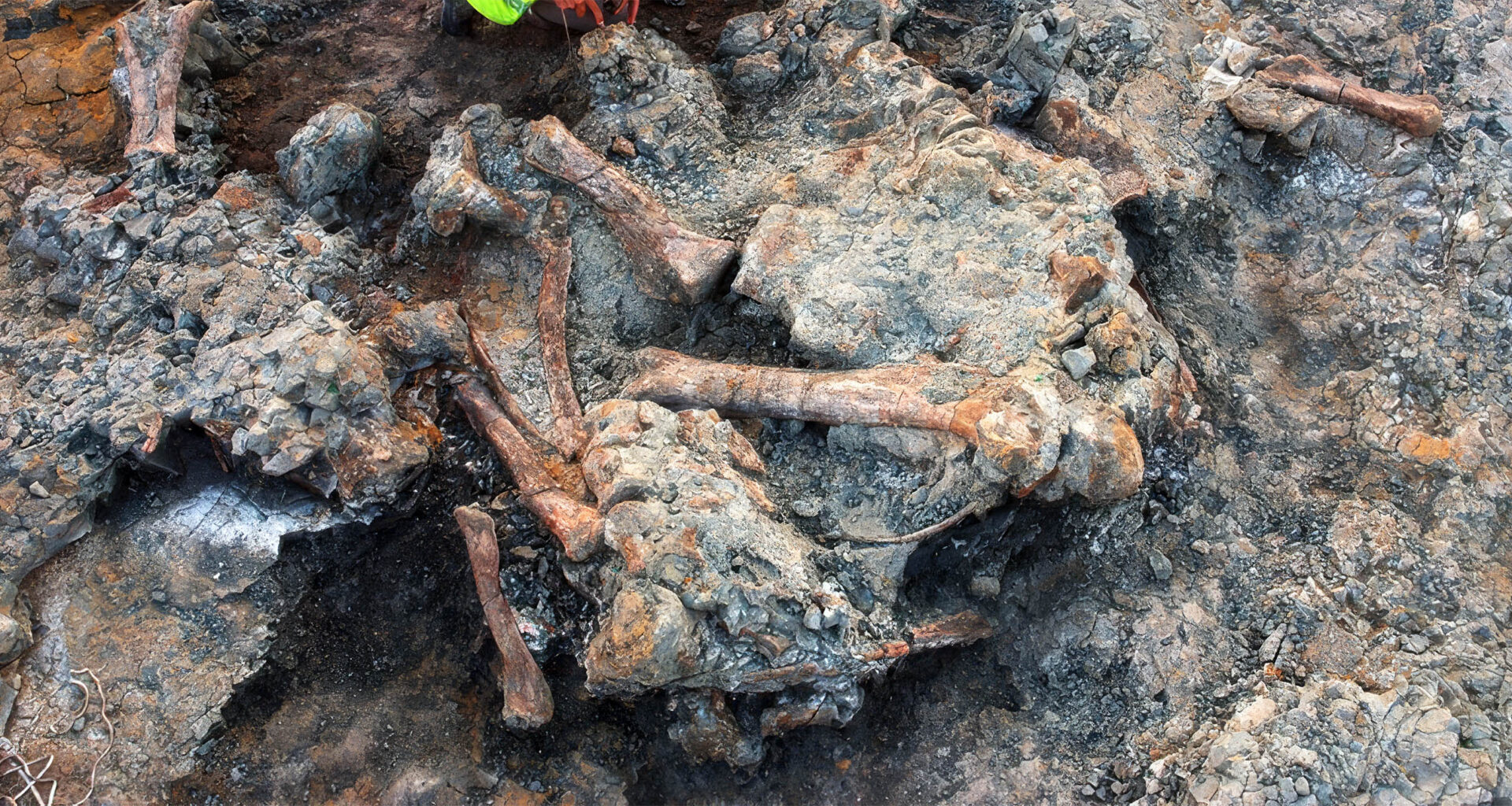
 Excavation of titanosaur remains at the Late Cretaceous site of Lo Hueco, in Fuentes (Cuenca, Spain). Credit: Francisco Ortega, UNED. Click image to enlarge.An overlooked fossil record
The study also includes a comprehensive review of more than 140 published references on insect bioerosion of bone tissue, spanning the Middle Triassic to the Holocene. Only one of those references concerns the Iberian Peninsula.
For a region with rich Late Cretaceous fossil deposits, that’s a striking gap. It underscores why a study like this one matters beyond the specific site it examines.
The beetles that worked through these titanosaur carcasses 70 million years ago left behind a record of their activity precise enough to revise our understanding of an entire fossil site.
That’s what insect traces in ancient bone can do when someone takes the time to look carefully at the holes.
The study is published in the journal Earth-Science Reviews.
—-
Like what you read? Subscribe to our newsletter for engaging articles, exclusive content, and the latest updates.
Check us out on EarthSnap, a free app brought to you by Eric Ralls and Earth.com.
——